 ChatGPT
 Claude
 Perplexity
 Gemini
 Grok
Deduplication means one record per prospect, with the history intact
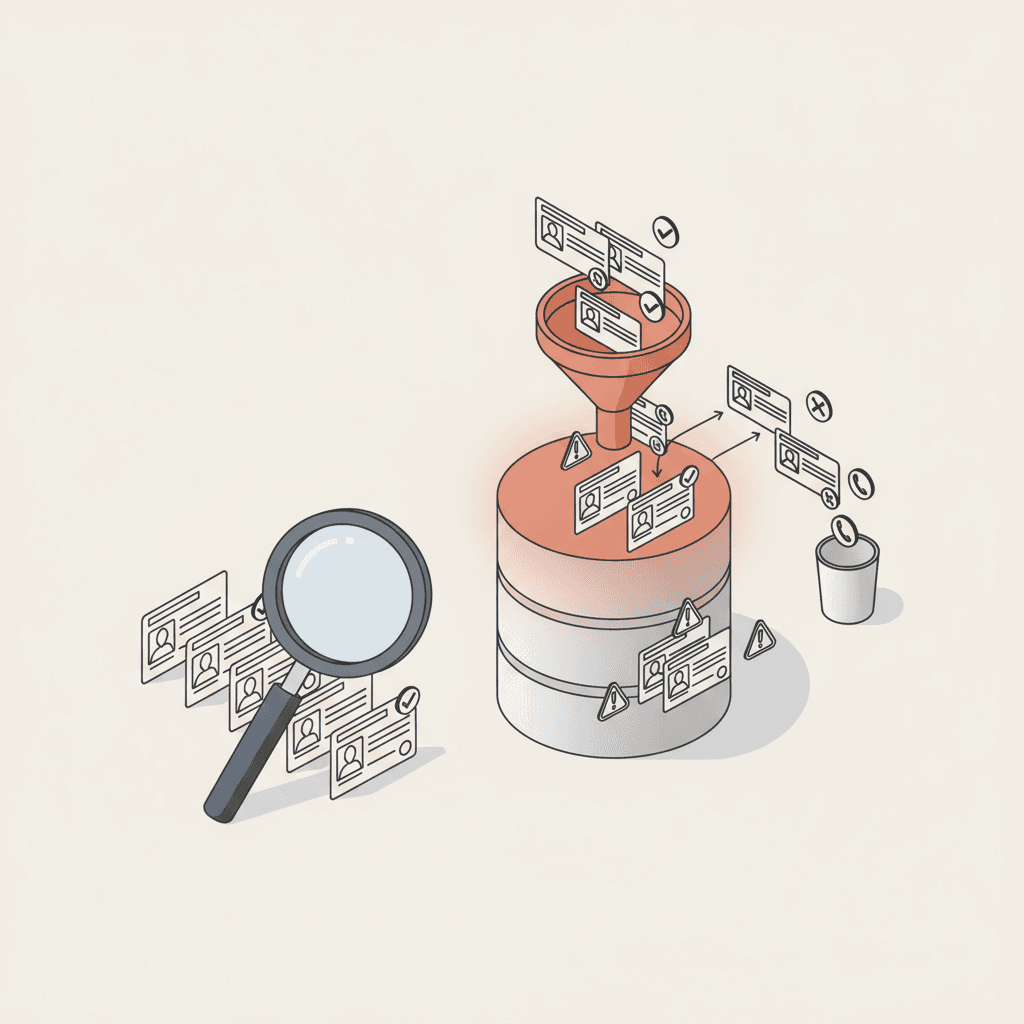
Student lead deduplication across channels means recognising that a web enquiry, a chat conversation, a message on a messaging app and a missed call came from the same person, then attaching them to one CRM record. For an admissions office the aim is practical: one adviser contacts the prospect, once, knowing what has already happened.
Irish recruitment has its own duplicate patterns. Leaving Certificate students apply to undergraduate courses through the CAO, which is a central application system, yet they still enquire directly with each college, attend open days and message several institutions. Mature applicants, further education learners and international students use direct routes. The same person can therefore leave separate fragments in your enquiry form, your chat and your phone log long before any CAO number exists.
This guide covers where duplicates come from, which matching keys to use, what merge rules to write down and which data protection rules apply. It builds on our pieces on cleaning a student lead database and lead routing and SLAs.
Where duplicates come from: a different identifier per channel
| Channel | Reliable identifier | Typical cause of a duplicate |
|---|---|---|
| Enquiry form on your site | Email, often mobile | Personal email first, school email later |
| Website chat | Nothing, or an email given mid-conversation | Anonymous visitor returning on another device |
| Messaging app | Mobile number | Number entered as 08x, +353 8x or with spaces |
| Inbound call | Caller ID, sometimes withheld | Parent's phone instead of the student's |
| Open days, school visits, guidance counsellor lists | Email, name | Bulk uploads with no checks |
Three cases need an explicit rule: the parent who enquires for a student, the student with two emails, and the applicant who later receives a CAO application number. Link the CAO number to the existing record rather than creating a new one.
Choose matching keys from safest to most fragile
- Exact match. The same normalised email (lower case, trimmed) or the same normalised mobile number. Matching can be automatic.
- Probable match. The same first and last name with the same course of interest, or the same mobile with different emails. The system suggests; a person confirms.
- Possible match. Similar names, Irish-language spellings of a name, apostrophes and hyphens. Flag, never auto-merge.
Irish names are a specific trap: "Ó Briain" and "O'Brien", or "Seán" and "Sean", can be one person. Use accent- and punctuation-insensitive comparison for names, and let a person confirm.
Normalise phone numbers to the international format in ITU recommendation E.164: +353, then the number without the leading zero. A mobile stored as 087… in the CRM and +353 87… in a messaging tool is the same number.
Never merge on name alone; namesakes are common and a wrong merge mixes two files.
Write merge rules before the first merge
- Master record. The oldest stays; the others attach to it, keeping the identifier your other systems use.
- Contact details. The most recent verified value wins; the older goes to history.
- Course of interest. Keep the latest stated interest and preserve earlier ones. A move from a Level 7 to a Level 8 programme is a signal, not noise.
- Owner. The adviser with the most recent human contact keeps the record; otherwise your routing rule decides.
- Consent and objections. The most restrictive setting wins.
- Audit trail. Log who merged what, when and why so merges can be reversed.
Keep un-merging possible, especially for shared family numbers.
Data protection: an objection must survive a merge
Merging records is processing personal data. EU Regulation 2016/679 and the Data Protection Act 2018 apply, and the Data Protection Commission is the supervisory authority in Ireland. You can read the regulation itself on EUR-Lex. Article 5 contains two principles that bear on deduplication: accuracy supports it, and data minimisation rules out keeping everything just in case.
The key risk is objections. If any merged record carries a marketing objection or an erasure request, the surviving record must inherit it. Otherwise the merge revives a contact the person had already refused. Electronic marketing is also covered by Irish rules implementing the ePrivacy framework, so have your data protection officer review your approach.
Three habits reduce risk:
- Store the date and source of each consent, channel by channel: permission to email is not permission to text or call.
- Apply the most restrictive setting when two records conflict.
- Keep a suppression list separate from the CRM so a later import cannot recreate an objection.
For prospects under 18, involve a parent or guardian in conversations that lead to a commitment, and do not merge their record into the student's.
Put the process in place in six steps
- List every entry point: forms, chat, messaging, phone lines, open days, school and guidance lists.
- Normalise on entry: lower-case emails, +353 phone format, cleaned names.
- Turn on CRM duplicate rules, in suggest mode first, then automatic for exact matches.
- Clear the existing database in batches, exact matches first.
- Write the ownership rule: who takes over the merged record and how the other adviser is told.
- Review monthly the rejected suggestions and reversed merges.
If several colleges or brands share one database, settle with your data protection officer whether matching across them is permitted before switching it on.
Measure without inventing a benchmark
No public source says what duplicate rate is normal for an Irish college, so measure your own before and after.
| Indicator | What it shows |
|---|---|
| Share of records with at least one probable duplicate | The size of the backlog |
| Duplicates created per channel per month | The entry point to fix first |
| Reversed merges | The quality of your keys |
| Prospects contacted by more than one adviser | The visible cost to the team |
| Merged records that kept an objection | Whether safeguards hold |
Do not credit fewer duplicates for higher yield. Admissions outcomes have many causes, and any effect has to be tested against your own comparison periods.
What Skolbot contributes, and what stays with the institution
Skolbot Chat is an agent installed on the institution's website. It answers from content the institution has published, qualifies the enquiry, offers an appointment or open day and hands the conversation to the team and the CRM. Capturing an email or mobile number early gives you a matching key anonymous visitors usually lack. The wider logic is in our article on AI agents from first contact to CRM.
Matching and merge rules stay with the institution and its CRM. How the connector behaves with your CRM is confirmed during scoping. To place your tooling, see the CRM comparison for higher education, and for the big picture return to our guide to recruiting more students.