 ChatGPT
 Claude
 Perplexity
 Gemini
 Grok
GrokOver 680,000 international students are currently enrolled in UK higher education — and language is consistently cited as the primary barrier to their first enquiry. An AI chatbot with automatic language detection removes that barrier entirely, responding natively in any language without a translator, without an international admissions officer, and without a time delay.
For the full strategic picture, see our complete guide to AI chatbots for schools.
Why language is a real barrier to international recruitment
Language friction kills enquiries before they start. A prospective student from South Korea or Mexico visiting your website at 11pm their time is not going to compose a careful email in English to ask whether your MSc fits their background — they will navigate away, find a competitor whose site feels accessible, and enquire there instead.
58% of prospects for European schools are non-native speakers of the institution's language (Source: automatic language detection across 8,500 Skolbot conversations, 2025–2026). For UK institutions, this translates directly into a silent attrition problem: the international enquiries you are not receiving are the ones that never started because the language barrier was too high at the first touchpoint.
UCAS data on international applicants consistently shows that applications from non-EU international students have grown by over 35% in the past five years, with South Asia and East Asia the dominant growth markets. Those markets are predominantly non-English-speaking at home. HESA statistics confirm that China, India, Nigeria, Pakistan, and the US now account for over 60% of all non-UK domiciled students in UK higher education — a mix of languages that no single admissions team can cover natively.
The ICEF Monitor analysis of AI tools in international student recruitment documents a structural shift: institutions that offer a multilingual first touchpoint are capturing 2x the enquiries from non-English-speaking markets compared to those limited to English-only contact. Language support is no longer a differentiator — it is a baseline expectation for any institution claiming an international strategy.
How an AI chatbot responds in 6+ languages automatically
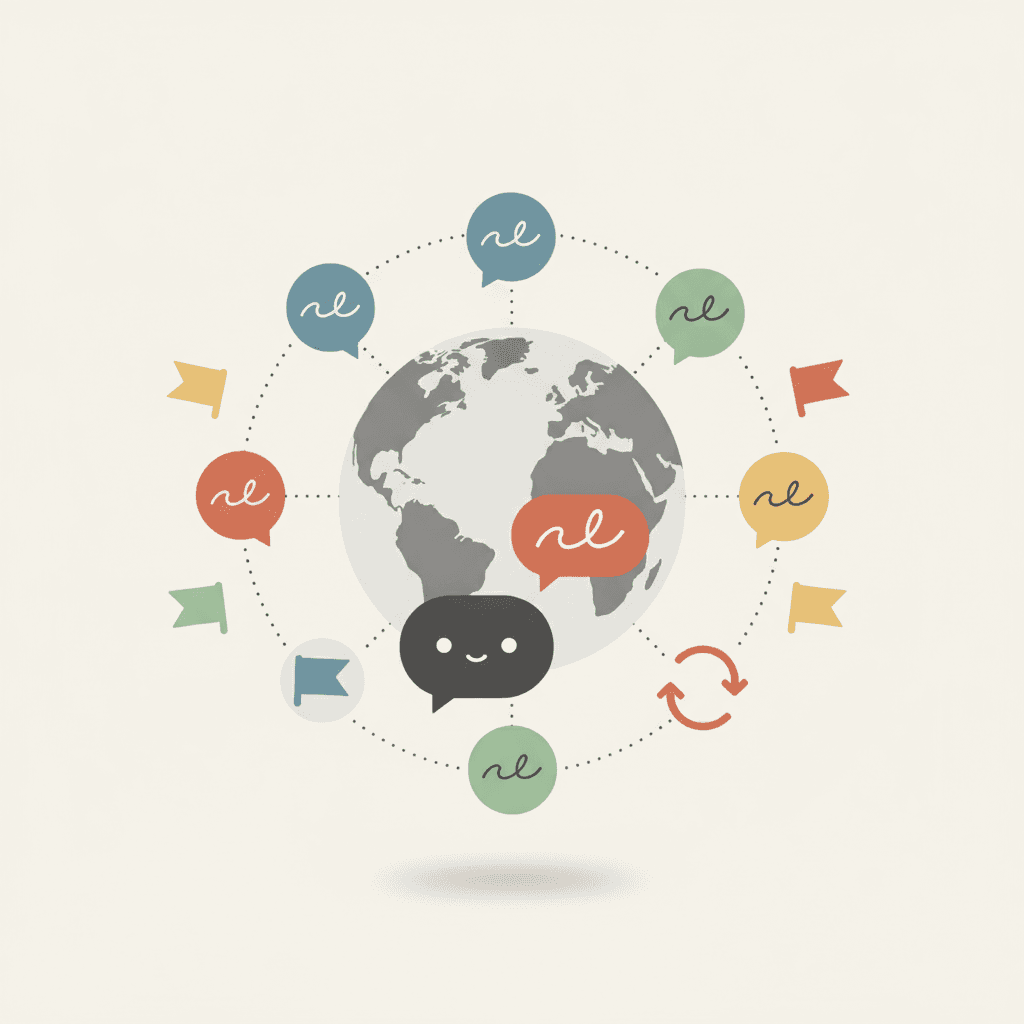
A multilingual AI chatbot does not require a separate version of itself for each language. It detects the language of the first message and responds in that language throughout the conversation — automatically, with no manual configuration and no language-switching prompts.
The underlying mechanism is straightforward. Modern large language models (LLMs) are trained on text across dozens of languages simultaneously. When a prospect types "¿Cuáles son los requisitos de admisión para el MBA?" the model recognises Spanish, retrieves the relevant content from your knowledge base, and generates a response in Spanish — drawing on the same underlying information it would use for an English-language query. Your knowledge base can remain entirely in English; the LLM handles the translation at generation time, without a separate translation step or a translated copy of your content.
The six languages that cover the largest share of international enquiries for UK institutions are English, Mandarin, Spanish, Arabic, Hindi, and French. Together these account for the vast majority of non-English interactions. Beyond these six, the same system handles Portuguese, German, Italian, Turkish, Bengali, and many others without additional configuration.
What this means operationally: you train the chatbot once, on your existing English-language content — programme pages, entry requirements, fee schedules, open day dates — and it becomes multilingual immediately. For a detailed walkthrough of how to structure that training, see our guide on training your chatbot on school data.
4 practical use cases for UK institutions
The multilingual capability is not a single feature — it operates across every stage of the prospect journey. The table below maps the most common international enquiry types to the chatbot response scenario.
| Prospect language | Enquiry type | Chatbot scenario | Outcome |
|---|---|---|---|
| Mandarin | Entry requirements for BSc Computer Science | Retrieves tariff points, A-level equivalents, foundation year route; responds in Simplified Chinese | Prospect receives accurate answer in under 3 seconds, bounce rate falls |
| Spanish | Tuition fees and scholarship availability | Quotes current fee schedule, lists merit bursaries and eligibility criteria; responds in Spanish | Prospect proceeds to open day registration without human intervention |
| Arabic | UCAS application process for international students | Explains UCAS timeline, document requirements, direct application route; responds in Arabic | Prospect submits enquiry form with programme interest recorded in CRM |
| Hindi | Visa and CAS requirements | Provides overview of Tier 4/Student visa process, signposts UKVI guidance; responds in Hindi; escalates complex individual cases to admissions adviser | Prospect receives initial answer instantly; complex cases routed with full conversation transcript |
The escalation row matters. The chatbot handles the information layer — what the process is, what documents are needed, what the deadlines are. It passes cases involving individual circumstances (visa refusal history, unusual qualifications, disability disclosure) to a human adviser with the full conversation transcript attached. The adviser picks up a warm, qualified conversation rather than a cold enquiry with no context.
The chatbot also operates 24/7, which is structurally important for international recruitment. A prospect in Mumbai enquiring at 7am IST is reaching your institution at 1:30am GMT. Without a chatbot, they receive nothing until the office opens — by which point they have typically shortlisted three other institutions. The same time-zone gap is why WhatsApp outperforms phone outreach for international recruitment: a call placed at a convenient hour for the admissions team lands in the middle of the prospect's night, and most won't pick up a call from an unknown number anyway.
What institutions actually gain: evidence from the field
The ROI case for a multilingual chatbot is not theoretical. Institutions using Skolbot achieve 280% ROI over 12 months, +62% qualified prospects, and a 38% reduction in cost per lead (Source: median results across 18 schools, Skolbot 2024–2025). These figures are medians — roughly half of institutions do better, half do worse — but the direction is consistent across institution types.
The engagement data is equally clear. The bounce rate on institution websites with an AI chatbot is 41%, compared to 68% without one (Source: A/B test across 22 partner school websites, Sept–Dec 2025). For international visitors — who typically arrive on an unfamiliar site in a non-native language — the chatbot effect is proportionally larger: an immediate response in their own language is the difference between engagement and exit.
The cost-per-acquisition context makes these figures meaningful for UK institutions specifically. Recruiting a non-EU international student through traditional channels — agents, international fairs, overseas offices — costs between £3,200 and £4,500 per enrolled student (Source: estimates based on EAIE, StudyPortals, and British Council benchmarks). A multilingual chatbot that increases first-contact rates from international visitors does not replace that acquisition cost, but it significantly improves the return on the traffic you are already paying to generate through those channels.
For UK institutions working through UCAS international pathways and managing the complexity of international qualification recognition, the chatbot also reduces admissions team workload on first-level queries — freeing advisers to focus on the cases that genuinely require human judgement. Our article on chatbot scenarios to increase enrolment documents the full qualification and routing workflow.
Deploying multilingual support without hiring international staff
The most common misconception about multilingual student support is that it requires multilingual staff. It does not. The chatbot is multilingual by default; your team does not need to be.
Step 1: Build the knowledge base in English. Your programme pages, entry requirements, fee schedules, scholarship information, and open day dates are almost certainly already in English. That content becomes the chatbot's source of truth. You do not need to create translated versions — the LLM generates responses in the prospect's language from your English-language source material. This is the single most important operational point: zero translation budget required for chatbot multilingual capability.
Step 2: Enable language detection at configuration. Language detection is automatic in modern chatbot platforms. You do not configure it language by language — you enable the capability once and it covers all supported languages simultaneously.
Step 3: Configure escalation for language-sensitive cases. Some enquiry types benefit from human follow-up regardless of language — individual visa circumstances, RPL route assessment, mature student admissions. Configure escalation triggers that pass the full conversation transcript (with the prospect's language flagged) to your admissions team. They can respond in English; if the prospect is in an English-medium programme context, that is appropriate. If language continuity matters, the transcript gives an adviser the context to bring in a colleague or use a translation tool precisely for that case.
Step 4: Audit the top enquiry languages after 30 days. Your chatbot dashboard will show which languages are generating the most conversations. Use that data to prioritise content updates — if 18% of your international interactions are in Mandarin, ensure your Mandarin-language responses cover your most frequently asked programme questions in full detail. Add content to the knowledge base in English; the chatbot handles the rest.
This approach is consistent with ICO guidance on AI transparency: prospects must be informed they are interacting with an AI system. That disclosure can itself be delivered in the prospect's detected language. The same principles that apply to English-language chatbot deployment under UK GDPR apply equally to multilingual deployment — the language of interaction does not change the compliance obligations.
For a structured approach to getting the knowledge base right before go-live, see our guide on recruiting international students.
The competitive cost of not going multilingual
The cost argument runs in both directions. International student recruitment through traditional channels — agents, overseas fairs, international offices — costs UK institutions between £3,200 and £4,500 per enrolled non-EU student (estimate based on EAIE, StudyPortals, and British Council sector benchmarks). That figure represents what you spend to generate traffic. A multilingual chatbot is what determines whether that traffic converts once it reaches your website.
The opportunity loss is straightforward to estimate. If your institution attracts 3,000 international website visitors per month and 58% of them are non-native English speakers, roughly 1,740 visitors are navigating in a non-native language. Of those, a meaningful share — conservative estimates put it at 20 to 30% — abandon before making contact specifically because the language barrier is too high. At a 3% conversion rate to formal enquiry, that is between 10 and 15 additional qualified enquiries per month that a multilingual chatbot recovers at zero marginal cost per interaction.
The maths compounds over an academic cycle. Institutions that have deployed multilingual AI chatbots consistently report that international enquiry volumes grow 15 to 25% within the first semester — not because they increased marketing spend, but because they removed the friction that was suppressing conversion from existing traffic.
The operational implications for admissions teams are equally significant. A multilingual chatbot handles the first-contact information layer across all languages — freeing human advisers from repetitive, low-complexity queries in multiple languages and allowing them to focus on the complex, high-value conversations that genuinely require human expertise. Our resource on chatbot scenarios to increase enrolment includes worked examples of how this triage operates across different enquiry types.
Test Skolbot on your school in 30 seconds