 ChatGPT
 Claude
 Perplexity
 Gemini
 Grok
GrokTwo people visit your website. You treat them as one.
A sixth-former opens your university homepage on their phone at 9 pm on a Sunday, looking for information about the societies on offer and whether the halls are mixed. At the same moment, their parent — in the same house — opens the same page on a laptop, wondering whether your TEF rating has improved since last year and what the graduate employment figures actually are.
One website. Two audiences. Two completely different sets of questions. And, in almost every UK institution, one single communication strategy attempting to serve both.
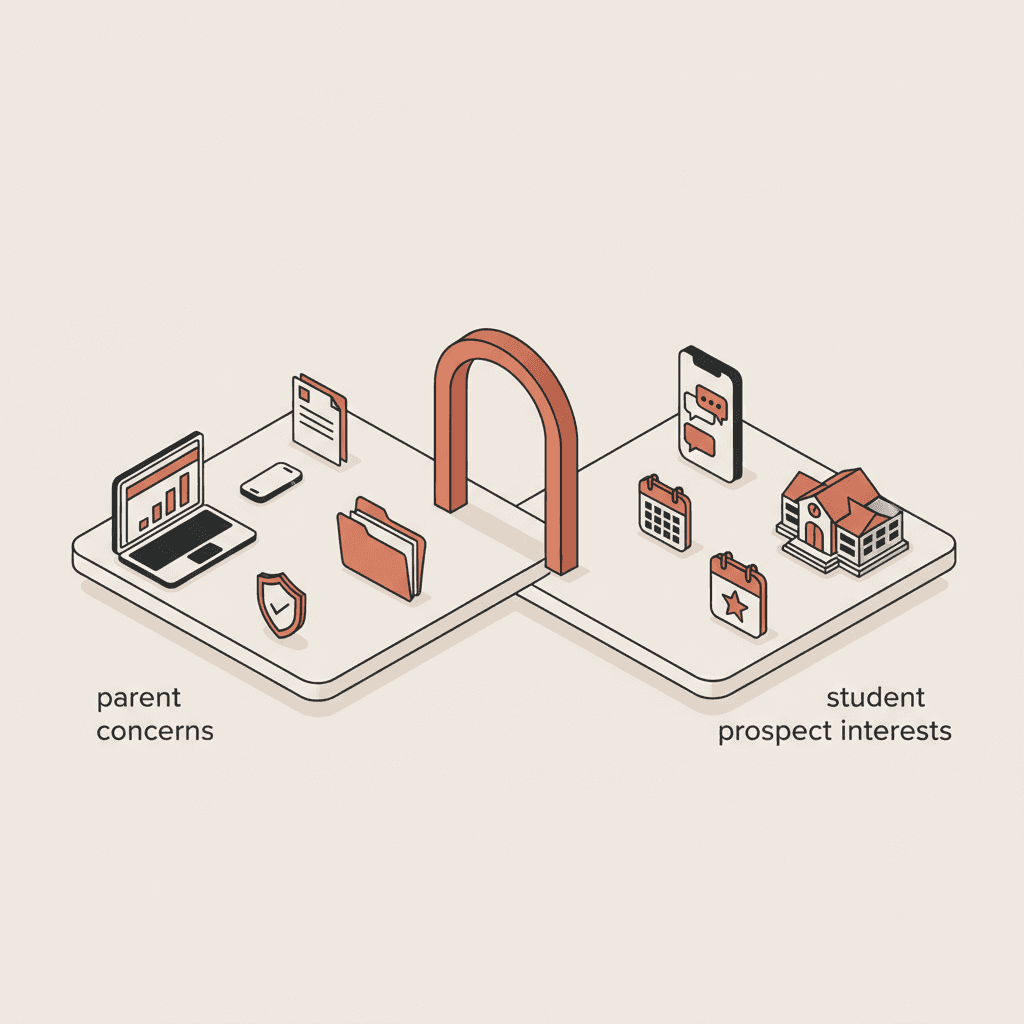
This is the central problem in higher education admissions today. Parents and prospective students are not variations of the same persona — they are distinct decision-makers, with different information needs, different communication preferences, and different fears. Institutions that recognise this distinction and build two parallel strategies consistently outperform those that do not.
This article sets out what each audience actually wants to know, where the gaps in current practice are, and how to bridge them — including the role an AI chatbot can play in qualifying which audience it is talking to before answering.
What parents care about: return on £9,250 per year
The current undergraduate tuition fee of £9,250 per year in England is not simply a cost — for most parents, it frames every subsequent question. When a parent visits your website, they are asking: is this institution worth the debt my child will graduate with?
Their research behaviour reflects this. Parents prioritise:
- TEF rating and NSS scores. The Teaching Excellence Framework, administered by the Office for Students (OfS), gives parents a government-validated signal about teaching quality. A Gold or Silver TEF rating carries weight with parents who have never engaged with higher education before and need an external quality benchmark they can trust.
- Graduate employment outcomes. Not a vague "strong employability" claim — parents want the data. The HESA Graduate Outcomes survey publishes employment rates at 15 months post-graduation by institution and subject. Parents who find this figure prominently displayed — "87% of our graduates are in skilled employment or further study within 15 months" — are significantly more likely to support their child's application.
- Russell Group or equivalent prestige signals. Whether or not your institution is in the Russell Group, parents use it as a mental shortcut. If you are not a member, you need a clear alternative credibility signal: specialist accreditation, Guardian University Guide ranking, Complete University Guide placement in subject tables, or OfS registration status.
- UCAS process clarity. Many parents have not navigated UCAS before. The application portal, personal statement requirements, UCAS tariff points, and offer condition types all need explanation — not for students, who have been briefed by their school, but for parents sitting beside them at the kitchen table.
- Value for money. With the total cost of a three-year degree in London easily exceeding £70,000 (including maintenance), parents want to know what their child actually gets for the fees. Student-to-staff ratio, contact hours, library resources, and career services are proxies for this calculation.
The parent's journey is rational and outcome-focused. They are running a mental ROI calculation on a substantial financial commitment. Your communications to parents need to supply the inputs to that calculation, not substitute them with marketing copy.
What prospective students care about: the experience of being there
The student making the same UCAS choice is running a parallel but fundamentally different evaluation. They are not primarily asking "will this degree pay off in 15 years?" They are asking "will I be happy here for three years?"
Analysis of 12,000 Skolbot chatbot conversations between September 2025 and February 2026 shows the pattern clearly: 89% of prospects ask about tuition fees and 84% ask about career outcomes — but these questions arrive early in the conversation and are quickly resolved. The questions that linger are the ones that determine shortlist position.
For prospective students, those questions are:
- Student union and societies. The Students' Union is the first social infrastructure a prospective student looks for. The richness of the society list — sports clubs, cultural societies, political groups, volunteering organisations — signals the quality of campus life. This is a genuine differentiation criterion between institutions with similar academic profiles.
- Accommodation. Halls of residence availability, cost per week, room types, catered versus self-catered, guarantee policies for first-year students: accommodation questions are among the most practically urgent for students relocating from home.
- Course content and contact hours. Students want to see actual module titles, not a description written for an institutional prospectus. They want to know how many hours per week they will spend in seminars, who teaches which modules, and whether the content reflects current practice in the field.
- Placements and sandwich years. Work placements have moved from optional to expected. Students want to know which employers have taken students, what the placement rate is, and whether the year is paid. This directly affects their post-graduation salary trajectory — which is also, indirectly, a financial question, but framed very differently from the way a parent frames it.
- The UCAS personal statement process. Students are anxious about what to write, how long it should be, and whether your admissions team actually reads them. Content about the personal statement — even brief — reduces application anxiety and increases the probability of submission.
For the full list of recurring questions across both audiences, see our analysis of the questions every prospect asks before enrolling.
The communication channel gap: where each audience actually lives
Identifying the different information needs is only half the problem. The other half is delivery. Parents and students do not receive information the same way, at the same time, or through the same channels.
| Channel | Parents | Prospective students |
|---|---|---|
| Email (long-form) | High preference | Low preference |
| Phone call | Actively used | Avoided |
| Minimal use | Daily use | |
| TikTok | Near-zero use | Primary discovery channel |
| University website | Primary research tool | Secondary (after social) |
| Printed prospectus | Still read | Largely ignored |
| Open day attendance | Active participant | Central commitment |
| WhatsApp / messaging | Growing use | Constant use |
| Peak activity time | Weekdays, business hours | Evenings and weekends |
The timing gap is especially significant. 67% of prospective student activity happens outside office hours, with the absolute peak on Sunday evenings (Source: Skolbot interaction logs, 200,000 sessions, Oct 2025 — Feb 2026). This is when students are doing their research — comparing shortlists, reading forums, watching student content on TikTok, and asking questions on university chatbots.
Parents, by contrast, tend to engage during working hours — calling the admissions office on a Tuesday morning, or reading a detailed email from a university while at their desk. This means the two audiences are rarely active at the same time, which makes serving them with a single communication approach doubly inefficient: you are optimising for neither.
The Sunday evening research window: why it matters for both audiences
Sunday evening is the highest-anxiety moment of the higher education research cycle. Students are comparing their options, second-guessing their UCAS choices, and looking for reassurance. This is when your institution either provides answers — or loses to one that does.
The challenge is that your admissions team is not online at 9 pm on a Sunday. Contact forms receive a reply 47 to 72 hours later. Phone calls go unanswered. If your website cannot respond to a question about halls of residence availability or your NSS student satisfaction score at that moment, the prospect — or the parent doing research on their behalf — moves on.
This is where a well-configured AI chatbot changes the dynamic. Not by replacing your admissions team, but by covering the hours they cannot. A chatbot available around the clock, trained on your institution's data, can answer the tuition fee question, the accommodation question, the TEF rating question, and the personal statement question at any hour — qualifying the conversation in real time so that when your admissions team follows up the next morning, they already know whether they are speaking to a student or a parent, and what that person actually needs.
For a full map of the moments where you gain or lose a prospective student, see our guide to the ideal prospect journey from first visit to enrolment.
Why one website and one communication flow is not enough
Most UK higher education institutions have designed their digital presence around the prospective student. The homepage uses language about "your future starts here". The social media channels are calibrated for Generation Z. The open day events are positioned as student experiences.
This is reasonable — students are the primary applicants. But parents are co-decision-makers in the majority of UK undergraduate applications, and at private institutions or for postgraduate programmes, parents are sometimes the primary financial stakeholder. A family that feels unacknowledged in your communications is less likely to support the application.
The solution is not to build two separate websites. It is to build two communication pathways within the same infrastructure:
- A parent-facing pathway that surfaces TEF rating, NSS scores, Graduate Outcomes data from HESA, OfS registration, and value-for-money indicators. This content should be reachable from the homepage without requiring a parent to navigate through student-focused content.
- A student-facing pathway that leads with course content, societies, accommodation, placements, and peer testimonials — and that works on mobile, responds to questions in seconds, and is accessible at 9 pm on a Sunday.
The key to making these pathways work simultaneously is qualification. An AI chatbot that opens with "Are you researching for yourself, or on behalf of a son or daughter?" can immediately route the conversation to the right content set, the right tone, and the right follow-up sequence.
The regulatory and quality signals parents expect to find
Parents navigating UK higher education are increasingly familiar with the regulatory landscape — particularly since the OfS began publishing institutional data in accessible formats. The signals they look for, and where to put them:
- OfS registration: confirming the institution is a registered provider — visible on the fees page and the admissions page.
- TEF rating: displayed on the homepage and the About page, with a plain-English explanation of what Gold, Silver, or Bronze means in practice.
- NSS (National Student Survey) results: the NSS measures current student satisfaction across teaching, assessment, academic support, and learning resources. Publishing your NSS scores — even if they are not sector-leading — demonstrates transparency that parents register positively.
- Guardian University Guide / Complete University Guide / Times Good University Guide rankings: these are the rankings UK parents actually use. QS and THE rankings are more relevant for international families. If you rank well in subject tables in the Guardian or Complete University Guide, say so explicitly.
- QAA quality status: QAA quality review outcomes, or degree-awarding powers confirmation, are reassurance signals for parents who are unfamiliar with the institution.
UK GDPR and ICO compliance signals — a visible privacy notice, clear data use policies, and a straightforward data request process — also matter increasingly to parents, particularly those paying attention to how student data is handled during and after the application process.
What this looks like in practice: the dual-strategy framework
The institutions that convert both parents and students effectively share a consistent operational pattern. They do not try to serve both audiences with the same content at the same time. They build a decision architecture that identifies which audience is present and serves accordingly.
The practical implementation has three components:
Content architecture: Create a dedicated "For Parents" section — linked from the main navigation — that contains TEF data, Graduate Outcomes statistics, OfS registration confirmation, UCAS process explanation, and a funding and fees summary. This section does not replace the student-facing content; it supplements it.
Channel strategy: Run separate communication flows. Parent-facing emails are long-form, data-heavy, sent during the week, and signed by a named head of admissions. Student-facing communications are brief, visual, sent via Instagram or WhatsApp, and peer-led where possible. Open day invitations to parents include outcome data; invitations to students emphasise the campus experience.
Real-time qualification: An AI chatbot on your site can identify, within the first two exchanges, whether the visitor is a prospective student or a parent. From that point, it serves different information, uses different language, and routes the conversation to the appropriate follow-up. This is the single highest-leverage change a mid-sized institution can make to its digital recruitment strategy.
For a detailed look at the open day as a conversion lever for both audiences, see our article on why prospects don't register for open days. For the pillar view of what Gen Z expects from a university digital presence, start with Gen Z expectations for school websites.