 ChatGPT
 Claude
 Perplexity
 Gemini
 Grok
GrokThe contact form has had its day — the data proves it
For fifteen years, the contact form has been the default channel for enquiries in higher education. Every institution has one. And every year, it delivers the same underwhelming results: low conversion rates, slow response times, and prospects who vanish without a trace.
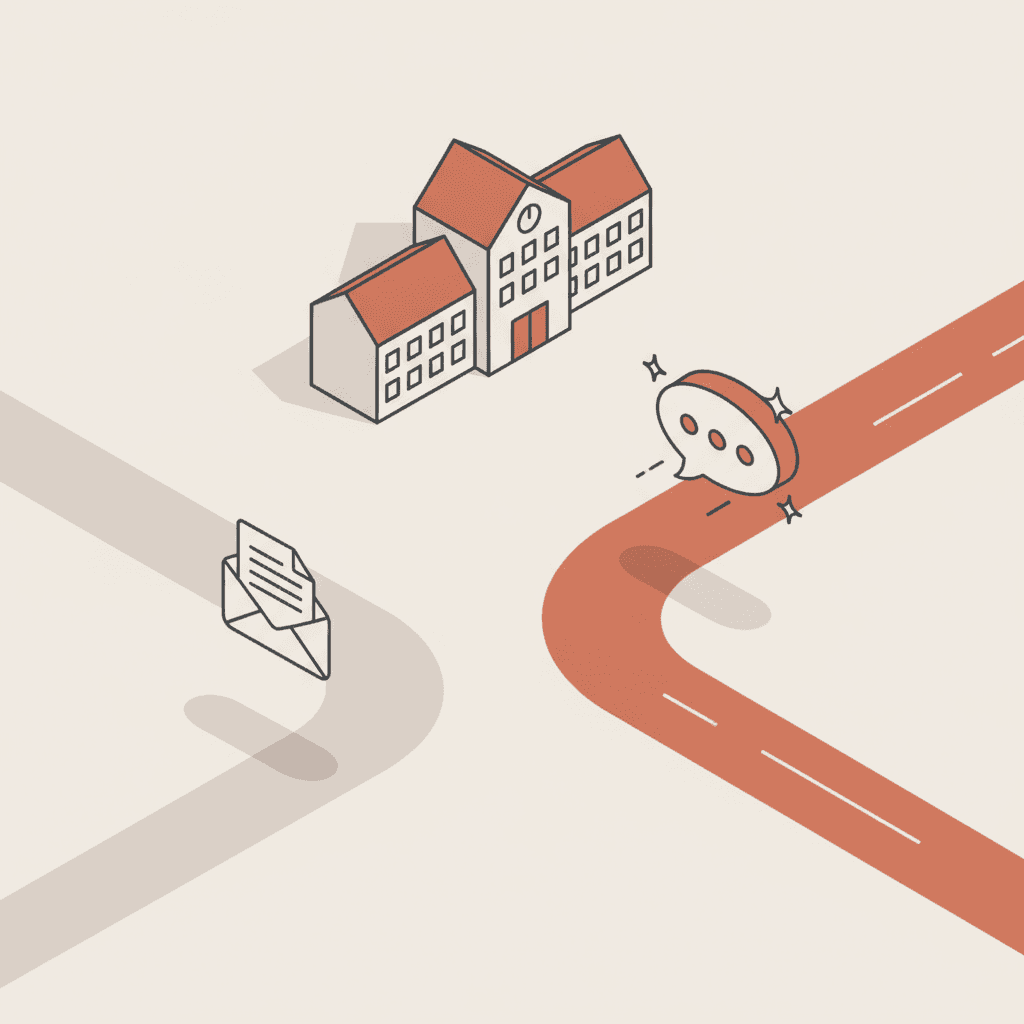
An AI chatbot is not a marketing gimmick. It is a communication channel that meets the real expectations of Gen Z prospects: immediacy, availability, personalisation. This comparison lays the data side by side so admissions directors can make an informed decision.
Response time: 3 seconds versus 72 hours
The most visible difference is response time. A mystery-shopping audit conducted by Skolbot across 80 UK institutions exposes the gap:
- Contact form: 72 hours average delay
- AI chatbot: 3 seconds, 24/7
(Source: Skolbot mystery-shopping audit, 2025, 80 institutions)
The form imposes a structural delay: the enquiry arrives in an inbox, waits for a human to read it, draft a reply, and send it. Even the most responsive teams rarely drop below four hours. The chatbot responds before the prospect has had time to scroll.
This gap has direct consequences on the recruitment funnel. For a deeper analysis of how delay affects enrolment, read our article on why response time is killing your enrolments.
Availability: 24/7 versus office hours
Prospects do not respect your timetable
67 % of prospect activity occurs outside office hours, peaking on Sunday evenings between 8 pm and 9 pm (Source: Skolbot interaction logs, 200 000 sessions, Oct 2025 — Feb 2026). During the UCAS deadline period in January, the out-of-hours share rises to 74 %.
The contact form is technically available around the clock — but it provides no answer. The prospect fills in the fields, clicks "submit", and faces a void: a generic confirmation message, no useful information, no certainty about when a reply will arrive.
The AI chatbot, by contrast, provides an immediate answer at every hour of the day and night. A prospect who logs on at 10 pm on a Sunday to ask about tuition fees receives a response in 3 seconds — not an acknowledgement promising "a reply at our earliest convenience".
Conversion rates: the chatbot delivers a threefold increase
Open Day registrations
The channel of interaction has a direct impact on conversion. UTM tracking data from 35 institutions shows:
- AI chatbot: 18.4 % Open Day registration rate
- Website form: 6.2 %
- Email campaign: 4.8 %
- Organic social media: 2.1 %
(Source: UTM tracking + multi-touch attribution, 2025-2026 season, 35 institutions)
The chatbot converts three times better than the form for Open Day registrations. The reason is mechanical: the chatbot detects interest in real time and proposes registration at the right moment in the conversation, when the prospect is engaged. The form is a cold channel — the prospect must take the initiative, fill in fields, and wait.
Impact on bounce rate
Sites with an AI chatbot record a bounce rate of 41 %, compared with 68 % without any chat (Source: A/B test across 22 institution websites, Sept-Dec 2025). The 39.7 % relative reduction is significant, but the story goes further.
The chatbot transforms passive browsing into active interaction. Pages per session rise from 1.8 to 3.4, and session duration from 1 min 45 s to 4 min 12 s. The prospect no longer views one page and leaves — they explore your offering.
Data collected: rich conversation versus sparse form
What a form collects
A standard contact form captures 3-5 fields: name, email, phone, programme of interest, free-text message. These data points are static, often incomplete, and reveal nothing about intent or behaviour.
What an AI chatbot collects
A chatbot conversation generates a substantially richer prospect profile:
- Questions asked: the topics that genuinely interest the candidate (89 % ask about tuition fees, 78 % about work placements, 67 % about international exchanges — Source: analysis of 12 000 Skolbot conversations, 2025-2026)
- Navigation path: pages visited before and after the conversation
- Engagement level: number of messages exchanged, time spent, subsequent returns
- Language detected: automatic identification for international prospects
- Application intent: automatic scoring based on conversational signals
These data feed directly into your CRM and enable personalised follow-up that a form simply cannot deliver. For a full ROI breakdown, read our detailed student chatbot ROI calculation.
Question complexity: 72 % can be automated
A common objection to chatbots is: "our enquiries are too complex for AI." The data tells a different story.
72 % of prospect questions are simple FAQ queries (tuition fees, entry requirements, dates). 21 % require institution-specific context (pathway options, special cases). Only 7 % require human intervention (personal circumstances, guidance counselling) (Source: automatic classification of 12 000 Skolbot conversations, 2025).
The chatbot does not replace the admissions team. It handles three quarters of the volume so the team can focus on the cases that genuinely need a human — the high-value 7 %.
The form, by contrast, treats 100 % of enquiries identically: an email in the inbox, a manual reply, regardless of complexity.
Cost and implementation: snippet versus development
Setting up a form
A well-designed contact form requires:
- UX design (field selection, validation, responsive layout)
- CRM or inbox integration
- Confirmation email configuration
- Ongoing maintenance and field updates
The upfront cost seems low, but the form carries a substantial hidden cost: the human time spent manually processing each enquiry. At 120 questions per month and 7 minutes per reply, that amounts to 14 hours monthly — nearly two full working days.
Setting up an AI chatbot
An AI chatbot such as Skolbot integrates via a JavaScript snippet:
<script src="https://cdn.skolbot.com/widget.js"
        data-school-id="your-id"
        async>
</script>
Deployment takes 48 hours: site scraping (2-6 h), answer validation (half a day), technical integration (5 minutes). No development skills are required on the institution's side.
Monthly cost varies by conversation volume, but measured against results — +62 % qualified leads, -38 % cost per lead (Source: median results, 18 institutions, 2024-2025) — the investment pays back in 5 months on average.
Prospect experience: conversation versus form
The form creates friction
Completing a form is an administrative task. The prospect must identify the right fields, formulate their question in a free-text box, and accept the uncertainty of an indefinite response time. Each step is a potential drop-off point.
The outcome: most prospects never fill in the form. 91 % of visitors leave the site without first contact (Source: Skolbot funnel analysis, 30 institutions, 2025-2026 cohort). The form is not a conversion channel — it is a filter that eliminates all but the most determined prospects.
The chatbot creates engagement
The chatbot reverses the dynamic. It initiates the conversation ("Hello — looking for information about a programme?"), lowers the barrier to entry, and adapts its responses in real time. The prospect does not need to know what to ask — the chatbot guides them.
This shift from friction to engagement explains why prospects who interacted with a chatbot return at a rate of 34 % within 7 days, versus 12 % without — a 2.8x multiplier (Source: Skolbot cohort analysis, 8 000 sessions, 2025).
When to keep the form
The contact form is not useless in every scenario. It remains relevant for:
- Document-based requests: when the prospect needs to attach a file (application dossier, transcripts)
- Formal complaints: when a structured written record is legally required
- Institutions without chatbot budget: a well-designed form is better than nothing
The best approach is not to choose one over the other, but to deploy the chatbot on the front line and reserve the form for the specific cases that warrant it. The chatbot captures 72 % of the flow; the form handles the 7 % of formal cases.
For a comprehensive chatbot strategy, read our complete AI chatbot guide for higher education. See also how Skolbot compares to other market solutions in our full comparison.