 ChatGPT
 Claude
 Perplexity
 Gemini
 Grok
GrokThe wrong CRM costs you more than its license fee
Most US colleges and universities have a CRM. Far fewer use it well. When I audited digital recruitment processes across 12 institutions over the past three years, the pattern was consistent: CRM data was incomplete, automation was underused, and admissions staff had reverted to spreadsheets for anything time-sensitive. The problem was not the teams — it was tools chosen for generic sales cycles, not for the complexity of higher education enrollment management.
The stakes are real. A graduate school applicant researching programs compares three or four institutions simultaneously. The one that responds fastest with relevant information wins the interview request. During late admissions or waitlist season, a 15-minute advantage can determine whether a student accepts your offer or a competitor's.
This guide compares the leading platforms for US institutions in 2026, with specific attention to Common App integration, AI capabilities, and what the data says about ROI.
The leading CRM platforms for US higher education
| Platform | Best for | Common App / Coalition integration | AI capabilities | Indicative cost |
|---|---|---|---|---|
| Slate (Technolutions) | Admissions-heavy institutions | Native | Limited built-in | Custom pricing |
| Salesforce Education Cloud | Large universities, multi-campus | Via connector | Einstein AI | From $180/user/month |
| Element451 | Digital-first recruitment | API | Conversational AI, SMS | $30K–80K/year |
| HubSpot | Inbound marketing focus | API | Marketing AI | $50–890/month |
| Ellucian CRM Recruit | Existing Ellucian SIS users | Native | Dynamics 365 AI | Custom pricing |
Slate: the benchmark for US admissions teams
In a 2025 survey of US higher education professionals, Slate was cited as the most widely used admissions CRM (over 60% of four-year institutions), a position it has held since 2020. Its strength is configurability — Slate Designer allows institutions to build custom applications, workflows, and communications without writing code. For institutions processing tens of thousands of Common App and direct applications annually, the native integration and track record justify the investment.
Where Slate falls short is marketing automation at scale. It was built for admissions, not for the full recruitment funnel from awareness to enrollment. Many institutions pair it with a separate marketing automation tool — which adds complexity.
Element451: built for Gen Z engagement
Element451 has grown rapidly among US institutions looking to modernize their prospect engagement. It offers conversational AI for 24/7 inquiry handling, SMS-first communication (critical during yield season), and mobile-optimized portals that match how prospective students actually browse. The platform's AI lead scoring surfaces high-intent prospects automatically — useful when managing thousands of applications across multiple cycles.
Its limitation is integration depth with legacy student information systems. If your institution runs Banner or Colleague without an IT team available for API work, implementation can be prolonged.
HubSpot: the marketing-first option
HubSpot is not purpose-built for higher education, but its marketing automation capabilities are unmatched. Institutions with strong inbound marketing strategies — content, SEO, paid social — find HubSpot more intuitive than specialist education platforms. The free CRM tier gives smaller institutions a starting point before committing to paid tiers.
For US-specific compliance, HubSpot has data processing agreements aligned with FERPA requirements and offers US-based data centers. Its API is fully open, which matters if you want to connect an AI chatbot for out-of-hours prospect engagement.
Selection criteria US institutions cannot afford to ignore
1. FERPA compliance and state privacy laws
FERPA (the Family Educational Rights and Privacy Act) applies to all institutions that receive federal funding — which is virtually every US college and university. Your CRM vendor must demonstrate FERPA compliance, including proper handling of education records, directory information opt-outs, and parental access provisions. Beyond FERPA, states like California (CCPA/CPRA), Virginia (VCDPA), and Colorado (CPA) have their own privacy laws that may apply to prospect data collected before enrollment.
The FTC has also increased scrutiny on ed-tech data practices. Verify your CRM vendor's compliance position across federal and state requirements before signing.
2. Common App integration and yield season readiness
Yield season — the period between acceptance and enrollment deposit — is a compressed window where data velocity determines results. During the 2025 yield cycle, institutions using real-time CRM integration with the Common App reported a 23% faster response to prospective student inquiries than those with manual processes. EDUCAUSE flags CRM-SIS interoperability as a top technology priority for US higher education in 2026. Verify whether your CRM vendor offers native Common App or Coalition App import or whether you'll need a custom API build.
3. Open API for AI integration
This is the non-negotiable criterion for 2026. A CRM without an open API locks you into a closed ecosystem. When your institution is ready to connect an AI chatbot for 24/7 prospect engagement — and most institutions are asking this question now — a closed CRM means starting over.
4. Accreditation and reporting requirements
Regional accreditation bodies (SACSCOC, HLC, MSCHE, WASC, NEASC, NWCCU) and the US Department of Education require institutions to demonstrate strong student outcomes and engagement. Your CRM should be able to generate reports that map to accreditation evidence categories: retention and graduation data, student engagement records, and satisfaction indicators. The IPEDS reporting cycle also demands clean, auditable data. Check whether your shortlisted platforms have pre-built accreditation reporting modules or whether this requires custom development.
What the data shows about CRM and AI integration
The clearest argument for connecting your CRM to an AI chatbot is the out-of-hours engagement problem. In 2025–26, 67% of prospect activity happened outside office hours, with the absolute peak on Sunday evenings (Source: Skolbot interaction logs, 200,000 sessions, Oct 2025 – Feb 2026). No admissions team covers this window.
When institutions connected an AI chatbot to their CRM, the results were consistent: qualified leads increased by 62% (from 120 to 195 per month), cost per qualified lead fell by 38% (from $42 to $26), and 12-month ROI reached 280%. (Source: median results across 18 institutions, including concurrent funnel optimizations, 2024–2025.)
The mechanism matters. The chatbot qualifies the inquiry (intended program, level, full-time or part-time), pushes the structured data into the CRM contact record, and triggers the appropriate nurturing sequence — all without admissions staff involvement. The team reviews qualified, scored prospects in the morning rather than raw inquiries.
For more on how to structure these sequences, see our guide to email nurturing for student prospects.
The integration architecture that works
The most effective setup we see across US institutions in 2026 follows a clear pattern:
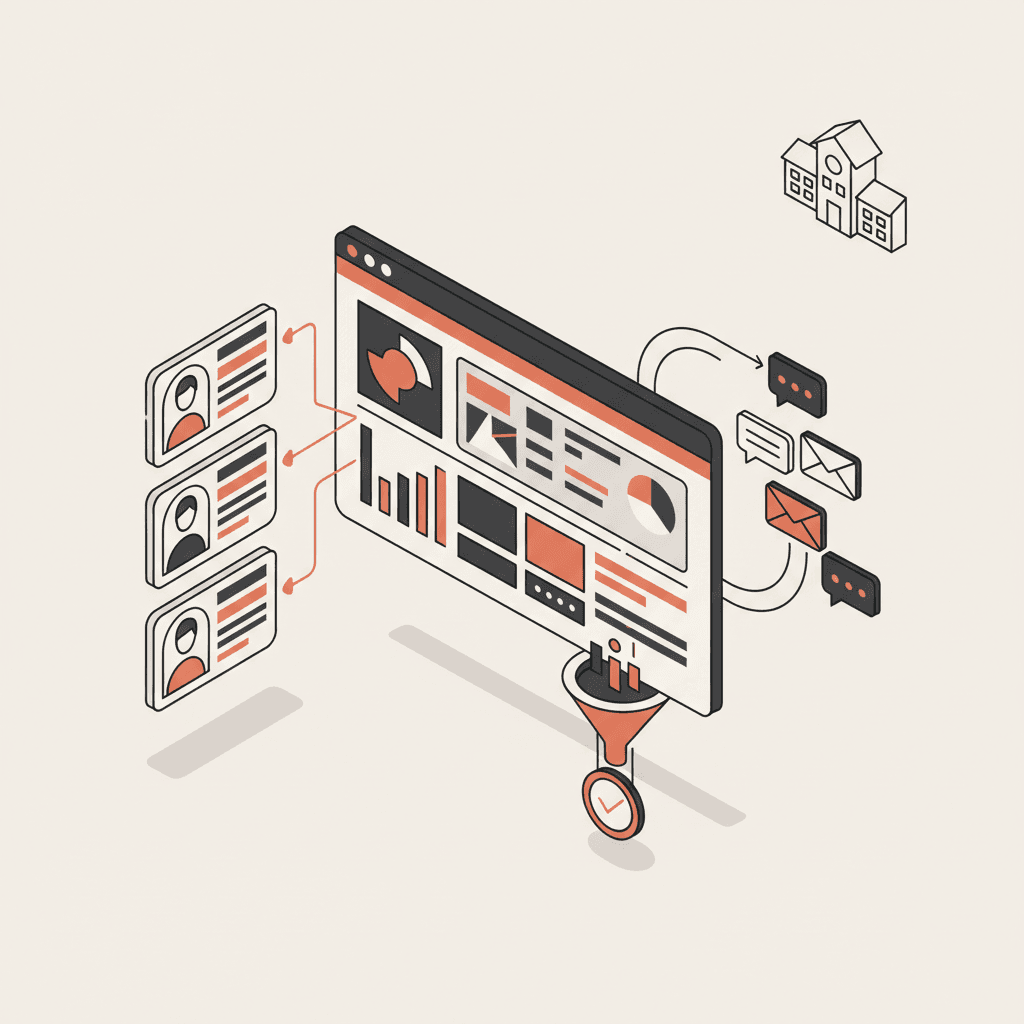
Website traffic → AI chatbot (qualification + 24/7 engagement) → CRM (scored contact + triggered sequence) → Admissions team (qualified prospects only)
The chatbot handles the top of the funnel: FAQ responses, program navigation, campus tour registration. Everything structured and qualifying flows into the CRM automatically. Your admissions counselors focus on the conversations that require human judgment.
This is not a replacement for human contact — it is a filter that ensures every human conversation is worth having. For institutions managing yield season or late admissions, this architecture becomes essential: the chatbot handles volume while counselors focus on conversion.
For a detailed look at how AI chatbots automate campus tour registration, see how an AI chatbot automatically registers prospects for campus tours.
Common implementation mistakes
Buying on features, deploying without a process map
The most common failure mode is purchasing a sophisticated CRM, then trying to map existing chaotic processes onto it. A CRM does not fix unclear ownership of leads, competing priorities between marketing and admissions, or a 48-hour response SLA that nobody enforces. Before procurement, document your current recruitment funnel step by step and identify where candidates drop off.
Ignoring the first-year data hygiene
CRM quality degrades quickly without maintenance. Duplicate records, outdated contact details, and unscored leads accumulate. Build a data hygiene routine into the project plan from day one: deduplication rules, contact validity checks, and a clear data retention policy aligned with FERPA and applicable state privacy laws.
Under-resourcing the training phase
A CRM that admissions staff don't trust is a CRM that sits unused. Budget for two full days of initial training per user cohort, plus quarterly refreshers. The institutions with the highest CRM adoption rates are those that designated internal champions — typically senior admissions counselors who tested the system in parallel before rollout.
For an overview of the complete digital marketing ecosystem for higher education, read our digital marketing guide for higher education.
Test Skolbot on your institution in 30 seconds