 ChatGPT
 Claude
 Perplexity
 Gemini
 Grok
GrokThe FERPA misconception that's making US college application forms unnecessarily complicated
Walk through the admissions section of almost any US private college website and you will find application forms containing FERPA disclosures — language like "pursuant to the Family Educational Rights and Privacy Act, you have the right to inspect your educational records." Admissions staff added it in good faith. Legal counsel signed off without digging into the statute. The language has been there so long nobody questions it.
Here is the problem: FERPA (20 U.S.C. § 1232g) does not apply to prospective students or applicants. It does not apply on the day someone fills out your inquiry form. It does not apply when they submit their essay, their SAT score, or their letters of recommendation. FERPA applies to the educational records of enrolled students at institutions receiving federal funding — and it only kicks in once a student is formally enrolled and official educational records are created in their name.
Data collected during the admissions process — names, contact information, application essays, test scores, letters of recommendation, demographic responses — is pre-enrollment data. It sits entirely outside FERPA's scope. The US Department of Education's Student Privacy Policy Office has been clear on this point: individuals who applied but did not enroll are not students under the statute, and their application materials are not education records.
The actual governing framework for pre-enrollment application data is:
- Your institution's published privacy policy — the primary governing document for how you collect and use applicant data
- FTC Act (Section 5) — your privacy practices must match your stated policy; unfair or deceptive data handling is actionable by the Federal Trade Commission
- CCPA/CPRA for California residents — the California Attorney General enforces rights to know, delete, and opt out of sale
- State data breach notification laws — all 50 states require notification to affected individuals in the event of a breach
None of these frameworks require FERPA language on your application form. Including it does not provide protection — it creates confusion for applicants and a false impression that FERPA rights govern data that FERPA does not actually reach.
What US law actually requires on a student application form
No single federal law mandates specific disclosure fields on private college application forms. But the absence of a prescriptive mandate does not mean no obligations exist — it means your obligations come from multiple overlapping sources, and getting the combination wrong carries real risk.
The core requirement under the FTC's reasonable-expectations standard is straightforward: what your institution says it does with applicant data must accurately reflect what it actually does. If your privacy policy says you do not share applicant data with third parties, and your CRM vendor is selling enriched prospect lists to advertisers, you have an FTC problem regardless of whether FERPA applies.
Here is the practical checklist for a legally sound US college application form:
| Element | Required | Standard | Example |
|---|---|---|---|
| Privacy policy link | Yes (FTC) | Linked from form | "Privacy Policy" link at bottom of form |
| Data collection purposes | Yes (FTC) | In privacy policy | "We use your information to process your application..." |
| CCPA "Do Not Sell" notice | If California applicants | Banner/link | "CA Residents: Do Not Sell My Personal Information" |
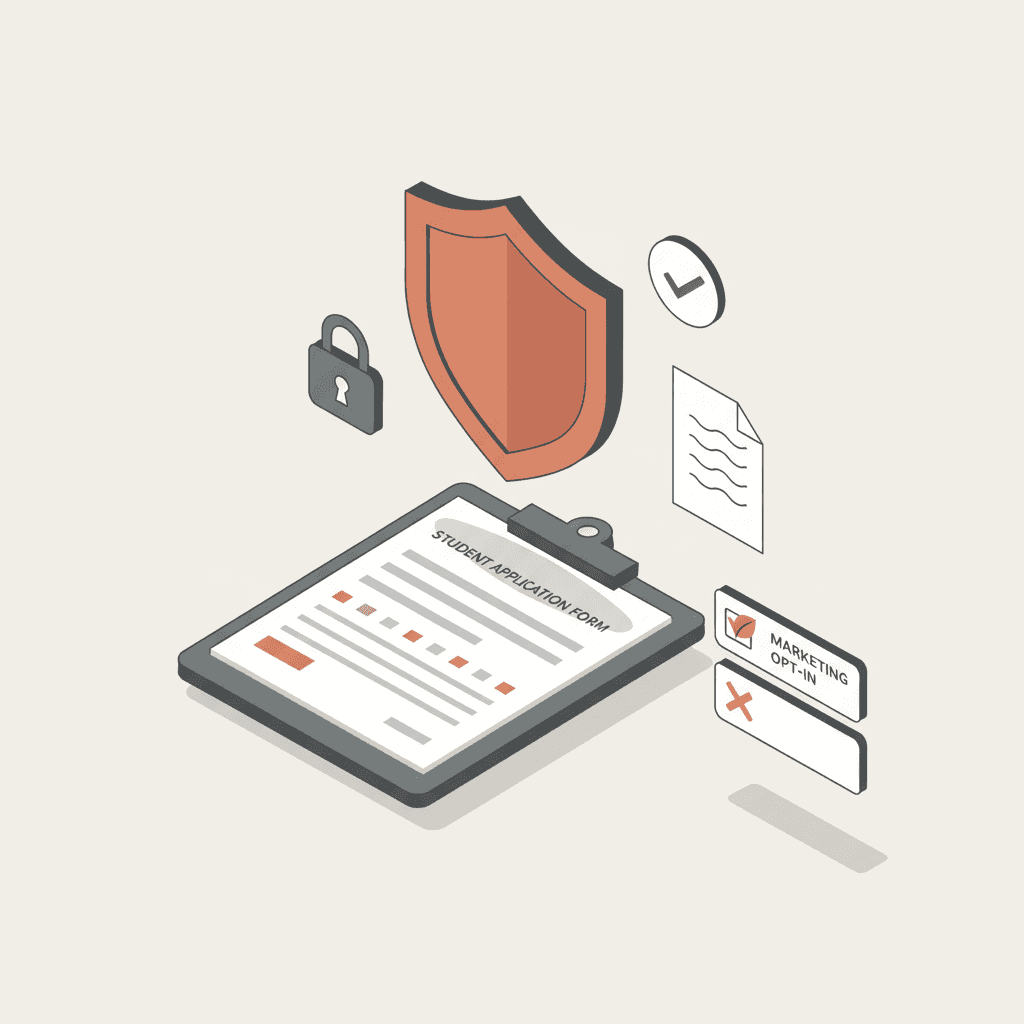
| Marketing email opt-in | Best practice | Unticked checkbox | "I'd like to receive updates about programs and campus life" |
| FERPA disclosure | NO (not applicable pre-enrollment) | — | Not needed on the application form |
| Checkbox for application processing | NO | — | Unnecessary |
Two items on this table deserve emphasis. The FERPA row is marked NO because adding FERPA language where it does not legally apply creates a misleading impression — it suggests to applicants that FERPA rights govern their application data when they do not, and it may actually undermine trust if a sophisticated applicant or attorney spots the error.
The marketing email opt-in row is marked "best practice" rather than legally required because the CAN-SPAM Act permits commercial email without prior consent, provided each message includes a clear unsubscribe mechanism and your institution's physical address, and opt-out requests are honored within 10 business days. But CAN-SPAM compliance is the floor, not the ceiling. Gen Z applicants — your primary audience — have sharply higher expectations around consent for marketing communications. An unticked opt-in checkbox costs you nothing in form completion rate and earns significant trust.
Three mistakes that complicate your application form and hurt enrollment
Mistake one: adding FERPA language to the application form. Beyond the legal inaccuracy, FERPA disclosure language is written in statutory terms that applicants find difficult to parse. Presenting it on an application form signals that your institution treats compliance as a bureaucratic checkbox rather than a genuine commitment to applicant privacy. It also creates a practical problem: if an applicant reads the FERPA language and later asks to exercise their FERPA rights over application materials — rights they do not actually have until enrolled — your admissions staff has to navigate a conversation about why the disclosure was on the form in the first place.
Mistake two: defaulting marketing email opt-ins to checked. Pre-checked opt-in boxes are a relic of an earlier era of digital marketing. They undermine trust, conflict with the spirit of state privacy laws even when they satisfy CAN-SPAM's minimum requirements, and generate low-quality marketing lists populated by applicants who never actively chose to hear from you. The result is poor email engagement, higher unsubscribe rates, and spam complaints that damage your sender reputation. An unticked checkbox with clear language produces a smaller but meaningfully more engaged list.
Mistake three: burying the privacy policy in fine print. The FTC's reasonable-expectations standard does not require that every applicant read your privacy policy — but it does require that your privacy policy be genuinely findable by someone who looks for it. A 6-point gray hyperlink at the bottom of a 40-field form does not clear that bar. This matters beyond legal compliance: 91% of visitors leave a school website without making first contact (Skolbot prospect dropout funnel analysis, 2025–2026). The applicants who make it to your form are already engaged. Visible, plainly-worded privacy information at the point of data collection builds the trust that converts intent into a submitted application.
The compliant, conversion-friendly US application form
A privacy-sound application form for a US private college does not require complexity. The structural elements are:
1. A visible privacy notice at the top of the form — not buried below the submit button.
Keep it to two or three sentences in plain English. Example:
"We collect the information on this form to evaluate your application for enrollment at [Institution Name]. Your data is used to process your application, communicate with you about admissions decisions, and, if admitted, to establish your student record. See our full [Privacy Policy] for details on your rights and how we protect your information."
That disclosure satisfies the FTC's reasonable-expectations standard. It accurately describes the purpose, signals that a full policy exists, and links to it.
2. A CCPA "Do Not Sell or Share My Personal Information" link, placed prominently and accessible to California applicants. If your institution recruits nationally — and most private colleges do — you almost certainly have California applicants. The California Privacy Protection Agency (CPPA) has made clear that educational institutions are not categorically exempt from CCPA obligations.
3. A separate, unticked marketing opt-in checkbox, clearly labeled and distinct from application processing consent. Example:
"☐ I'd like to receive information about programs, campus life, and upcoming events from [Institution Name]."
Do not conflate application processing with marketing consent. Applicants should be able to submit their application without agreeing to receive marketing emails.
4. No FERPA language. Leave it off entirely. If your legal counsel is uncertain, point them to studentprivacy.ed.gov — the Department of Education's own FAQ confirms that FERPA does not apply to applicants who have not yet enrolled.
Common App note: if your institution accepts the Common App, Common App is an independent data controller with its own privacy notice. Applicants consent to Common App's data practices directly. Your institution is also a controller for the data it receives — your privacy notice should address what happens to application data once it arrives in your systems. For direct applications, your institution is the sole controller and this question does not arise.
Common App vs. direct application — two different privacy frameworks
When a student applies through the Common App, they interact with two distinct data controllers: Common App, which operates the application platform and maintains its own privacy notice, and your institution, which receives and processes the application data in its own systems. Common App has its own terms of service, its own data retention policies, and its own disclosure framework — none of which your institution controls.
The practical implication: your institution's privacy obligations begin the moment application data arrives in your CRM, your admissions management system, or your inbox. From that point, your privacy policy governs. If your policy says you retain denied applicant data for two years and then delete it, that commitment applies regardless of what channel the application arrived through.
For direct applications — your institution's own form on your own website — your institution is the sole data controller from the first field entry. This is the cleanest privacy posture, and it gives you complete control over the data collection scope, the disclosure language, and the retention schedule.
The channel also affects enrollment conversion. Admissions teams that add a conversational touchpoint — an AI chatbot that can answer program questions, register prospects for campus tours, and capture application intent — see meaningfully different results: 18.4% of prospects register for an open house via chatbot versus 6.2% via a classic static form (Skolbot UTM tracking data, 35 institutions, 2025–2026). That gap compounds across a full recruitment cycle. See our guide on FERPA-compliant chatbot vendors for colleges for a breakdown of what data governance standards to require from any vendor operating in this space.
FAQ — Privacy compliance on US student application forms
Does FERPA apply to our application form?
No. FERPA (20 U.S.C. § 1232g) applies to educational records of enrolled students at institutions receiving federal funding. It does not apply to prospective student data collected during the admissions process. The relevant framework for pre-enrollment data is your institution's privacy policy, FTC standards, and applicable state laws — particularly the CCPA for California applicants. For a comprehensive overview of how these frameworks interact, see our FERPA and student data guide.
What should our privacy disclosure say on the application form?
Keep it short and specific. A compliant FTC-standard disclosure might read: "We collect your personal information to process your application for enrollment. Your data is used to evaluate your application, communicate about admissions decisions, and, if admitted, to establish your student record. See our full Privacy Policy for details." Two to three sentences, plain language, a link to the full policy. Do not use FERPA language here — it does not apply and it will confuse applicants.
Can we send follow-up emails to applicants without explicit consent?
Yes, under CAN-SPAM Act rules. You can send commercial email without prior consent, provided each message includes a clear and functional unsubscribe mechanism, your institution's physical mailing address, and opt-out requests are honored within 10 business days. However, best practice — and increasingly the expectation among Gen Z applicants — is to offer an explicit opt-in for marketing communications and honor opt-outs promptly. A pre-checked opt-in box does not constitute meaningful consent in the current regulatory and cultural environment.
How long should we retain data on applicants who don't enroll?
There is no federal mandate for pre-enrollment data retention at private colleges. Common practice is 1–3 years after the application cycle ends, which aligns with CAN-SPAM expectations, the CCPA's 12-month look-back period for consumer requests, and the statute of limitations for consumer protection claims in most states. Denied applicant files are often retained for 2 years specifically to preserve documentation for potential discrimination claims. Whatever period you choose, document it in your institutional data retention policy and enforce it technically — manual deletion schedules do not hold up at scale. See our complete guide on student data retention.
What are the risks if we get this wrong?
The risk stack is real. FTC enforcement actions for deceptive privacy practices can result in consent decrees and mandatory compliance programs. CCPA fines reach up to $2,500 per unintentional violation and $7,500 per intentional violation for California residents — and the California Privacy Protection Agency has signaled that educational institutions are not exempt. State attorney general offices in Colorado, Virginia, Texas, and other states with comprehensive privacy laws have similar enforcement authority. State data breach notification laws impose notification obligations and per-violation penalties if improperly handled data is exposed. And for institutions with regional accreditation — HLC, SACSCOC, MSCHE, WASC, NEASC, NWCCU — documented recurring privacy failures can surface during reaffirmation reviews. The reputational cost with prospective applicants is harder to quantify but no less real. For guidance on whether your institution needs a dedicated compliance officer to manage this landscape, see our guide on privacy officers for private higher education.
Useful external resources:
- studentprivacy.ed.gov — FERPA FAQ — the Department of Education's authoritative guidance on FERPA scope
- FTC — Privacy Notices — FTC guidance on what your privacy notice must say and where it must appear
- California AG — CCPA — consumer rights and enforcement guidance for the California Consumer Privacy Act