 ChatGPT
 Claude
 Perplexity
 Gemini
 Grok
GrokThe student recruitment challenge facing private institutions
Private colleges and universities across the United States are navigating the most competitive recruitment landscape in a generation. Shrinking cohorts of 18-year-olds — the so-called "demographic cliff" — a Gen Z cohort that behaves nothing like its predecessors, and a digital ecosystem that moves faster than most admissions teams can adapt: these forces are converging in 2026 with real consequences for enrollment numbers.
This guide breaks down what is driving the shift, what the data actually says, and which strategies deliver measurable results.
The National Student Clearinghouse Research Center projects enrollment declines accelerating through 2030 as the birth rate drop from the 2008 recession hits college-age populations. The Common App reported a 1% decline in unique applicants from certain domestic segments in 2025, while the Institute of International Education (IIE) noted international application growth plateauing for the first time in a decade. The average cost per enrolled student ranges from $2,400-$3,200 domestically, and climbs to $3,800-$5,500 for international candidates (Source: sector estimates based on NACAC, IIE, EAB data).
When each lost student represents tens of thousands in lifetime revenue, recruitment efficiency is no longer a "nice to have" — it is existential.
Demographic decline: the numbers behind the narrative
The birth rate drop across the United States following the 2008 financial crisis is now hitting higher education. This is what demographers and enrollment managers call the "enrollment cliff." According to the Western Interstate Commission for Higher Education (WICHE), high school graduates will peak in 2025 and then decline by over 13% through 2037, with the steepest drops in the Northeast and Midwest.
Why private institutions feel it first
Public universities absorb demand through lower in-state tuition, often subsidized by state funding. The Common App and brand familiarity funnel candidates toward established state flagship institutions by default. Private colleges and universities — especially those outside the Ivy League and top-50 US News rankings — must actively justify their premium, and they must do it before the prospect clicks away.
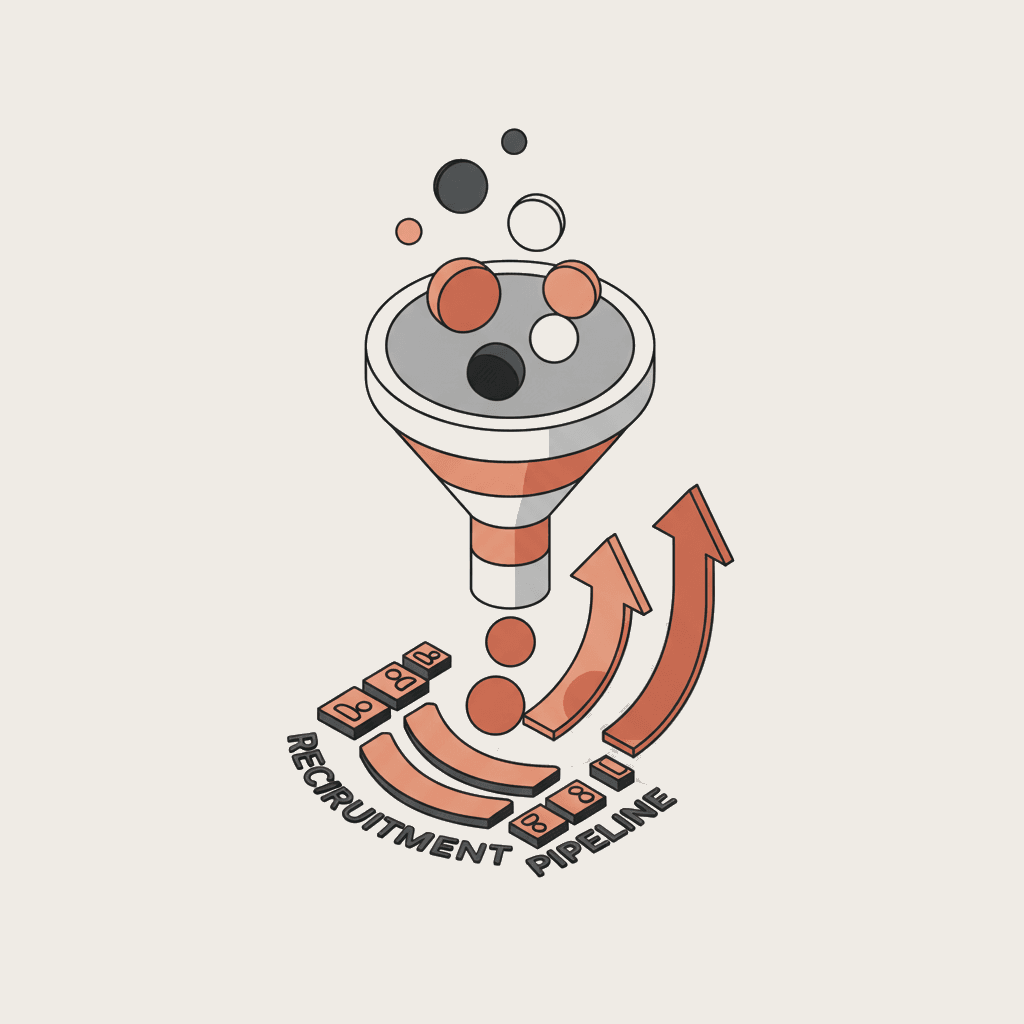
The funnel data is sobering: 91% of website visitors leave without making any contact, and the overall visit-to-enrollment conversion rate sits at just 0.8% (Source: funnel analysis across 30 institutions, 2025-2026 cohort). Improving either side of that equation — more traffic or better conversion — has a direct impact on revenue.
Gen Z prospects: three behaviors you cannot ignore
The generation born between 1997 and 2012 approaches school selection differently from Millennials. Three patterns stand out consistently across markets.
They expect instant answers
A 72-hour email response time is not slow — it is invisible. Gen Z prospects treat delayed responses the same way they treat a broken link: they move on. This dynamic is explored in depth in our article on why response time kills enrollments.
They research outside office hours
67% of prospect activity occurs outside business hours, with the absolute peak on Sunday evenings between 8 pm and 9 pm (Source: Skolbot interaction logs, 200,000 sessions, Oct 2025 — Feb 2026). During the Common App Regular Decision period (January) and the FAFSA priority deadline season, the share of out-of-hours activity rises further. An admissions office that closes at 5 pm is functionally unavailable for two-thirds of its audience.
They trust peers over institutions
Research from Keystone Academic Solutions and QS shows that Gen Z prospects consult 7-12 sources before making contact. Student testimonials on YouTube, Google reviews, and Reddit threads carry more weight than glossy viewbooks. The National Survey of Student Engagement (NSSE) confirms that peer recommendations are the most trusted information source. Institutions that invest in student ambassador programs and authentic short-form video content outperform those relying on traditional marketing collateral.
Digital transformation: beyond the website redesign
Going digital does not mean launching a new website every three years. It means rethinking every touchpoint in the prospect journey, from first click to confirmed enrollment.
The website as a conversion engine
Before a prospect ever speaks to an admissions counselor, they judge the institution through its website. And they judge quickly. Bounce rates average 68% on school websites without chat functionality, compared to 41% on sites with an AI chatbot — a relative reduction of nearly 40% (Source: A/B testing across 22 partner institution websites, Sept — Dec 2025).
Session depth tells the same story: 1.8 pages per session without chat versus 3.4 pages with a chatbot. Session duration jumps from 1 min 45 s to 4 min 12 s. These engagement metrics feed directly into search rankings and conversion probability. We examine these benchmarks in detail in our article on conversion rates by school type.
CRM as the backbone
A higher education CRM — whether HubSpot Education, Salesforce Education Cloud, or specialist platforms like Slate by Technolutions or Full Fabric — enables lead scoring, automated nurture sequences, and stage-by-stage funnel measurement. Without one, admissions teams operate on intuition. With one, they can pinpoint exactly where prospects drop off and why. Slate is particularly dominant in the US market, used by over 1,500 institutions.
Conversational AI: the most undervalued lever
An AI chatbot designed for higher education solves a specific problem: 72% of prospect questions are automatable FAQ queries (Source: automatic classification of 12,000 Skolbot conversations, 2025). Tuition costs, admission requirements, internships, degree accreditation — these questions recur in 9 out of 10 conversations.
Automating these responses delivers three benefits simultaneously. The prospect gets an answer in 3 seconds, around the clock. The admissions team focuses on the 7% of complex cases that genuinely require human judgment. And every chatbot interaction generates structured data that refines marketing targeting.
Five strategies that deliver results in 2026
1. Cut first-response time to under 5 minutes
Response speed is the single strongest predictor of conversion. Research published in Harvard Business Review found that prospects contacted within 5 minutes are 21 times more likely to convert than those contacted after 30 minutes. Institutions combining AI chatbots with real-time CRM alerts reduce their average first-contact time from 47 hours (email) to under 10 seconds.
2. Meet prospects on the channels they actually use
Traditional recruitment campaigns — college fairs, print advertising, direct mail — generate diminishing returns. In 2026, the three highest-performing channels for private institutions are targeted Google Ads on intent-based queries ("business school with co-op program in Boston"), behavior-triggered email and SMS nurture sequences, and short-form video content on TikTok and Instagram Reels showcasing authentic campus life.
3. Fix campus visit no-shows
Campus tours and admitted students days remain the highest-converting events in the admissions calendar, but no-shows erode their impact. Without any follow-up, 52% of registrants fail to attend. With personalized chatbot reminders, the no-show rate falls to 19% (Source: tracking of 4,200 campus visit registrations across 12 institutions, Oct 2025 — Feb 2026). Our dedicated guide to campus visit optimization covers this in full.
4. Optimize the conversion path page by page
Every page on the website plays a role in the funnel. The program page must answer questions about career outcomes and internships. The admissions page must make the process transparent — Common App vs. institutional application, Early Decision vs. Regular Decision, rolling admissions. The financial aid page must reassure on FAFSA, institutional grants, merit scholarships, and payment plans. Page-by-page audits combined with A/B testing can lift conversion rates by 30-80%, depending on the starting point.
5. Let data drive decisions
The institutions recruiting most effectively in 2026 share a common trait: they measure everything. Conversion rate by source, cost per qualified lead, no-show rate by reminder channel, average time to enrollment. A dashboard updated weekly catches performance dips before they affect the incoming class.
The cost of standing still
A private university that loses 20 enrollments per year due to a poorly optimized conversion path forfeits up to $3.2 million in revenue (based on a student lifetime value of $160,000 over 4 years at a mid-tier private university — Source: calculation based on average published tuition fees, US News, College Board, institutional websites).
The upside is equally measurable. Institutions partnering with Skolbot see a median 12-month ROI of 280% on their chatbot investment, with payback in 5 months (Source: median results across 18 institutions, including concurrent funnel optimizations, 2024-2025).
None of these gains hold if the admissions team burns out chasing them. For practical guidance on structuring roles and coverage through the Common App and Regular Decision crunch, see our guide on preventing admissions team burnout during peak season.