 ChatGPT
 Claude
 Perplexity
 Gemini
 Grok
GrokThe search landscape for US universities has split in two
The difference between SEO and GEO is straightforward: SEO gets your pages ranked in Google's blue link results, GEO gets your institution cited in the answers generated by ChatGPT, Perplexity, and Gemini. That distinction matters enormously for student recruitment.
A prospective student searching for "best business school in New York" in 2023 received a list of ten links to click through. Today, an increasing share of those same 16-to-21-year-olds ask ChatGPT or Perplexity directly — and receive a synthesized recommendation naming specific institutions. If your university is not in that answer, it effectively does not exist for that student in that moment.
The scale of this shift is already measurable. According to Gartner, traditional search volume is projected to decline by 25% by 2027 as AI interfaces absorb early-stage research queries. EducationDynamics research from 2025 found that 37% of prospective students specifically use AI chatbots when building their college shortlist. Yet 71% of higher education institution pages currently fail to appear in AI-generated answers on relevant queries.
SEO remains essential — but it no longer covers the full territory.
For broader context on GEO strategy for schools, see our complete GEO guide for higher education institutions.
What SEO still does well — and where it falls short
The enduring strengths of SEO for universities
Traditional SEO — keyword optimization, technical site health, authoritative backlinks from sector sources like accreditation bodies, Common App data pages, and US News Rankings — continues to deliver measurable results for high-intent queries. A university well-positioned on queries like "part-time MBA New York no GMAT" or "BS mechanical engineering with co-op" can generate consistent, cost-effective prospect traffic. Conversion rates from organic search consistently outperform paid social for programs where the decision cycle spans several months.
Accreditation body pages (from SACSCOC, HLC, MSCHE, WASC), Common App program listings, and US News Rankings remain powerful sources of domain authority — and they directly feed both SEO and GEO signals.
Where SEO stops working for AI visibility
SEO optimizes for an index — a ranked catalog of pages. AI generates answers from its understanding of entities and facts. These two mechanisms diverge significantly.
Semrush data from 2025 shows that 80% of URLs cited by AI models do not appear in Google's top 100 results for the same query. An Ivy League university could dominate traditional search and remain completely absent from AI recommendations — and vice versa. Google rankings no longer predict AI citation rates.
Three common SEO practices actively harm GEO performance:
- Keyword-padded content — Pages written to rank on volume queries typically lack the entity density and factual precision that AI models prioritize when generating recommendations.
- Critical data locked in PDFs — Tuition costs, accreditation status, graduate employment outcomes, and SAT/ACT score ranges published as PDFs are largely invisible to AI retrieval systems. HTML structured data outperforms PDFs for AI citation.
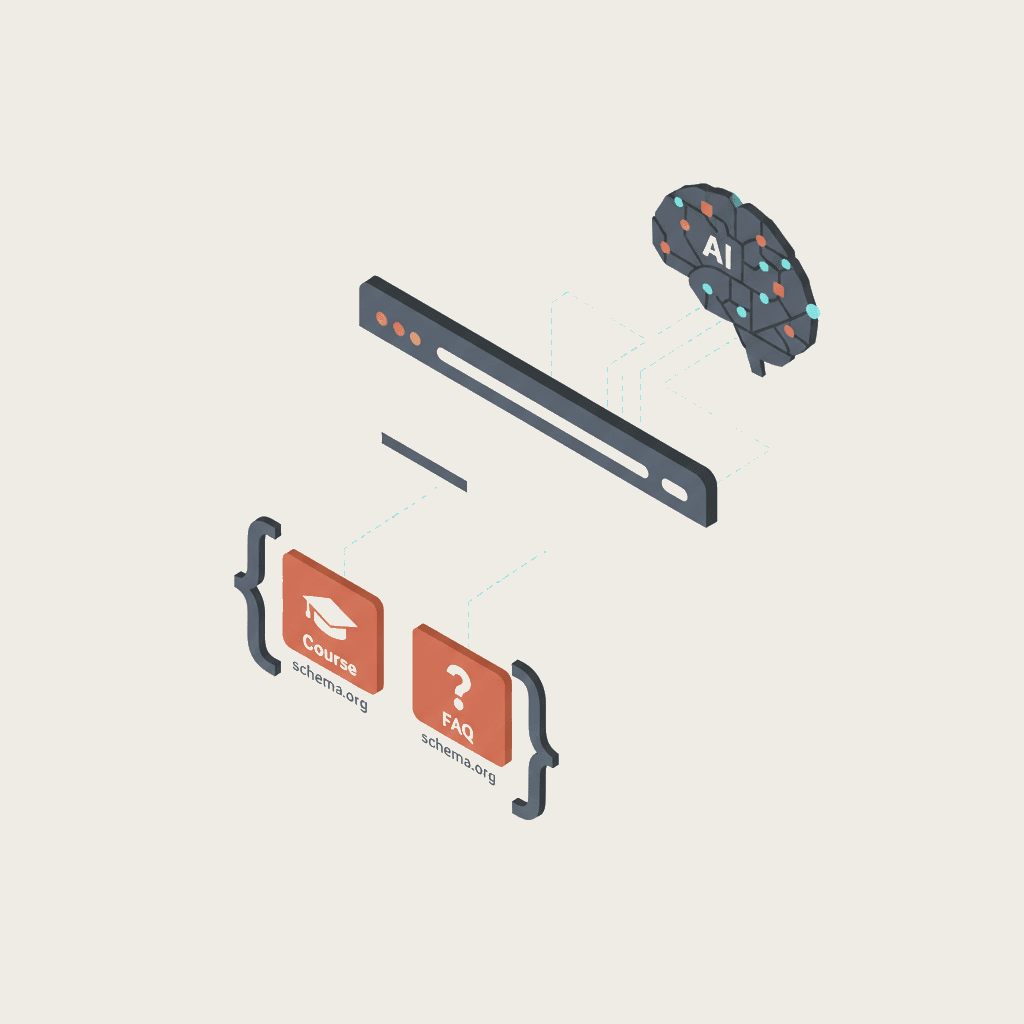
- Missing structured markup — Without Schema.org, an AI model cannot identify your institution as a verified entity, link it to its programs, accreditations, and outcomes, or include it in a recommendation with confidence.
SEO vs GEO: a structural comparison
| Dimension | Traditional SEO | GEO (AI engines) |
|---|---|---|
| Goal | Position in search results | Citation in AI-generated answer |
| Primary signal | Backlinks + keyword relevance | Entity density + structured data |
| Success metric | Ranking position, CTR, organic traffic | Citation frequency, mention context |
| Optimal content | Keyword-targeted 1,500-word article | Direct answers + sourced factual data |
| Priority technique | Meta tags, page speed, mobile-first | Schema.org, FAQPage, verifiable data |
| Time to impact | 3–6 months to rank | 2–4 weeks for structured data |
| Measurement tool | Google Search Console, Semrush | Manual monitoring + AI-specific tools |
Universities that implement structured Schema.org markup gain an average of 12 additional GEO visibility points compared to those that have not (Source: Skolbot GEO monitoring, 500 queries x 6 countries x 3 AI engines, Feb. 2026). This is the highest-ROI GEO lever available: a one-time technical investment with lasting effect.
Four GEO levers specific to US higher education
1. Schema.org structured markup for US universities
For a US institution, priority markup types are:
- EducationalOrganization — Full legal name, address, URL, logo, regional accreditation status (SACSCOC, HLC, MSCHE, WASC, NEASC, NWCCU), Carnegie Classification, US News ranking
- EducationalOccupationalProgram — For each program: duration, qualification level (BS, BA, MS, MBA), delivery mode, SAT/ACT score ranges, GPA requirements, application deadlines
- FAQPage — Structured question-answer markup on every FAQ page
Schema.org's EducationalOrganization specification and Google Search Central's structured data documentation provide exact syntax. FAQPage markup makes pages 3.2x more likely to appear in AI Overviews (Semrush, 2025).
For a full technical implementation guide, see our article on structured data that makes your school visible in AI.
2. Entity density: make your institution unmistakably identifiable
AI models identify named entities — accreditation bodies, ranking positions, verifiable statistics. Do not write "our programs are highly regarded." Write: "AACSB-accredited, HLC-accredited, ranked #14 in US News Best Undergraduate Business Programs 2025, 94% graduate employment rate at six months (IPEDS Graduate Outcomes, 2024)."
Each named entity — AACSB, HLC, IPEDS, US News — is a reference point the AI can cross-check against other sources. The denser your verifiable entity network, the stronger your GEO signal.
3. Presence on US sector authority sources
AI models assess institutional credibility by cross-referencing mentions across trusted third-party sources. For US universities and colleges, priority sources include:
- Common App / Coalition App — Program listings on commonapp.org are indexed and cited by AI models
- Regional accreditation bodies — SACSCOC, HLC, MSCHE, WASC, NEASC, NWCCU — registered provider status carries strong authority signals
- US News, Princeton Review, Niche — Ranking mentions are frequently cited verbatim in AI responses
- EDUCAUSE and NACAC — Sector body publications carry domain authority for EdTech and enrollment strategy queries
Ensure your Common App program data is current, complete, and matches the information on your own website. Inconsistencies between sources reduce AI citation confidence.
4. Conversational content structure for AI extraction
AI models extract passages, not full pages. Every section of your admissions and program pages should open with a direct answer to the implicit question in the heading. A 60-word paragraph containing a verifiable statistic and its source will be cited ahead of a 400-word descriptive passage.
Our guide on whether your school is visible in ChatGPT provides a 30-minute diagnostic methodology to assess your current GEO standing.
Building a combined SEO + GEO strategy in 2026
SEO and GEO are not competing disciplines — they are complementary layers of the same digital visibility strategy. Factually dense, entity-rich content performs better in both traditional search and AI citation. Fast, mobile-first pages serve both channels.
Specific GEO investments that go beyond SEO:
- Complete Schema.org implementation — Two to three days of development; measurable impact within four weeks
- Program page rewrite — Shift from marketing narrative to structured factual content with entity density
- Third-party presence audit — Verify accreditation body listings, Common App data, and ranking entries are accurate and complete
- Structured FAQ pages — Turns every program page into a candidate for AI citation
Institutions that establish GEO authority in 2026 are building a structural advantage. The AI citation landscape today resembles SEO in 2010: early movers benefit from visibility that late adopters will struggle to match even with significant investment.
To understand the precise criteria AI engines apply when deciding which institutions to recommend, see our analysis of the 10 criteria AI uses to recommend a school.