 ChatGPT
 Claude
 Perplexity
 Gemini
 Grok
GrokA generic AI chatbot can answer "how does the Common App work?" A chatbot trained on your institution's data can answer "do I meet the admission requirements for your MS Marketing if I have a 3.0 GPA and three years of agency experience?" That distinction is the difference between a widget and a recruitment tool. This guide covers every step: what data to use, how to structure it, the difference between RAG and fine-tuning, FERPA and state privacy law boundaries, and how to improve the chatbot continuously once it is live.
For the full strategic picture, start with our AI Chatbot for Schools: The Complete Guide.
Why Training Matters: Generic vs Institution-Specific
A generic large language model (LLM) has broad knowledge but zero institutional context. It does not know your tuition, your application deadlines, whether your undergraduate programs accept the Common App, or how your transfer credit evaluation works. Left untrained, it will either refuse to answer or — worse — hallucinate plausible-sounding but incorrect details about your institution.
Schools with an AI chatbot trained on their own data reduce first-contact drop-off from 91% to 76%, generating 167% more first contacts (Source: funnel analysis across 30 schools, 2025–2026 cohort). That lift does not come from deploying any chatbot — it comes from deploying one that actually knows your institution.
The training process — more precisely, the knowledge-base configuration process — is what creates that difference. It takes a working LLM and grounds its responses in your authoritative content: no invented tuition figures, no hallucinated admission criteria, no fabricated campus visit dates.
What Data to Use: Your Institution's Knowledge Assets
The best source material for a college chatbot is the content your admissions team already produces and maintains. The question is not "where do we get this data?" but "which of what we already have should we prioritize?"
| Data Source | Content Type | Priority | Format |
|---|---|---|---|
| Program pages | Degree titles, courses, duration, outcomes | High | Web pages / PDF |
| Admission requirements | GPA range, SAT/ACT, AP/IB credit, transfer credit, adult learner pathways | High | Web pages / PDF |
| Tuition and aid | Undergraduate, graduate, international, part-time, merit and need-based aid | High | Web pages / PDF |
| Application process | How to apply via Common App, Coalition App, direct application, waitlist | High | Web pages |
| Campus visit schedule | Dates, registration links, campus locations | High | Web pages / structured list |
| Existing FAQ | Questions your admissions team already answers repeatedly | High | Text document |
| Scholarship and grant pages | Eligibility criteria, amounts, deadlines, FAFSA priority dates | Medium | Web pages / PDF |
| Housing information | Residence halls, off-campus options, costs | Medium | Web pages |
| Student services | Wellbeing, disability accommodations, career services | Medium | Web pages |
| Accreditation and rankings | Regional accreditation, programmatic accreditation (AACSB, ABET, CAEP, etc.) | Medium | Web pages |
| Alumni outcomes | Graduate employment rates, typical salaries, case studies | Low | Web pages |
| Staff profiles | Key contacts in admissions and student services | Low | Web pages |
Focus the first version of your knowledge base on the top four or five categories. Automated classification of 12,000 Skolbot conversations in 2025 found that 72% of prospect questions are simple FAQ questions answerable with that core content — tuition, admission requirements, application process, and program descriptions. Expanding to the full list matters, but it should not delay deployment.
What to exclude from the knowledge base: anything not publicly intended for prospects. Internal appeals procedures, staff HR documents, financial reporting, strategic planning documents, and individual student records have no place in a chatbot knowledge base — and including them creates both FERPA risk (covered below) and reputational exposure if the chatbot surfaces confidential content.
Data Preparation: Cleaning, Formatting, Structuring
Raw documents do not become a knowledge base automatically. Unstructured PDFs, outdated web content, and internally inconsistent tuition schedules will produce a chatbot that gives confident but wrong answers. Data preparation is unglamorous work, but it is the single biggest determinant of chatbot quality.
Step 1: Audit What You Have
List every document and web page you plan to include. For each one, confirm:
- Is it current? Tuition for the 2024–25 cycle is not the tuition for 2026–27. Admission requirements change. Campus visit dates are updated every year. Any document that has not been reviewed in the last 12 months needs verification before ingestion.
- Is it authoritative? Your admissions team's informal FAQs in a shared Drive folder may contain useful questions, but the answers need to match your official program pages. Use the official version as the source of truth.
- Does it conflict with anything else? A common problem in multi-campus institutions is that two program pages list slightly different admission criteria for what is nominally the same major. Resolve conflicts before ingestion, not after.
Step 2: Convert to Clean Text
LLMs process text. PDFs can be ingested, but complex layouts — multi-column viewbooks, graphic-heavy course catalogs, scanned images of documents — produce garbled text when extracted. For each source document:
- Export PDFs to clean text or structured HTML where possible
- Remove headers, footers, page numbers, and boilerplate legalese that will confuse the model
- Break long documents into logical sections (each program should be its own chunk, not buried in a 200-page course catalog)
- Standardize terminology — if some pages say "general education requirements" and others say "core curriculum", pick one and use it consistently
Step 3: Structure for Retrieval
When using RAG (see the next section), the knowledge base is divided into chunks that the system retrieves in response to a question. How you chunk your data affects retrieval quality significantly.
- Chunk by logical unit, not by arbitrary word count. A program description with admission requirements, course list, and career outcomes should stay together — splitting it mid-way through admission requirements produces incomplete answers.
- Add metadata to each chunk: program name, level (undergraduate/graduate), subject area, campus location. Metadata allows the retrieval system to filter before it searches, improving accuracy.
- Keep chunks between 300 and 600 words. Too short, and the chatbot lacks enough context to answer well. Too long, and retrieval becomes noisy.
Step 4: Version Control
Your knowledge base will need to be updated regularly. Build a simple version-control habit from day one: record what was changed, when, and why. When the chatbot gives a wrong answer in six months' time, you need to trace whether the source data was wrong or the retrieval logic failed.
Training Methodology: RAG vs Fine-Tuning
This is the question most admissions teams reach for when they first engage with AI chatbot projects — and the answer, for college chatbots, is almost always the same.
RAG (Retrieval-Augmented Generation): How It Works
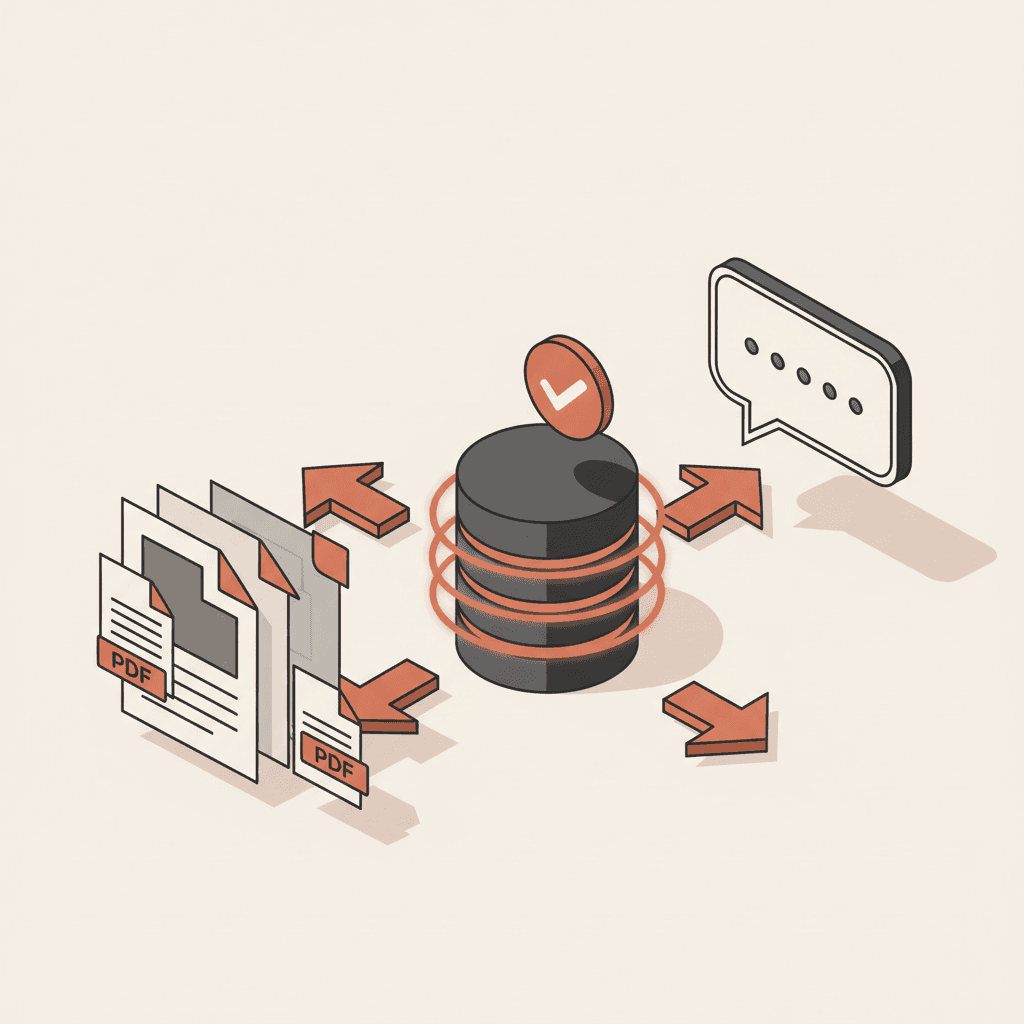
RAG does not change the underlying language model. Instead, it gives the model access to a searchable knowledge base at the moment a question is asked. The process is:
- A prospect types a question
- The system searches your knowledge base for the most relevant chunks
- Those chunks are passed to the LLM as context
- The LLM generates a response grounded in that context
The key property of RAG is that the model only answers based on what is in your knowledge base. If a prospect asks about a major you do not offer, the chatbot says so — it does not invent one. If the tuition for your BS Business is $42,500, the chatbot quotes $42,500 — not a plausible-sounding figure it generated from general knowledge.
RAG is the right approach for college chatbots because:
- It is updatable without retraining. When your tuition changes, you update a document in the knowledge base. The chatbot reflects the new figure immediately, with no model retraining required.
- It is auditable. Every response can be traced to a source chunk. This is essential for regional accreditation contexts (SACSCOC, HLC, MSCHE, WASC, NEASC, NWCCU) and for FTC-aligned consumer information accuracy — you can verify that the chatbot's answer came from your official published content.
- It reduces hallucination. Grounded responses are significantly less likely to fabricate information than free-generation responses from an uncontrolled LLM.
Fine-Tuning: When It Is and Is Not Appropriate
Fine-tuning means retraining the underlying model on your data — teaching it to write like you, understand your terminology, and adopt your institutional voice. It is expensive (compute costs, specialist ML engineering), slow (weeks of iteration), and requires retraining every time your content changes materially.
For a college chatbot answering admissions questions, fine-tuning adds cost and complexity without a meaningful accuracy advantage over a well-constructed RAG system. Fine-tuning is appropriate when:
- You need the model to adopt a very specific linguistic register or brand voice at a deep level
- You are building a system that generates long-form content (program descriptions, email drafts) rather than answering questions
- Your volume of interactions justifies the engineering investment
For the vast majority of US private and public higher education institutions, RAG with a well-maintained knowledge base is the right choice. Gartner's analysis of enterprise AI adoption consistently shows that data quality and retrieval architecture outperform model sophistication as drivers of accuracy in domain-specific chatbot deployments.
US Compliance: FERPA, State Privacy Laws, ADA
Training a chatbot on institutional data intersects directly with US data protection and accessibility law. The relevant frameworks are federal (FERPA, the ADA, Section 508, FTC Act Section 5), state (CCPA/CPRA, CDPA, CPA, CTDPA, TDPSA, and 20+ similar laws by 2026), and emerging AI-specific (Colorado SB 24-205 for high-risk AI). The US Department of Education Student Privacy Policy Office and the NIST AI Risk Management Framework are the most authoritative reference points.
What You Can Use
Publicly available content you authored. Your website pages, your published viewbook, your official FAQ — all of this is data your institution created and published for the purpose of informing prospective students. Using it to train an AI that informs prospective students is consistent with the original purpose. No new legal basis is required.
Anonymized and aggregated internal data. If you extract patterns from past inquiries — "the 30 most common questions asked by applicants in 2025" — and use those questions to improve your knowledge base, you are not processing personal data. Aggregate patterns are not personal data under FERPA or state privacy laws.
Consented operational data. If a prospect interacts with your chatbot and provides explicit consent for their conversation to be used to improve the service, that conversation log can be used for knowledge-base gap analysis. Consent should be specific and informed — generic privacy policy acceptance does not constitute valid consent for this purpose, and CCPA/CPRA in particular requires affirmative opt-in for sale or sharing of personal information.
What You Cannot Use
Individual student education records. Academic transcripts, application essays, recommendation letters, disability disclosures, FAFSA submissions — these are FERPA-covered education records once a student is enrolled or matriculating. Using them to train an AI system would constitute disclosure that almost certainly does not meet any FERPA exception, and would also trigger FTC concerns about deceptive data practices if it contradicts your privacy notice.
Unmoderated live conversations containing third-party personal data. Live chat transcripts often contain personal information that was not consented for AI training — a prospect's GPA, their disability status, a parent's email address. Before using any conversation data, it must be reviewed for personal data, stripped of identifiers, and confirmed against your data retention schedule.
Staff personal data. Individual staff profiles, employment terms, internal communications — none of this has a place in a prospect-facing knowledge base or in training data.
Data from third parties without a written agreement. Common App data, federal student aid records, school-reported transcript information — your institution is a data processor or controller for this data under specific terms. Using it for AI training almost certainly falls outside those terms.
The US Department of Education's Privacy Technical Assistance Center is the definitive federal reference. Your General Counsel, FERPA Coordinator, or Chief Privacy Officer should review the knowledge-base content list before deployment. Privacy compliance for chatbot data is also covered in detail in our guide to protecting prospect data.
Accessibility Requirements (ADA + Section 508)
Beyond data protection, US institutions deploying student-facing AI must meet accessibility obligations. The Department of Justice's 2024 ADA Title II rule explicitly covers state and local government websites and mobile apps with WCAG 2.1 AA as the conformance standard. Section 508 imposes parallel requirements on federal funds recipients. In practice, your chatbot vendor should provide a current VPAT (Voluntary Product Accessibility Template) or Accessibility Conformance Report, and your team should test the chatbot interface with screen readers and keyboard navigation before go-live.
Transparency Requirements
Under FTC Section 5 and most state privacy laws, prospects interacting with your chatbot must be informed that they are interacting with an automated system. The chatbot must identify itself as an AI. If it collects personal data (name, email, major interest), the privacy notice must cover this processing — and CCPA/CPRA in particular requires a "Notice at Collection" that itemizes the categories of personal information collected and the purposes. This is a legal requirement, not a design choice. Colorado SB 24-205 adds explicit disclosure obligations for high-risk AI in education.
Continuous Improvement: Learning From Real Conversations
A chatbot knowledge base is not a one-time project. The first version will have gaps. Prospects will ask questions your knowledge base does not cover. Some answers will be incomplete. The value of a deployed chatbot is that it tells you, in real time, where those gaps are.
The Unanswered Question Log
The single most important continuous improvement input is the list of questions the chatbot failed to answer satisfactorily. Most chatbot platforms expose this data as "unresolved conversations" or "fallback triggers". Review this log weekly for the first three months of deployment, then monthly thereafter.
For each unanswered question category, the response is always one of three things:
- Add content to the knowledge base. The question is reasonable; the content simply does not exist yet. Write it and ingest it.
- Improve existing content. The content exists but is not being retrieved correctly — often because it is buried in a long document or uses different terminology than prospects use. Restructure or rewrite the relevant chunk.
- Flag for human escalation. Some question types should never be handled by the chatbot. If prospects are repeatedly asking about individual circumstances that require counselor judgment, configure those triggers to route to a human. Our article on AI Chatbot vs Human Advisor: When to Hand Over covers those escalation triggers in detail.
Seasonal Updates: The Admissions Calendar
Higher education in the US runs on a predictable annual cycle. Your knowledge base needs to track it:
- August–October: new cohort admission requirements confirmed, updated program pages live, FAFSA opens (typically October 1)
- November–January: Common App and direct application deadlines; tuition and merit aid information must be accurate; Early Decision and Early Action notifications
- February–April: regular decision admit letters and aid packages; National Decision Day on May 1
- May–August: summer melt prevention, waitlist movement, orientation prep, transfer applications
Build these update cycles into your calendar alongside your standard content review process. A chatbot quoting last year's Common App deadline during November is not a minor error — it is an active recruitment liability.
Conversation Analysis for Program Intelligence
Beyond gap-filling, conversation data reveals what prospective students actually care about — as opposed to what your marketing team assumes they care about. If the chatbot logs show that 40% of prospective graduate applicants ask about funded assistantships before they ask about program content, that is a signal about how you position your graduate offering. If first-generation applicants consistently ask about student support before tuition, that tells you something about the order in which your program pages should present information.
For a practical guide to deploying the chatbot correctly on your website and ensuring it is surfaced to the right visitors, see our article on How to Integrate an AI Chatbot into Your School Website.