 ChatGPT
 Claude
 Perplexity
 Gemini
 Grok
The wrong CRM costs you more than its licence fee
A higher education CRM should help admissions teams track enquiries, applications and follow-up without losing context. Compare it against your actual process: where a contact starts, who owns the next action, which records belong in the student information system, and how errors are resolved.
This guide is a procurement checklist for UK institutions. It does not rank vendors by market share or promise a return on investment. Product pages were checked on 14 October 2026; contract terms, supported connectors and local pricing still need a written vendor response.
Compare CRM options against the same evidence
| Platform to assess | Evidence to request | Question for the demonstration |
|---|---|---|
| Slate (Technolutions) | Admissions workflow, permissions and export documentation | Can staff trace an enquiry through application and decision? |
| Salesforce Education Cloud | Edition, implementation scope and eligible pricing | Which features and integrations are included in our quote? |
| Element451 | Current product scope and connector documentation | How does the proposed setup hand an unresolved enquiry to staff? |
| HubSpot | CRM, automation and admissions configuration scope | Which parts are standard and which need custom configuration? |
| Ellucian CRM Recruit | Current product availability and SIS compatibility | Which versions and interfaces does the proposed integration support? |
These questions are not claims that every listed product supports every workflow. Ask vendors to demonstrate the same test cases with synthetic records. Record each answer as supported, conditional or unverified.
Slate: verify the proposed admissions workflow
Technolutions describes admissions workflows and AI features in its enterprise CRM overview. That description does not establish a local market-share ranking or compatibility with your specific admissions feed. Check permissions, data mapping, error handling and staff ownership in the proposed configuration.
Salesforce: compare the full scope of the quote
The Education pricing page distinguishes editions and identifies its displayed pricing as nonprofit pricing. Do not apply those cards to every institution or convert them into a local quote. Request the applicable currency, eligibility, billing period, implementation fees, usage limits and add-ons.
HubSpot and other options: separate the CRM from the integration
HubSpot's education CRM overview describes its education use case. Treat vendor descriptions as the start of evaluation, not proof that your admissions workflow is ready. For every option, request the current integration documentation, data-processing terms and support arrangements. A product name does not establish regulatory compliance.
Selection criteria UK institutions cannot afford to ignore
1. Privacy and contractual scope
Ask your privacy team to identify the rules applicable to your institution and each data flow. Record the processing purposes, retention periods, access roles, hosting locations, subprocessors and transfer arrangements. Do not infer that a vendor or contract is ICO-approved from its marketing.
2. Admissions integration and peak-period readiness
Ask the vendor to demonstrate import and export with UCAS where relevant to your institution. Confirm field mappings, update frequency, duplicate handling, rejected records and recovery after an outage. Do not assume that a connector exists or that its configuration is included in the licence.
Test peak-period workflows using synthetic applications. Measure elapsed time from receipt to staff availability and check that failed transfers remain visible. These measurements describe your test, not a sector-wide response-time benchmark.
3. Integration access and reporting
Check whether the proposed edition provides the API, webhook or supported import needed by your workflow. Ask about authentication, rate limits, retries, change notifications and export rights. A documented API is useful only if the team can operate it and monitor failures.
List the reports your institution needs and ask which fields supply them. Separate admissions activity from academic records held in the SIS. Do not assume a CRM meets accreditation or statutory reporting requirements without checking the relevant specification.
Measure the value of CRM and AI integration
Start with a baseline from your own process: completed enquiries, qualified contacts, time to first human response and staff time spent correcting records. Define a qualified contact before the pilot. Keep spam, tests and duplicate submissions out of the count.
Test a bounded workflow with synthetic records first, then an approved pilot. Record changes to advertising, admissions deadlines and staffing during the same period. A rise in enquiries alone does not establish that the integration caused it, or that more students enrolled.
Estimate total cost across licences, setup, data migration, support and maintenance. Compare that cost with observed time savings and outcomes. This guide provides no customer-derived benchmark or guaranteed ROI.
For more on follow-up design, see our guide to email nurturing for student prospects.
The integration architecture that works
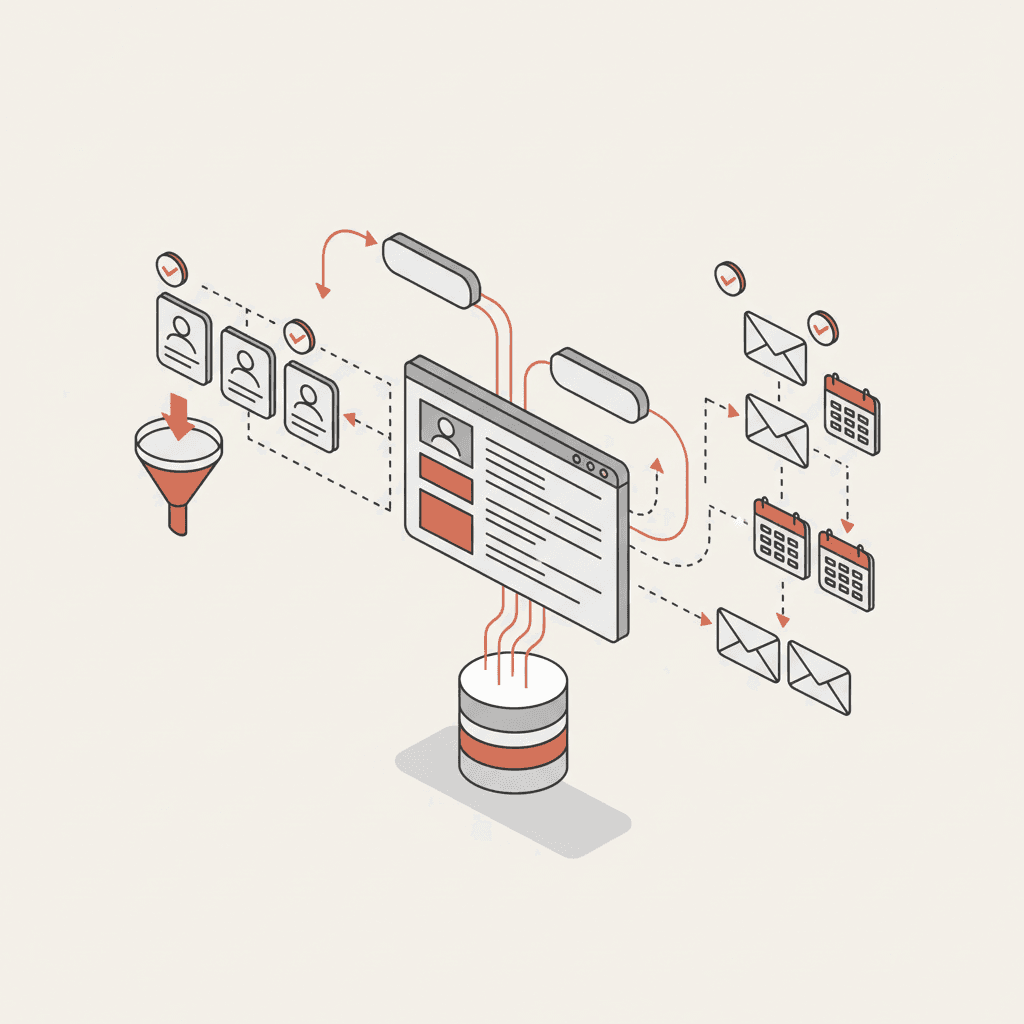
A proposed architecture to test is:
Website enquiry → grounded answer or human handoff → reviewed CRM record → assigned admissions follow-up
Define which questions the assistant may answer from published institutional pages and which go to a person. Transfer only the fields needed for follow-up. Check that staff can see the source, the contact’s request and any unresolved question.
Keep staff in control of admissions decisions. Test duplicate records, missing consent, unavailable systems and ambiguous questions. This is a design pattern to evaluate, not a claim that a particular Skolbot connector is already deployed.
For a detailed look at how AI chatbots automate open day registration, see how an AI chatbot automatically registers prospects for open days.
Common implementation mistakes
Buying on features, deploying without a process map
The most common failure mode is purchasing a sophisticated CRM, then trying to map existing chaotic processes onto it. A CRM does not fix unclear ownership of leads, competing priorities between marketing and admissions, or a 48-hour response SLA that nobody enforces. Before procurement, document your current recruitment funnel step by step and identify where candidates drop off.
Ignoring the first-year data hygiene
CRM quality degrades quickly without maintenance. Duplicate records, outdated contact details, and unscored leads accumulate — and if you're about to launch a major recruitment push, it's worth running a full lead database clean-up before the campaign starts rather than mid-flight. Build a data hygiene routine into the project plan from day one: deduplication rules, contact validity checks, and a clear data retention policy aligned with UK GDPR.
Under-resourcing the training phase
Plan training around the tasks staff must complete: finding a record, correcting an error, handling an escalation and exporting a report. Assign an owner for each workflow and confirm readiness through observed task completion rather than a fixed training duration.
For an overview of the complete digital marketing ecosystem for higher education, read our digital marketing guide for higher education. If your institution runs on Salesforce Education Cloud specifically, our guide on which admissions data an AI agent should actually use breaks down the data categories to scope before connecting one.
Test Skolbot on your institution in 30 seconds