 ChatGPT
 Claude
 Perplexity
 Gemini
 Grok
GrokWhat marketing automation actually means for UK higher education
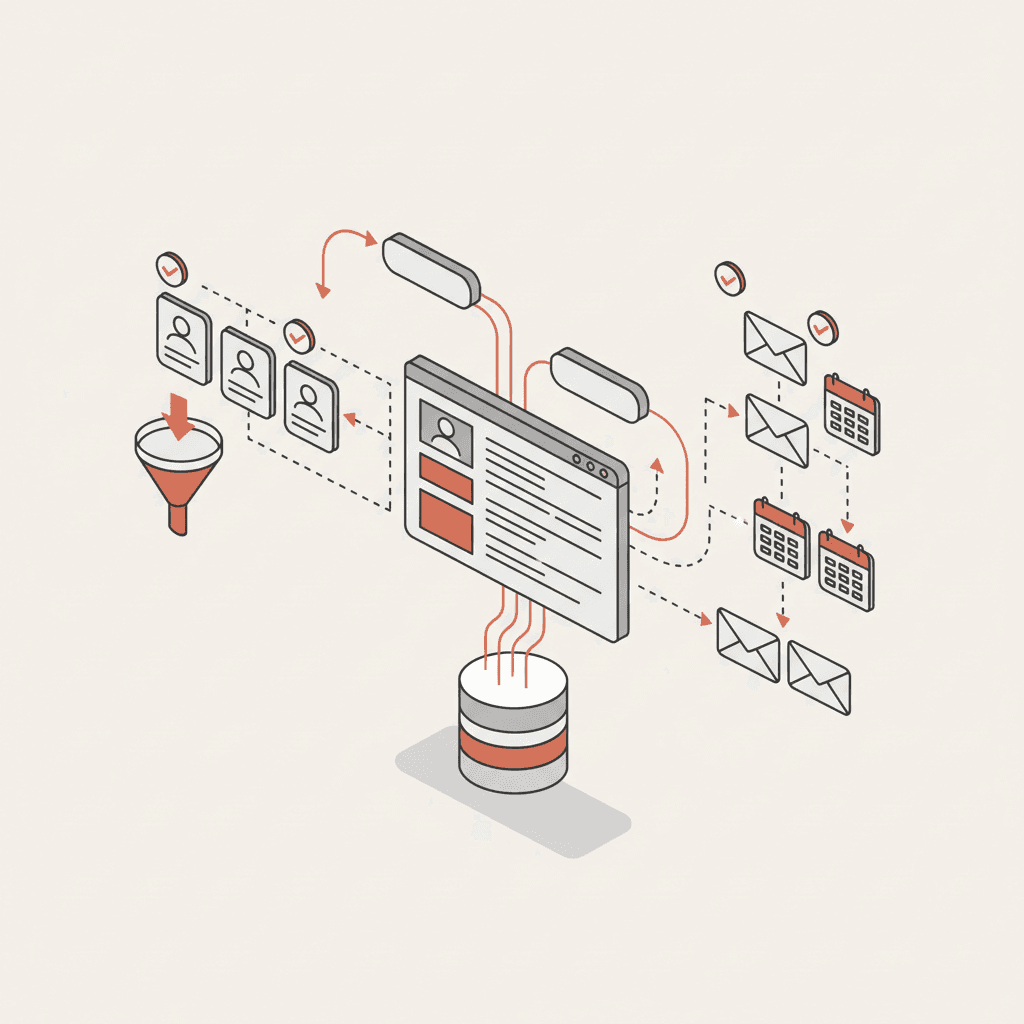
Marketing automation in a higher education context means using software to send the right message to the right prospect at the right moment — without your admissions team doing it manually. That covers everything from a welcome email triggered by a prospectus download, to a re-engagement sequence three months after a prospect went quiet, to an SMS reminder the evening before an open day.
The business case is unambiguous. The average cost to recruit one enrolled student in the UK runs between £2,400 and £3,200 (Source: estimates based on public data, EAIE, StudyPortals, EAB. Indicative ranges.). Every step of the funnel you can systematise — without sacrificing personalisation — pulls that number down. Institutions that automated their prospect follow-up sequences recorded a median +62% increase in qualified enquiries per month and a 280% ROI over 12 months (Source: median results across 18 institutions, including concurrent funnel optimisations. Period 2024–2025, Skolbot.)
UK higher education has particular requirements that generic automation platforms often underestimate: UCAS cycle timing, ICO guidance on email marketing and consent, Clearing week volume spikes, and the need to reach students across a nine-to-eighteen-month decision window. The tools in this comparison have all been evaluated against those specific demands.
For a broader view of the digital acquisition ecosystem, see our digital marketing guide for higher education.
Key criteria for choosing a marketing automation platform
Before looking at individual tools, these are the criteria that matter most for UK institutions — and where many procurement decisions go wrong.
UK GDPR and ICO compliance: Under UK GDPR, marketing to prospective students requires a valid lawful basis — typically consent — plus a clear record of when and how that consent was obtained. Any platform you choose must support consent management, preference centres, and suppression lists. The ICO's direct marketing guidance sets out specific requirements around soft opt-in and consent records. Non-compliance carries fines of up to £17.5 million or 4% of global turnover under the UK GDPR regime enforced by the ICO.
UCAS cycle alignment: Automation that cannot be configured around UCAS deadlines, Clearing windows, and Confirmation periods is automation that will misfire at the worst possible moments. Your platform needs flexible scheduling, suppression during specific date ranges, and the ability to trigger sequences based on UCAS status updates if you have API access.
Deliverability: A platform with poor sender reputation means your emails land in spam — precisely the scenario that kills Clearing response rates. Look for published deliverability benchmarks, dedicated IP options, and a UK or EEA data centre for UK GDPR alignment.
CRM integration depth: Automation only works if contact data flows cleanly between your CRM, your student records system, and your automation platform. One-way syncs and daily batch updates are not sufficient for time-sensitive sequences. See our CRM comparison for higher education for detail on which platforms integrate with which automation tools.
Lead scoring and segmentation: Sending the same sequence to a prospective undergraduate who browsed two pages and a postgraduate who attended a virtual open day is a wasted opportunity. Your automation platform should support behavioural scoring — and ideally update scores in real time rather than overnight.
Reporting and attribution: Without clear reporting on open rates, click rates, application submissions, and enrolment by sequence, you cannot justify renewal budgets or optimise underperforming sequences. Look for dashboards that connect email engagement to downstream outcomes. Our article on marketing attribution for higher education explains why last-click dashboards routinely undervalue your automation investment.
Comparison table
| Platform | Best for | UK GDPR ready | Automation depth | Indicative cost | HE-specific features |
|---|---|---|---|---|---|
| HubSpot Marketing Hub | Inbound-led institutions, mid to large | Yes (EEA data centres) | High | From £45/month (Starter) | Extensive; education templates available |
| Brevo | Budget-conscious institutions, European focus | Yes (EU-based) | Medium–High | Free tier; from £19/month (Starter) | Contact volume-based pricing suits seasonal spikes |
| Slate (Technolutions) | Admissions-heavy universities | Yes (configurable) | Medium | Custom pricing | Native admissions workflow; UCAS integration |
| ActiveCampaign | Nurturing sequence depth, mid-sized institutions | Yes (EU data residency option) | Very High | From £29/month (Plus) | Strong conditional logic; no native HE templates |
| Dotdigital | UK-first institutions prioritising deliverability | Yes (UK-based) | High | Custom (typically £800–£3,000/month) | HE client base; dedicated account management |
| Salesforce Marketing Cloud | Large universities, multi-campus operations | Yes (with configuration) | Highest | From £1,250/month (Growth) | Deepest integration; steepest learning curve |
Detailed tool reviews
HubSpot Marketing Hub
HubSpot is the most widely used marketing automation platform among UK private schools and mid-sized universities for a reason: its all-in-one structure means your CRM, email automation, landing pages, and reporting live in the same system. There is no integration tax — data flows without custom connectors.
For higher education specifically, HubSpot's Workflows tool supports the behavioural triggers that matter: prospectus downloaded, open day registered, programme page visited three times in seven days. You can build the full UCAS-cycle nurturing sequence — welcome, post-open day, pre-deadline, Clearing — without leaving the platform.
On UK GDPR: HubSpot maintains EEA-based data centres and provides a Data Processing Agreement as standard. Its consent management tools log opt-in timestamps and source, which satisfies ICO audit requirements. HubSpot's dedicated education resources also include pre-built templates for higher education use cases.
Where it falls short: HubSpot is not purpose-built for admissions. UCAS application status tracking requires either a manual workaround or a custom API connection. Institutions that process large volumes of UCAS applications typically pair HubSpot with Slate rather than replacing Slate entirely.
Best for: institutions with an active inbound marketing strategy — content, SEO, paid social — where the CRM and marketing platform need to be one system.
Brevo
Brevo (formerly Sendinblue) is the European platform that punches significantly above its price point. Unlike most US-based competitors, Brevo's pricing is based on email volume rather than contact count — which suits higher education perfectly, where prospect databases can be large but active sending periods are seasonal.
Its automation builder supports multi-step sequences with conditional branching, behavioural triggers, and A/B testing. Deliverability is a genuine strength: Brevo's transactional infrastructure means it handles volume spikes — Clearing week, deadline reminders — without inbox placement degrading.
On UK GDPR: Brevo is headquartered in Paris and processes data within the EU, which is compatible with UK data transfer requirements under the adequacy decision framework. Its consent management tools meet ICO standards, though the interface is less polished than HubSpot's.
Where it falls short: Brevo's native CRM is lightweight. For institutions that need deep CRM functionality alongside automation, Brevo works best as the email engine connected to Slate, Salesforce, or another CRM via Zapier or native integration.
Best for: institutions with limited budgets that need solid deliverability and automation without paying for features they will not use.
Slate (Technolutions)
Slate is not primarily a marketing automation platform — it is an admissions CRM with automation capabilities built in. That distinction matters. Where HubSpot or ActiveCampaign excel at prospect nurturing across long decision cycles, Slate excels at managing the application process itself: tracking UCAS submissions, coordinating interview scheduling, managing offers and deferrals.
The automation that comes built into Slate covers admissions communications well: application acknowledgements, decision letters, condition-clearing reminders. For institutions that need a single system managing the full admissions workflow, nothing else matches it.
On UK GDPR: Slate's data residency options have expanded since 2024. UK institutions can now configure Slate to store data within the UK or EEA, which addresses the ICO's data transfer requirements. JISC's guidance on higher education technology infrastructure lists Slate among the platforms with UK-appropriate data processing agreements.
Where it falls short: Slate is not designed for pre-enquiry marketing. Awareness-stage nurturing — email sequences to prospectus downloaders who have not yet applied — requires either significant Slate customisation or a separate marketing automation tool.
Best for: universities processing large UCAS volumes that want admissions automation and a system-of-record for applications. Often paired with a dedicated marketing automation platform for top-of-funnel.
ActiveCampaign
ActiveCampaign has the most sophisticated automation builder of any platform at its price point. Its visual workflow editor supports conditional logic that other platforms treat as enterprise-only features: if a prospect opens email 2 but does not click, wait 48 hours, then send a variant; if they click, move them to the Clearing sequence; if their lead score crosses 75, notify the admissions adviser. That granularity matters for institutions running multiple concurrent sequence types.
Its CRM is more capable than Brevo's — contact scoring, deal pipelines, and task automation are all included. For email nurturing strategy, see our detailed guide to email nurturing for student prospects — ActiveCampaign can implement every sequence described there out of the box.
On UK GDPR: ActiveCampaign offers an EU data residency option (Frankfurt data centre) and provides a GDPR-compliant DPA. Its unsubscribe and consent management tools meet ICO requirements, including one-click unsubscribe — now mandatory under Google's bulk sender rules.
Where it falls short: ActiveCampaign does not have native UCAS integration, and its reporting, while detailed, is less intuitive than HubSpot's. Institutions that need executive-ready dashboards often find the interface requires more configuration than expected.
Best for: mid-sized institutions that want deep nurturing automation and are willing to invest time in configuration to get it exactly right.
Dotdigital
Dotdigital is the only major marketing automation platform headquartered in the UK, and that provenance is not just a flag-waving point — it means their data processing, support team, and product roadmap are shaped by UK regulatory requirements from the start. Several UK universities and conservatoires are long-standing clients, and the platform's deliverability infrastructure is specifically tuned for UK inbox providers.
Its automation features cover the standard higher education use cases: behavioural triggers, multi-step sequences, SMS integration, and an A/B testing engine. The platform's WinstonAI layer (introduced 2024) adds subject line optimisation and send-time personalisation based on individual engagement history — useful for improving open rates across Clearing week sends.
On UK GDPR: as a UK-based processor, Dotdigital's data handling is directly subject to ICO jurisdiction. DPAs are standard and UK-specific, which simplifies the procurement compliance process for institutions that need sign-off from their DPO before going live.
Where it falls short: Dotdigital's pricing is enterprise-oriented. Monthly contracts start significantly higher than Brevo or ActiveCampaign, and the sales process is account-managed rather than self-serve. For smaller institutions or those with tight marketing budgets, it may be disproportionate.
Best for: UK universities and private schools for whom UK data residency and dedicated UK-based support are non-negotiable.
Salesforce Marketing Cloud
Salesforce Marketing Cloud is the most powerful platform in this comparison — and the most complex. Its Journey Builder tool can model prospect journeys of any length and complexity: multi-year postgraduate recruitment, international student campaigns across fifteen markets, or coordinated communications spanning marketing, admissions, and student services.
For large Russell Group universities and multi-campus institutions already running Salesforce CRM or Salesforce Education Cloud, Marketing Cloud is the natural extension. The data model is unified: a single prospect record holds every interaction, score, and sequence membership without manual syncing.
On UK GDPR: Salesforce has invested heavily in its data residency options since 2023. UK institutions can configure Marketing Cloud to keep data within the UK, and Salesforce's DPA covers UK GDPR explicitly. The compliance architecture is robust — but configuring it correctly requires either an experienced Salesforce administrator or a specialist implementation partner.
Where it falls short: cost and complexity. Marketing Cloud starts at £1,250/month for the Growth tier and scales quickly with contact volumes, send volumes, and add-on modules. Implementation timelines of six to twelve months are common. For institutions without dedicated Salesforce resource, the learning curve is steep enough to delay ROI by a year.
Best for: large universities and business schools with existing Salesforce infrastructure and dedicated CRM resource.
How to choose based on institution type
Small private school or conservatoire (under 500 annual enquiries): Brevo or ActiveCampaign. Both deliver solid automation at a cost that scales with your contact base. Start with the free or entry tier, build three core sequences — welcome, post-open day, pre-deadline — and add complexity once you have baseline data. If a single person is running admissions, see our guide to the minimal tool stack a solo admissions manager actually needs before layering on a full automation platform.
Mid-sized private university or business school (500–5,000 annual enquiries): HubSpot Marketing Hub Professional or ActiveCampaign Plus. The added investment buys you better reporting, deeper CRM functionality, and the integrations you will need as you add a chatbot layer. HubSpot is easier to onboard; ActiveCampaign offers more automation depth per pound.
Large university or multi-site institution (5,000+ annual enquiries): Salesforce Marketing Cloud if you are already in the Salesforce ecosystem; Dotdigital if you want UK-based support and strong deliverability without the Salesforce complexity. Slate should remain your admissions system of record regardless.
Institutions mid-UCAS cycle who need deliverability confidence for Clearing: Dotdigital. Its UK infrastructure and account management model means you have a named contact available during the highest-pressure week of your recruitment calendar.
Across all institution types, the single most impactful addition to any automation stack is a well-configured AI chatbot that qualifies prospects in real time and pushes structured data into your automation platform. That top-of-funnel qualification step is what determines whether your sequences reach people worth nurturing — or just reach people.