 ChatGPT
 Claude
 Perplexity
 Gemini
 Grok
GrokThe attribution model your marketing team uses directly shapes every budget decision you make. A business school running last-click attribution will systematically overspend on branded search while cutting open day promotions and social campaigns that actually introduce prospective students to the institution. This guide explains the five main attribution models, their limitations in a UK higher education context, and a practical method for choosing the right one for your institution.
Why Last-Click Attribution Distorts Your Budget
Last-click attribution — the default in Google Analytics 4 — assigns 100% of the conversion credit to the final touchpoint before a student submits an application or registers for an open day. It is simple to report, simple to defend in budget meetings, and systematically misleading for institutions with long enrolment cycles.
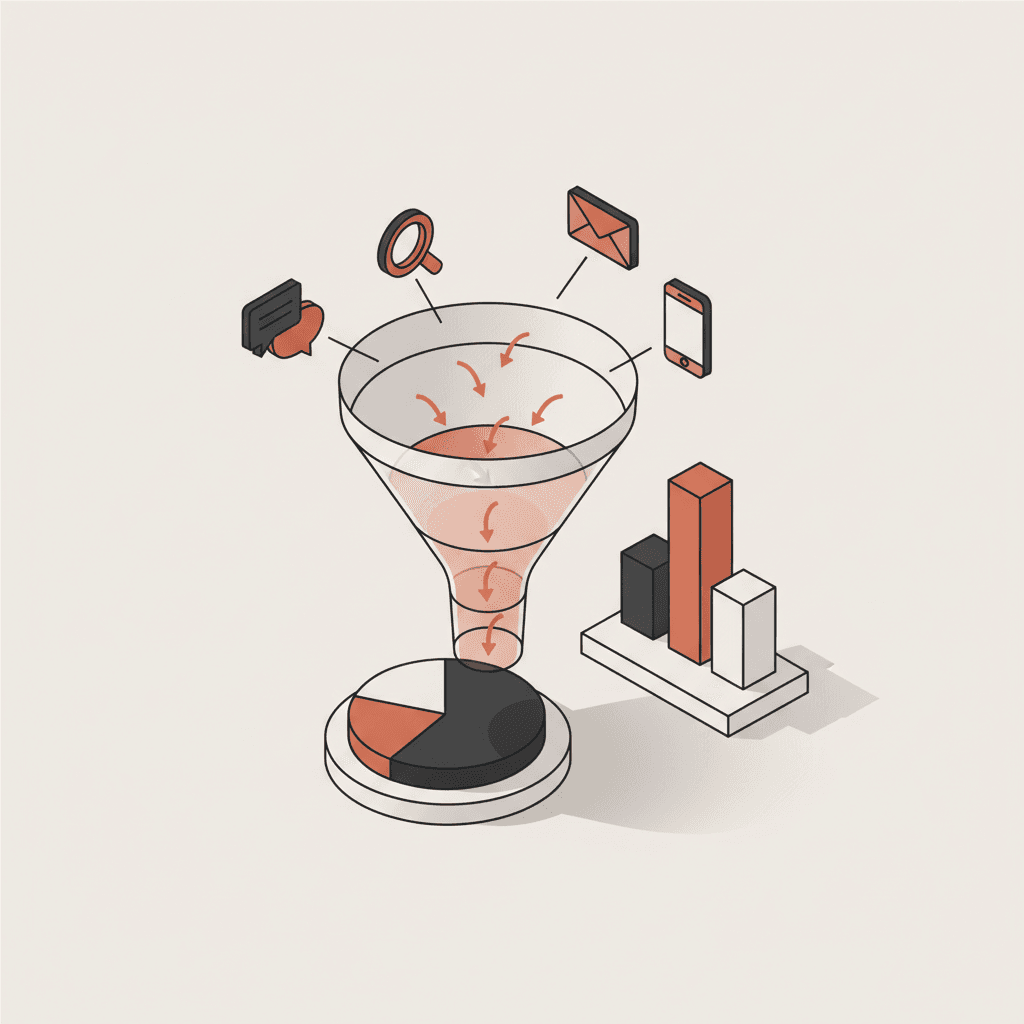
A typical UCAS applicant interacts with an institution across seven to twelve touchpoints over six to eighteen months: a UCAS fair, an Instagram ad, a YouTube video, a website visit, a chatbot conversation, a follow-up email, an open day, and finally the UCAS application itself. Assigning all credit to that final direct visit erases the full picture of what actually drove the decision.
The practical consequence is well-documented: marketing teams that cut social media or events budgets because those channels "don't convert" in their dashboards — while multi-touch analysis consistently shows those channels initiate the majority of student journeys. Multi-touch tracking across 35 partner institutions shows that 18.4% of open day registrations originate from the on-site chatbot — compared to 4.8% for email campaigns and 3.7% for paid social (Source: UTM tracking + multi-touch attribution, academic year 2025–2026, Skolbot). Removing the chatbot because it never captures last-click credit would be a measurement error, not a strategic decision.
For a broader view of acquisition ROI, see our student acquisition ROI guide.
The Five Attribution Models Explained
| Model | Principle | Credit Distribution | Best For | Limitation |
|---|---|---|---|---|
| Last-click | 100% to final touchpoint | Closing channel | Simple reporting | Ignores entire awareness journey |
| First-click | 100% to first touchpoint | Discovery channel | Awareness measurement | Ignores conversion path |
| Linear | Equal credit at every step | All channels | Balanced view | Does not weight importance |
| Time decay | More credit to recent contacts | Near-conversion channels | Short cycles | Undervalues awareness |
| Data-driven | AI-based on actual data | By real contribution | Most accurate | Requires >600 conversions/month |
Last-click and first-click: single-touch models
Single-touch models are the fastest to set up and the easiest to explain in a senior leadership meeting. Their flaw is symmetric: first-click overvalues awareness channels (display, social, fairs), last-click overvalues closing channels (branded search, direct email). Neither captures the complexity of the modern student journey, which spans multiple sessions, devices, and often academic years.
Linear attribution
The linear model distributes equal credit across all touchpoints. Six interactions means each channel receives 16.7% of the credit. An improvement over single-touch, but it treats a two-second banner impression the same as a 40-minute open day visit.
Time decay attribution
The time decay model assigns more credit to interactions closer to conversion. A touchpoint the day before application carries more weight than a fair visited nine months earlier. Well-suited to short cycles like postgraduate diploma programmes or professional short courses. For undergraduate degrees with 12–18 month decision windows, it tends to undervalue the top-of-funnel touchpoints that first established interest.
Data-driven attribution: the recommended standard
GA4's data-driven model analyses all conversion paths to identify which channels actually contributed to the decision — not just which channels appeared in the path. According to Google Analytics documentation, it requires a minimum of 600 conversion events per month and 3,000 associated visits. For universities and larger private colleges, this is the standard to target. Higher Education Marketing notes that institutions using CRM-connected data-driven attribution consistently outperform peers in enrolment efficiency.
Which Attribution Model for Which Institution?
The right choice depends on three variables: application volumes, decision cycle length, and your team's analytical maturity.
| Institution Type | Decision Cycle | Annual Applications | Recommended Model |
|---|---|---|---|
| Russell Group research university | 12–18 months | >5,000 | Data-driven |
| Private business school | 10–16 months | >500 | Data-driven or position-based |
| Specialist arts/design school | 8–12 months | 200–500 | Linear or position-based |
| Further education / HND | 3–6 months | Variable | Time decay |
| Postgraduate taught | 3–8 months | <300 | Time decay or linear |
| MBA / executive education | 1–4 months | <150 | Last-click + first-click combined |
The position-based model: an effective middle ground
The position-based (U-shaped) model assigns 40% credit to the first touchpoint, 40% to the last, and distributes 20% across interactions in between. It acknowledges that both discovery and conversion are critical — without ignoring the middle of the journey. For private institutions with 200–600 applications per year, this is often the best starting point before data volumes justify moving to a full data-driven approach.
Implementation in Four Practical Steps
Step 1: audit your tracking infrastructure
Before changing your attribution model, verify that your underlying data is reliable. GA4 must have clearly defined conversion events: application submission, open day registration, prospectus request, course enquiry. UTM parameters must be applied consistently across all campaigns — Google Ads, Meta, email, and UCAS partnership links. Switching attribution models with inconsistent tracking data merely relocates the errors.
Step 2: connect CRM and analytics
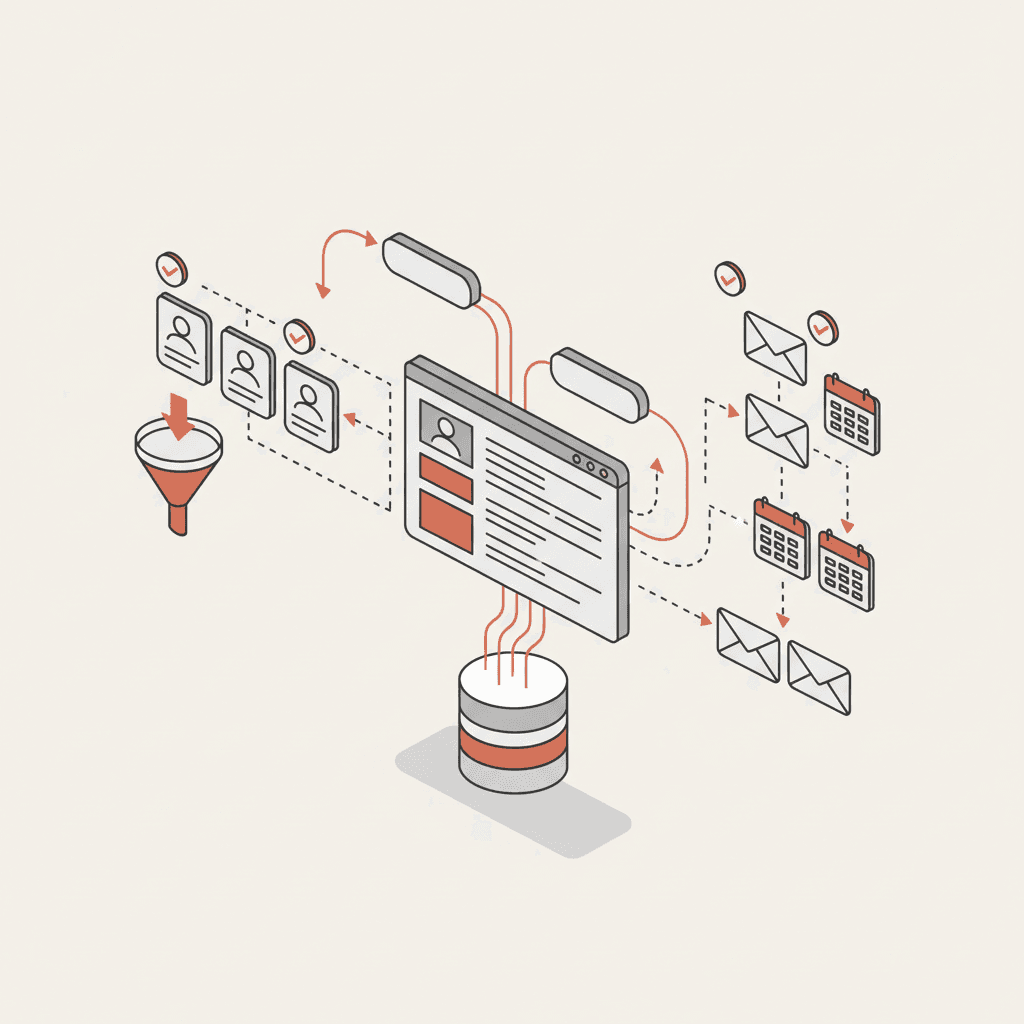
Attribution in silos — GA4 on one side, Salesforce or HubSpot on the other — creates irreconcilable gaps. A student who clicked a LinkedIn ad six months ago and submits via UCAS today typically only appears in your CRM, not in GA4. Connecting the two via shared identifiers (hashed email, user_id) is the prerequisite for cross-channel attribution that reflects reality.
Step 3: define a hierarchy of conversion events
Not all conversions carry equal weight. Distinguishing a prospectus download (low intent) from an open day registration (medium intent) from a completed application (high intent) allows you to apply different attribution logic for different objectives. Many institutions use time decay for open day sign-ups and data-driven for full applications. Review our Google Ads keyword strategy for higher education to align your paid channel measurement with your attribution setup.
Step 4: back-test over three months
Before deploying a new model operationally, run it against the past three months of data and compare what it would have recommended versus what you actually spent. If data-driven would have shifted 25% of budget from branded search to YouTube, check whether that aligns with your qualitative understanding of how students discover your institution. Attribution models are decision aids, not mandates.
Attribution and UK GDPR: Constraints to Plan For
Multi-touch attribution depends on cookies and tracking identifiers. Following the ICO's updated guidance and the phased introduction of the Privacy Sandbox, attribution data has become increasingly incomplete for institutions that cannot achieve high consent rates.
According to the ICO guidance on cookies and similar technologies, analytics cookies require active consent under UK GDPR. In practice:
- Without valid consent, institutions typically lose 30–40% of measurable conversions in GA4
- iOS journeys are underrepresented since Apple's App Tracking Transparency (ATT) framework
- Cross-device conversions — a student browsing on mobile and applying on desktop — are often unattributed
The practical response is to implement Google Consent Mode v2 with modelling enabled, which provides statistical estimates of unconsenented conversions, and to use enhanced conversions in Google Ads to maintain accuracy in paid campaigns even without third-party cookies. See our school landing page conversion guide for related implementation advice.