 ChatGPT
 Claude
 Perplexity
 Gemini
 Grok
GrokWhy this diagnostic is urgent
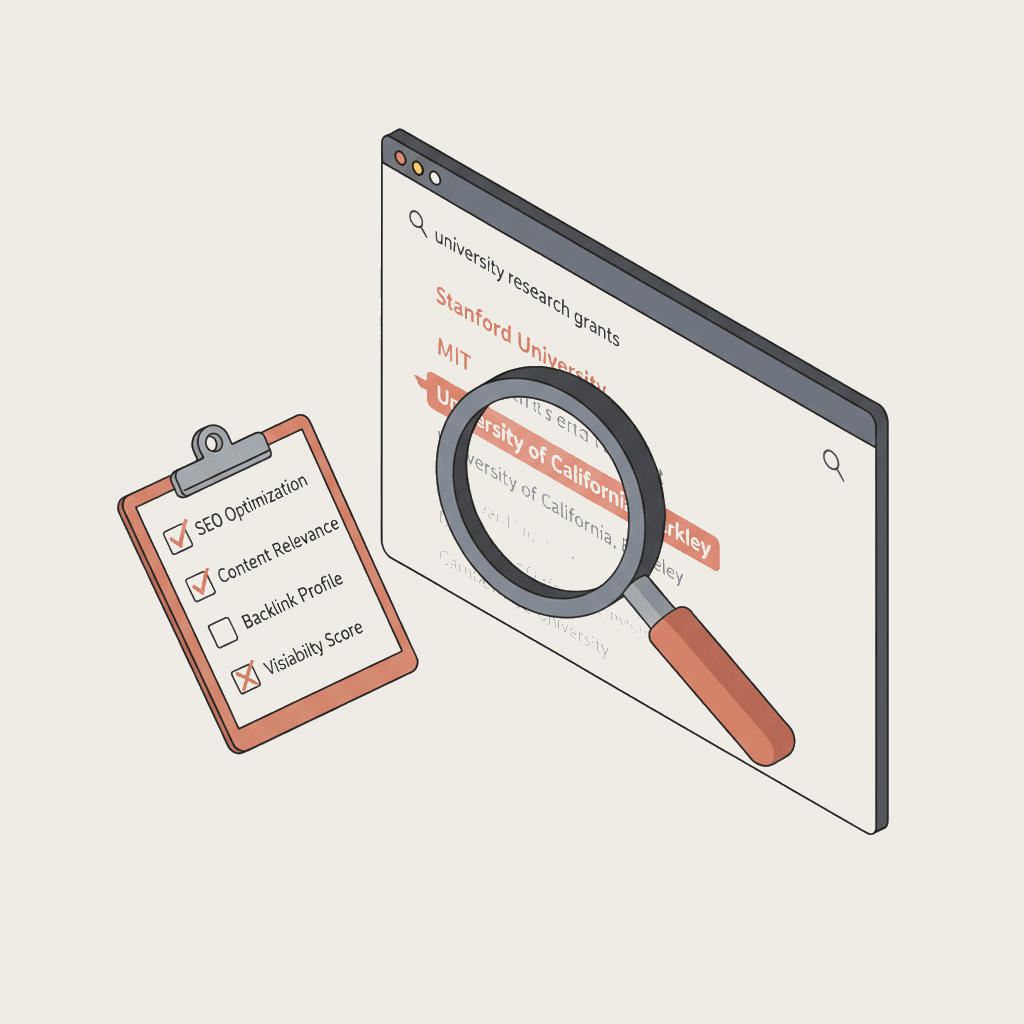
Your future students no longer start their research on Google. In 2026, 41% of 16-to-24-year-olds use an AI engine (ChatGPT, Perplexity, Gemini) as their first point of contact when researching post-secondary education (Source: UCAS/Savanta survey, Jan 2026, 4,200 UK sixth-formers and undergraduates). That figure was 12% in 2024. The shift is underway, and it is fast.
The question is no longer whether AI engines influence student recruitment. It is whether your institution appears in their answers — or whether only your competitors do.
This diagnostic takes 30 minutes, requires no paid tools and produces a prioritised correction plan.
Step 1: Test your branded queries
Branded queries are the most basic: the prospect types your institution's name directly into an AI engine. If the AI does not know you by name, the problem is serious.
The 3 prompts to test
Submit these three prompts to ChatGPT, Perplexity and Gemini (9 tests total):
- "What do you know about [your university]?" — The engine should return: full name, location, degree types, accreditations, general positioning
- "[Your university] student reviews" — The engine should cite student feedback, scores or testimonials
- "[Your university] tuition fees and graduate outcomes" — The engine should provide concrete figures
Scoring grid
For each response, score on 4 points:
| Criterion | 0 points | 1 point |
|---|---|---|
| Institution named correctly | Not mentioned or name wrong | Exact name |
| Information is accurate | Factual errors | Correct data |
| Accreditations cited | Absent | At least one cited |
| Verifiable figures provided | No figures | At least one sourced figure |
Score /12 per engine (3 prompts x 4 criteria). A score below 6 on any engine means your institution is poorly referenced in its corpus. A score of 0 means you are invisible.
Average score observed across 50 institutions tested: 4.2/12 on ChatGPT, 5.8/12 on Perplexity, 3.1/12 on Gemini (Source: Skolbot GEO diagnostic, panel of 50 European institutions, Feb 2026). Russell Group universities average 7.1/12. Post-92 universities average 2.8/12.
Step 2: Test your generic queries
Generic queries are the most strategic. The prospect is not searching for your institution specifically — they are searching for "the best business school in London" or "an MBA with placements." These are the queries where the visibility battle is fought.
The 5 prompts to test
Adapt these prompts to your context (city, discipline, level):
- "What are the best [type of institution] in [city]?" — Example: "What are the best business schools in Manchester?"
- "What course should I study to work in [field]?" — Example: "What course should I study to work in data science?"
- "[Type of institution] with placements in [city/region]" — Example: "Engineering university with placements in the Midlands"
- "Comparison [your university] vs [competitor]" — Example: "Warwick vs Bath"
- "Reviews of [type of course] in the UK for international students" — Example: "Reviews of MBA programmes in the UK for international students"
Scoring grid
For each prompt, score:
| Criterion | Score |
|---|---|
| Your institution is mentioned | 2 points |
| Your institution is in the top 3 recommendations | 1 bonus point |
| Information about your institution is accurate | 1 point |
| A differentiating attribute is cited (accreditation, specialism, price) | 1 point |
Maximum score: 20 points (5 prompts x 4 points). A score below 5 means your institution is absent from AI recommendations for its strategic queries.
Across 50 institutions tested, 72% score 0 on ChatGPT's generic queries — they are simply never mentioned (Source: Skolbot GEO diagnostic, Feb 2026). On Perplexity, that figure drops to 54%, confirming that Perplexity is more permeable to recent content.
Step 3: Audit your structured data
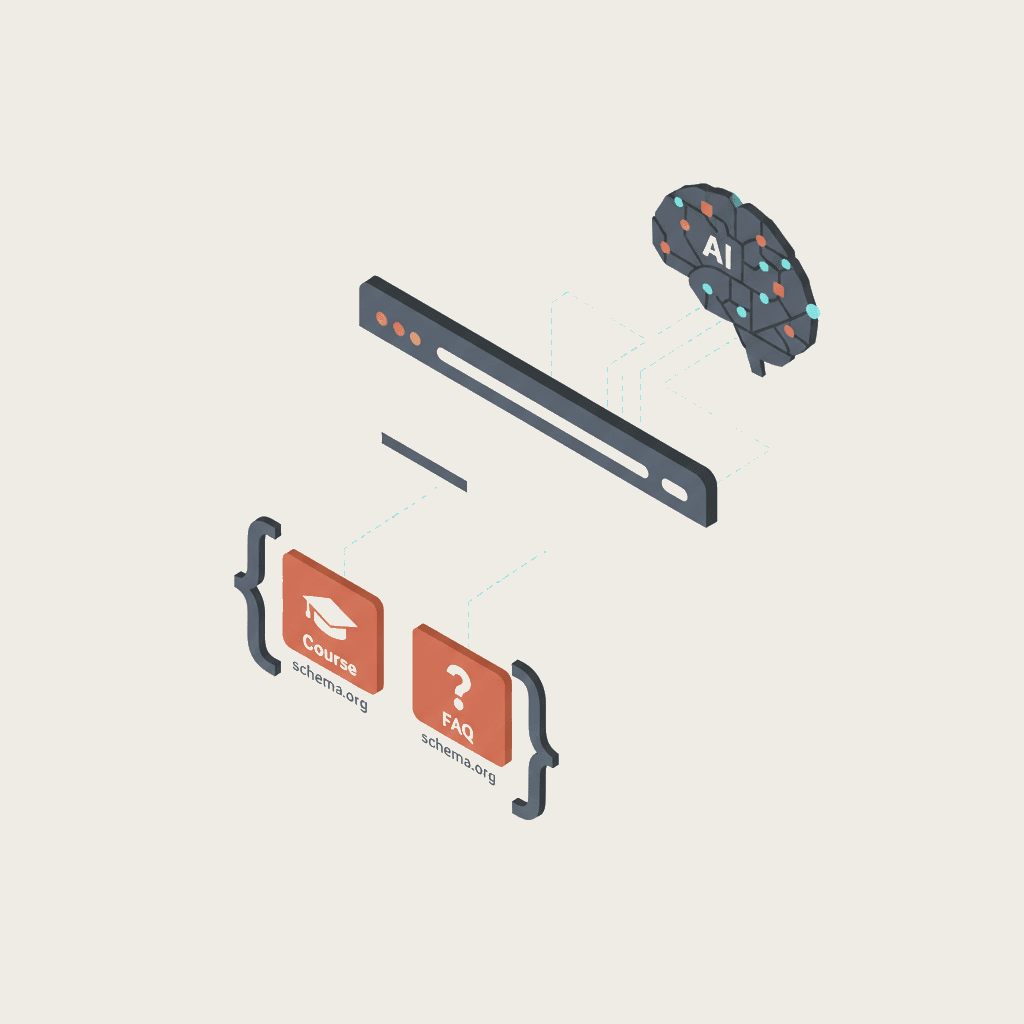
Schema.org structured data is the most actionable technical lever. This step takes 5 minutes per page.
The 3-click test
- Open the Google Rich Results Test
- Enter your homepage URL, then a programme page URL
- Check for the following schemas:
| Schema | Present? | GEO impact |
|---|---|---|
| EducationalOrganization | yes/no | Critical — identifies your institution as an entity |
| Course | yes/no | High — makes each programme citable |
| FAQPage | yes/no | High — provides extractable answers |
| AggregateRating | yes/no | Moderate — verifiable social proof |
If none of these schemas are detected, your site is technically invisible to AI engines. This is the case for 82% of European institutions (Source: Skolbot technical audit, 120 institutions, Jan 2026).
To implement these schemas, our guide to structured data for universities details the process with JSON-LD code examples.
Step 4: Evaluate your verifiable data density
AI engines cite facts, not slogans. This step assesses the richness of verifiable data on your key pages.
The entity-counting method
Open your 5 most visited pages (homepage, main programme page, admissions page, fees page, student life page) and count for each:
- Sourced figures — Employment rate, salary, student numbers, ranking position, with a verifiable source
- Named entities — Accreditations (AACSB, TEF), organisations (OfS, UCAS), rankings (QS, THE), named partners
- Precise dates — 2026 intake, HESA Graduate Outcomes 2025, QS Ranking 2026
Scoring
| Verifiable data per page | Level |
|---|---|
| 0-2 | Critical — content too generic for AI |
| 3-5 | Insufficient — some signals but not enough |
| 6-10 | Adequate — exploitable base for AI engines |
| 10+ | Excellent — high density, strong citation probability |
The observed median is 2.3 verifiable data points per page across European university websites (Source: Skolbot semantic analysis, 800 pages from 120 institutions, Feb 2026). The top 10 GEO institutions show a median of 8.7 verifiable data points per page.
The gap is considerable. It alone explains why some institutions are systematically cited while others are systematically ignored.
Step 5: Map your external mentions
AI engines cross-reference sources. The more your institution is mentioned on trusted third-party sites, the more it is considered notable and reliable.
The 12-source checklist
Check whether your institution is listed (with current information) on each of these sites:
| Source | Type | Verified? |
|---|---|---|
| UCAS | Institutional | yes/no |
| OfS | Regulatory | yes/no |
| HESA | Statistical | yes/no |
| QS World University Rankings | Ranking | yes/no |
| THE World University Rankings | Ranking | yes/no |
| Complete University Guide | Ranking | yes/no |
| WhatUni | Review platform | yes/no |
| StudyPortals | International directory | yes/no |
| Google Business Profile | Local | yes/no |
| Wikipedia (dedicated article) | Encyclopaedia | yes/no |
| LinkedIn (institution page) | Professional network | yes/no |
| AACSB / EQUIS / TEF | Accreditation | yes/no |
Scoring
| Sources confirmed | Level |
|---|---|
| 0-3 | Critical — minimal visibility |
| 4-6 | Insufficient — efforts needed |
| 7-9 | Adequate — solid base |
| 10-12 | Excellent — high AI trust profile |
Institutions present on 7+ third-party sources are 3.2x more likely to be cited by an AI engine than those on 3 or fewer (Source: Skolbot GEO correlation analysis, 120 institutions, Feb 2026).
Diagnostic summary: your overall score
Add your scores across the 5 steps to get your AI visibility profile:
| Step | Max score | Your score |
|---|---|---|
| 1. Branded queries | 12 | __ /12 |
| 2. Generic queries | 20 | __ /20 |
| 3. Structured data | 4 schemas | __ /4 |
| 4. Data density | 10+ per page | __ (median) |
| 5. External mentions | 12 sources | __ /12 |
Interpretation
- Profile A (high scores throughout) — Well positioned. Maintain freshness and monitor quarterly
- Profile B (strong on brand, weak on generic) — The AI knows you but does not recommend you. Work on structured content and verifiable data
- Profile C (low throughout except mentions) — Your reputation exists but your site does not reflect it. Priority: Schema.org
- Profile D (low throughout) — Full overhaul needed. The plan below is your roadmap
Prioritised correction plan
Priority 1 — Week 1: the technical foundation
Implement Schema.org (EducationalOrganization, Course, FAQPage) on your key pages. A developer can do this in 3 to 5 days.
Priority 2 — Week 2: content enrichment
Add verifiable data to your 5 most visited pages: sourced employment rate, median salary, named accreditations. Target: 8+ verifiable data points per page.
Priority 3 — Week 3: structured FAQs
Create marked-up FAQs on your admissions and programme pages. Answer the most common questions prospects ask.
Priority 4 — Weeks 4-8: external mentions
Update your listings on UCAS, OfS, HESA, QS, THE. Complete your Google Business Profile and encourage student reviews.
Priority 5 — Ongoing: freshness
Quarterly update of programme pages. Two blog posts per month minimum.
For a deep understanding of GEO strategy in higher education, our complete GEO guide for universities covers the 5 pillars of AI visibility. Once the diagnosis is done, structure your response with our 90-day action plan to get cited by ChatGPT and Perplexity.
Book a demo Explore more strategies for AI visibility in higher education