 ChatGPT
 Claude
 Perplexity
 Gemini
 Grok
GrokWhy Parents Are the Real Decision-Makers in Private Higher Education
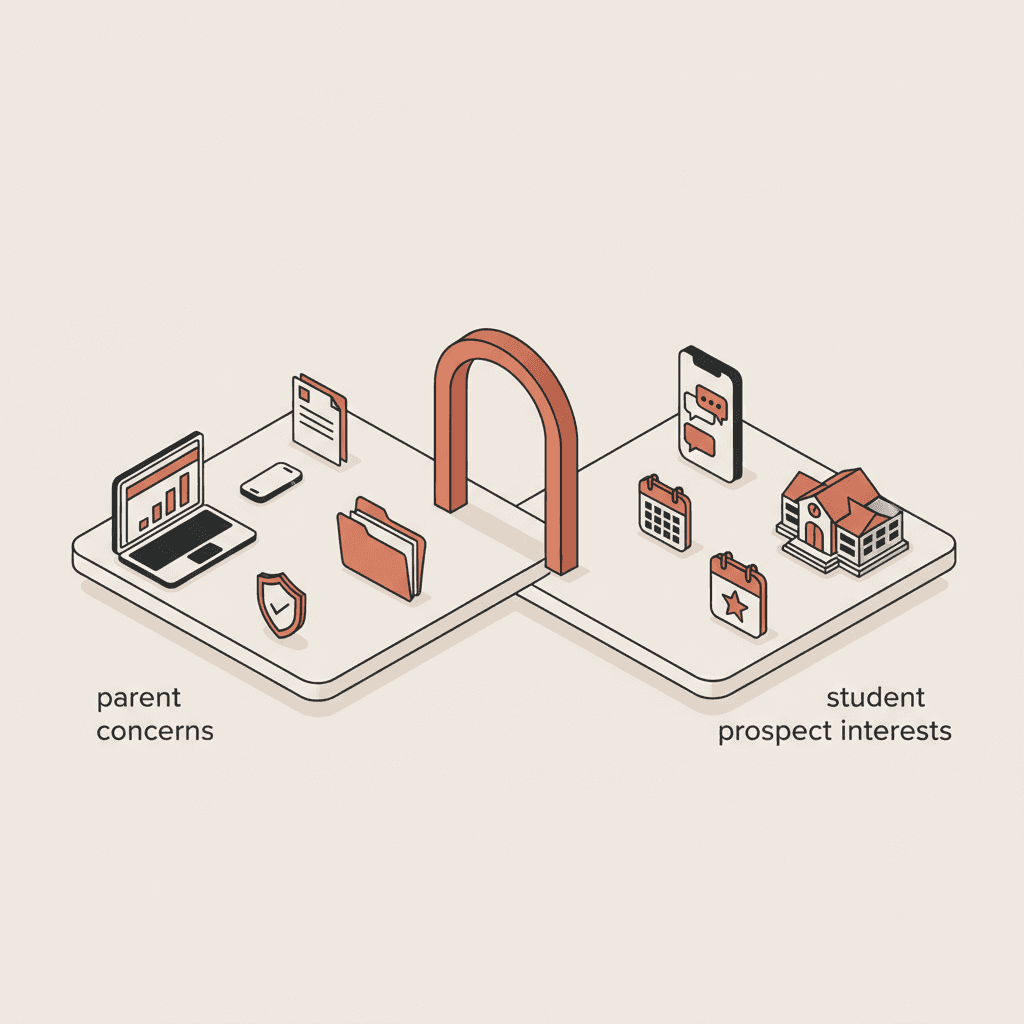
Parents are not bystanders in the UK university selection process — they are co-authors of it. Research across the sector consistently shows that 60 to 70% of undergraduate enrolment decisions involve active parental input, and at private institutions, where annual fees regularly exceed £12,000, that figure climbs higher still. Yet the majority of UK higher education websites are built almost entirely for the prospective student, leaving parents to navigate content designed for a 17-year-old and draw their own conclusions.
The practical consequence is a conversion leak. A sixth-former may be enthusiastic about your institution, but if their parent cannot find the Graduate Outcomes data, the Office for Students registration status, or a plain-English explanation of what the tuition fee actually covers, their support is conditional at best.
Understanding what parents look for — and building content that addresses it directly — is one of the highest-return changes an admissions director can make to a digital recruitment strategy. This article sets out what that content looks like and where it should live.
For the broader picture of how parents and students differ as distinct audiences, see Parents vs Students: Two Journeys, Two Strategies for Schools.
What Parents Actually Check Before Giving the Green Light
Parents prioritise a specific set of information categories, in a broadly consistent order. They are running a financial and reputational risk assessment. They want to know whether the institution is legitimate, whether the degree will translate into employment, and whether the total cost is manageable. Every other concern is secondary to these three.
The table below maps the most common parent concerns to the content type that addresses each one most effectively.
| Parent concern | What they actually want to see | Recommended content type |
|---|---|---|
| Value for money | Fees, contact hours, staff-to-student ratio | Fees page with itemised breakdown |
| Graduate outcomes | Employment rate and median salary at 15 months | HESA Graduate Outcomes data, prominently displayed |
| Institutional legitimacy | OfS registration, degree-awarding powers | "About" page and admissions page badge |
| Teaching quality | TEF rating with plain-English explanation | Homepage and course pages |
| Student satisfaction | NSS scores by category | Dedicated quality page or transparency report |
| Accreditation | QAA review outcome, PSRB accreditation | Course pages and "About" section |
| UCAS process | Tariff points, deadlines, offer conditions | Dedicated "How to apply" section |
| Financial support | Scholarships, bursaries, Student Finance eligibility | Fees page and a standalone funding page |
| Safety and welfare | Student support services, counselling, mental health provision | Student life section |
| Reputation signals | Guardian University Guide ranking, Russell Group status | Homepage and programme pages |
89% of prospects ask about tuition fees before anything else in the research process (Source: Skolbot analysis of 12,000 chatbot conversations, 2025–2026). Parents ask this question too — but they follow it immediately with a second question students rarely ask: "and what exactly does that fee include?" The difference matters. A student wants a number; a parent wants a justification.
The Financial Content That Removes Hesitation
Cost is the primary filter parents apply when building a shortlist. The current undergraduate tuition fee cap of £9,250 per year in England is well-known, but private institutions and specialist colleges operate outside this cap — and parents comparing options across the sector need to understand why one institution charges £13,500 while another charges £9,250 without concluding that the former is simply more expensive.
The financial content that converts parental scepticism into support has four components.
A transparent fees page. The fee itself is table stakes. What parents want alongside it is a breakdown: what does the fee cover in terms of contact hours, library resources, careers support, and digital access? Institutions that publish this breakdown consistently report higher parental satisfaction at open days, because parents arrive having already answered their own question.
Graduate salary data. The HESA Graduate Outcomes survey publishes employment rates and median salaries at 15 months post-graduation, broken down by institution and subject. A parent who can see that 87% of your graduates are in skilled employment or further study within 15 months — with a median salary figure to accompany it — can complete the ROI calculation they have been trying to run since they first heard your institution's name. Publishing this data prominently is the single most effective thing a private college can do to address parental financial anxiety.
Scholarship and bursary information. Half of prospective students explicitly ask about funding options. Parents ask at an even higher rate, because they are thinking about the total cost across three or four years and looking for mechanisms to reduce it. Student Finance England eligibility, institutional scholarships, and any means-tested bursaries should all appear on the same page as the fee — not behind a separate tab or a brochure download.
Total cost of study. Tuition is one line in the calculation. Accommodation, transport, and living costs complete it. Publishing a realistic "total annual cost" estimate — drawing on UCAS national benchmarks and your own accommodation rates — removes the ambiguity that otherwise leaves parents assuming the worst. An institution in a lower-cost city outside London can make a compelling case here; one that never publishes the data cannot.
Quality Signals: Accreditation and Graduate Outcomes
After cost, legitimacy. Parents unfamiliar with a particular institution need external validation before they will support an application. In the UK, the primary quality architecture consists of four interconnected systems that parents recognise increasingly well.
The Teaching Excellence Framework (TEF), administered by the Office for Students, provides a government-validated rating — Gold, Silver, or Bronze — that gives parents a shortcut for assessing teaching quality. A TEF Gold rating carries more weight with a parent who has never engaged with your institution than any marketing copy you could write. Display it on your homepage, explain what it means in one sentence ("assessed by an independent panel against national standards for teaching quality, student outcomes and learning environment"), and link to the official OfS source.
The National Student Survey (NSS) captures current student satisfaction across eight categories: teaching, learning opportunities, assessment, academic support, organisation, learning resources, student voice, and mental wellbeing support. Publishing your NSS scores — even if they are not sector-leading in every category — signals transparency that parents respond to positively. An institution that highlights strong NSS scores in academic support and learning resources is telling a parent: "our students are looked after."
QAA quality review outcomes confirm that your academic standards and quality assurance meet national expectations. For private and alternative providers, QAA review status is particularly important because it is the signal that bridges the gap left by Russell Group membership. If your institution holds a QAA review outcome of "meets UK expectations", say so clearly and link to the published report.
Professional, Statutory and Regulatory Body (PSRB) accreditation matters most at programme level. AMBA or EQUIS accreditation for a business school, IET accreditation for an engineering degree, BPS recognition for psychology: these are signals parents understand and cite to each other. They belong on every relevant programme page, not just the "About" section.
The JISC digital experience tracker data adds one further layer: parents are beginning to ask about digital learning infrastructure. An institution that publishes its virtual learning environment provision, digital library access, and online support availability is addressing a question that will become standard within two years.
Human Evidence: Alumni Stories and Open Days
Data persuades parents intellectually. Alumni stories persuade them emotionally. Both are required.
A parent reading a case study from a graduate who joined a firm they recognise, or who went on to a postgraduate degree at a university they respect, is receiving the same ROI signal as a Graduate Outcomes percentage — but in a form that sticks. The most effective alumni content for parents follows a simple structure: where the student started, what the programme gave them, where they are now, and what they would say to a parent considering the same investment.
Three elements make alumni content credible to parents specifically:
- A named graduate (anonymous testimonials carry no weight)
- A specific employer or institution named in the outcome
- A timeframe — "three years after graduating"
Open days serve a dual function. For students, they are an experience of the campus and the community. For parents, they are a due diligence exercise. The parents who attend open days are checking whether the institution matches the impression its website created. The admissions presentations that convert parents most effectively spend time on Graduate Outcomes data, financial support options, the progression from undergraduate degree to career, and the pastoral care available to students — not on the history of the institution or the architecture of the campus.
A dedicated "For Parents" session within the open day programme, with a named contact from admissions available to answer individual questions, consistently generates the highest conversion rate of any single open day element.
91% of website visitors leave without making contact (Source: Skolbot funnel analysis, 30 institutions, 2025–2026 cohort). The open day is one of the few moments where a parent has already committed enough engagement to stay. That moment deserves specific preparation.
Making Your Content Reachable for Parents
Publishing the right content is only half the problem. Parents need to find it without navigating through student-facing pages that were not built for them.
The structural solution is a dedicated "For Parents" section — accessible directly from the main navigation, not buried three clicks deep. This section should aggregate, in one place: OfS registration status, TEF rating with explanation, Graduate Outcomes data, NSS scores, UCAS process overview, funding and Student Finance summary, and a named admissions contact. No parent should have to guess where to find these pages.
67% of prospect activity happens outside office hours (Source: Skolbot interaction logs, 200,000 sessions, Oct 2025 – Feb 2026). This figure applies to students, but parents research during working hours — which means your admissions team is more likely to be available when parents are active. However, the Sunday evening research window, when a parent sits with their child to review shortlisted institutions, is precisely the moment your website needs to answer questions without human intervention.
An AI chatbot configured to recognise parental questions — TEF ratings, Graduate Outcomes percentages, fee breakdowns, OfS registration status — and route them to the correct content can cover this gap. The chatbot does not replace your admissions team for complex conversations; it ensures that a parent researching at 9 pm on a Sunday does not leave your site with unanswered questions.
The content strategy that addresses parental concerns most efficiently across the full recruitment cycle covers five page types:
- A fees and funding page with full breakdown and scholarship details
- A dedicated "Our results" or "Graduate Outcomes" page citing HESA data directly
- A quality and accreditation page covering TEF, NSS, QAA, and PSRB status
- A "How to apply" page that addresses the UCAS cycle step by step
- A "For Parents" hub linking to all of the above
For the full analysis of the questions that trigger the most parental engagement, see The 15 Questions Every Prospect Asks Before Enrolling and What Gen Z Expects from a School Website.
Reputation is also a factor that parents investigate through channels your admissions team cannot directly control. For the role of Google reviews and third-party reputation signals in parental decision-making, see Google Reviews, School Reputation and Student Recruitment.