 ChatGPT
 Claude
 Perplexity
 Gemini
 Grok
GrokEvery admissions director building a 2027 entry budget faces the same problem: a fixed pot of money, three levers — Open Days, digital marketing, and AI chatbot infrastructure — and no shared formula for splitting it. Most institutions allocate by habit, protecting last year's events budget and treating digital as the variable. That ordering is backwards for most UK institutions in 2026.
This article sets out a decision framework tied to institution size and the UCAS calendar, so the split reflects where your funnel leaks rather than where the budget lived last year, drawing on HubSpot Research's marketing benchmarking data alongside UK sector reporting. For the broader channel strategy this framework sits inside, see our digital marketing guide for higher education.
How the three levers actually interact
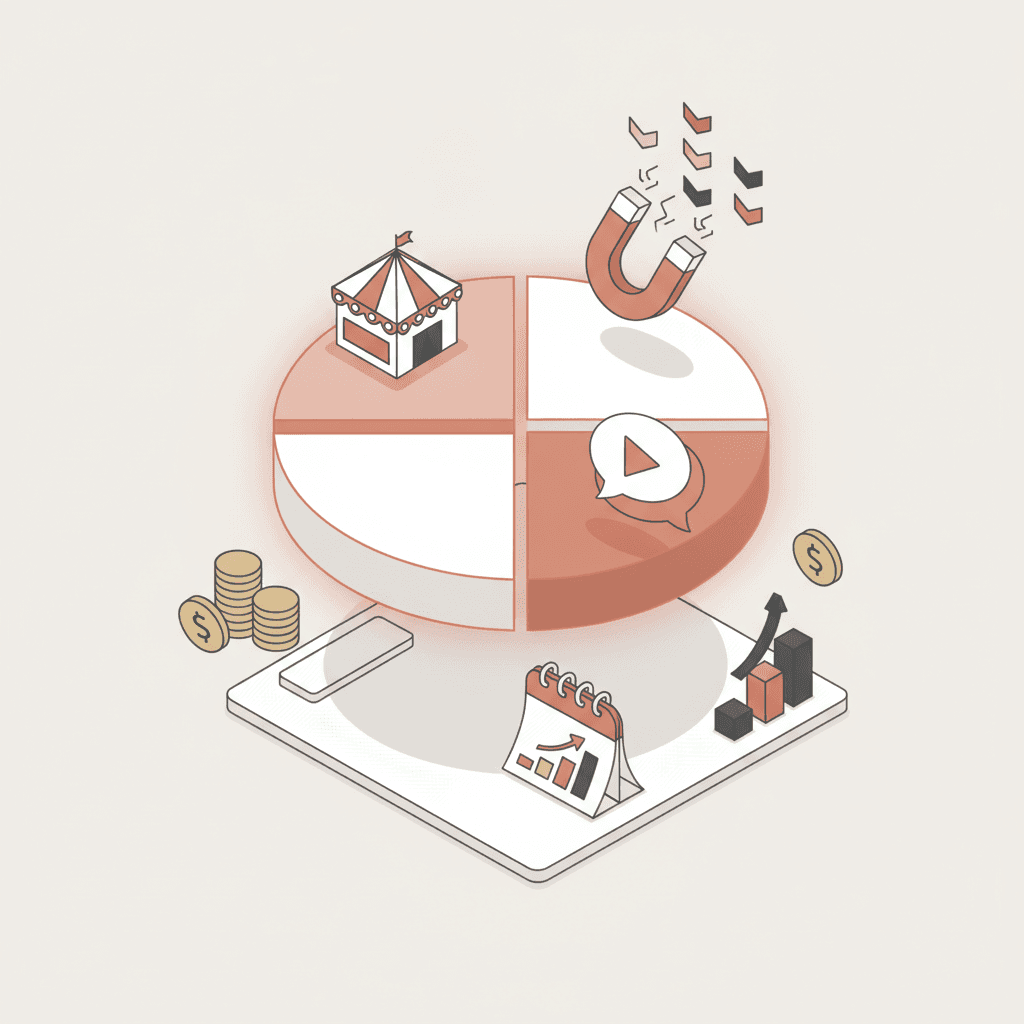
Open Days, digital marketing and chatbot infrastructure are not competing budget lines — they are sequential stages of the same funnel. Treating them as rivals produces the most common budgeting error in UK admissions: overspending on the stage that already converts well while starving the one that leaks prospects fastest.
Digital marketing generates and captures demand. Open Days convert that demand into applicants once prospects set foot on campus. Chatbot infrastructure sits between the two, catching prospects who visit the website or ask a question but never reach a form or an open day. Digital channels now account for roughly 72% of UK university marketing spend, up from around 42% in 2020 — leaving many teams with a large paid-search line and no allocation for the conversational layer connecting the two (Source: Whitehat SEO higher education marketing benchmarks).
An institution that pours money into paid search but sends that traffic to a static programme page with a contact form is buying expensive clicks that convert poorly. Open day registration rates vary sharply by acquisition channel — 18.4% for a website chatbot versus 6.2% for a contact form and 4.8% for an email campaign (Source: UTM tracking and multi-touch attribution, 2025–2026 season, 35 institutions). Paid social converts at 3.7% and organic social at 2.1%, while self-reported word-of-mouth sits at 12.6% — useful context, but not a channel you can budget against directly. The chatbot line is frequently the single highest-converting step in the whole funnel, not a nice-to-have outside the digital budget.
Open Days: the highest-converting but most expensive lever
Open Days remain the highest-converting single touchpoint in UK student recruitment, but also the most expensive per prospect reached — reason to give them a defined budget share rather than whatever remains after digital spend is set.
UCAS reports that most applicants attend an open day as part of their decision-making, and in-person events convert attendees to enrolled students at an estimated 15–20%, against roughly 8–12% for virtual open days (Source: UCAS — university open days). Virtual formats cost an estimated 60–70% less to produce and reach a wider audience, making them a complement rather than a replacement.
Timing matters as much as spend level. UK Open Day season clusters into two windows: an autumn wave running roughly September through November, ahead of the UCAS equal consideration deadline (13 January 2027, 6pm, per UCAS key dates), and a spring wave in March–April targeting offer-holders deciding between institutions. A single autumn event leaves the spring decision window — when applicants compare firm and insurance offers — uncovered.
Follow-up spend is where most Open Day budgets fall short. Automated email sequences triggered within 24 hours of attendance have been associated with an 18–25% lift in offer acceptance — a return that costs a fraction of the event itself but is routinely left unbudgeted (Source: Whitehat SEO student recruitment marketing analysis). A chatbot that re-engages no-shows and answers post-visit questions closes this gap without adding headcount to admissions.
UCAS exhibition stands are a related but distinct line from an institution's own Open Days, and merit the same qualified-cost-per-lead scrutiny before renewal — our comparison of recruitment-fair and digital cost per lead sets out how to run that calculation.
Digital marketing: where SEO and paid search fit the calendar
Digital marketing should absorb the largest single share of a 2027 budget, but the SEO/paid-search split within it needs to track the UCAS calendar rather than sit spread evenly across twelve months.
UK institutions typically allocate 15–25% of total recruitment budget to SEO and content, generating an estimated 35–45% of enquiries at £15–45 per acquisition — a strong return, but one that takes 6–12 months to build, consistent with Google Search Central's guidance that organic authority compounds over months, not days. Paid search absorbs a larger share during UCAS peak periods, with cost-per-acquisition benchmarks in the £35–120 range (Source: Whitehat SEO university digital marketing channel guide). For a full breakdown of when to weight each channel, see our SEA vs SEO budget arbitrage guide and our channel-by-channel acquisition cost analysis.
Three windows justify concentrated paid spend: the run-up to 13 January, results day and Clearing in August, and the late-spring offer comparison period. Institutions concentrate around 70% of annual digital budget into the September–January window (Source: Whitehat SEO higher education marketing benchmarks). Outside those windows, reducing paid bids and reallocating to content production is the more efficient use of the same pound.
The average cost per enrolled student in UK higher education sits at £2,400–3,200, a fully loaded figure combining direct marketing spend, staff time, events and technology (Source: Estimates based on public data and sector reports — EAIE, StudyPortals, EAB. Indicative ranges). Every improvement in conversion rate — at the landing page, at open day registration, at the chatbot first-contact stage — reduces the paid clicks needed to reach the same cohort, which is why chatbot spend belongs in the same budget conversation as media spend, not filed separately as an "IT tool."
AI chatbot infrastructure: the smallest line with the fastest payback
Chatbot infrastructure is typically the smallest budget line by absolute spend, but it delivers the fastest payback of the three levers — reason enough to ring-fence it rather than treat it as an optional add-on.
Institutions deploying an AI chatbot see qualified leads rise from a median of 120 to 195 per month (+62%), cost per lead fall from £42 to £26 (-38%), and open day registration rates climb from 6.2% to 18.4% — a median 12-month ROI of 280%, with payback typically arriving within 5 months (Source: Median results across 18 schools, including concurrent funnel optimisations, 2024–2025 period). Those figures reflect the combined effect of the chatbot and simultaneous funnel work, not the chatbot alone — a caveat worth stating plainly rather than overselling.
The mechanism is a funnel-leak problem, not a lead-generation problem. Across UK institutions, 91% of website visitors never make first contact with admissions; a deployed AI chatbot reduces that drop-off to 76%, generating 167% more first contacts from the same traffic (Source: Funnel analysis across 30 schools, 2025–2026 cohort). No amount of extra paid search spend fixes a leak that occurs after the click is already paid for — chatbot and paid search budgets should be planned together, not sequentially.
A chatbot also changes what the admissions team spends its time on, not just what prospects experience. Automating the roughly three-quarters of enquiries that are simple, repeatable questions — fees, deadlines, entry requirements — frees admissions staff for the complex cases genuinely requiring a human conversation, rather than replacing it. For the tooling landscape this sits within, see our comparison of marketing automation platforms.
The 2027 budget split by institution maturity
The right split depends more on where an institution sits on the maturity curve — student numbers, digital authority, current chatbot adoption — than on total budget size alone. The framework below is Skolbot's recommendation, not a measured average; use it as a starting point to adjust against your own funnel data.
| Institution stage | Open Days | Digital marketing | Chatbot/AI infrastructure | Typical annual acquisition spend |
|---|---|---|---|---|
| Early-stage (new provider, <500 new enrolments/year) | 35–40% | 50–55% | 5–8% | <£75k |
| Growing (established, expanding programme portfolio) | 30–35% | 50–55% | 10–15% | £75k–£300k |
| Mature (Russell Group / large multi-faculty institution) | 25–30% | 55–60% | 12–18% | £300k+ |
Two rules apply across every stage. Never let the chatbot line fall below roughly 8% of total spend once digital traffic exceeds a few thousand monthly visitors, below which the funnel-leak cost outweighs the tooling cost. And revisit the split annually against your own data rather than carrying last year's ratio forward — a growing institution's digital share should rise as SEO authority compounds, freeing budget for chatbot and event follow-up.
Sequencing spend across the UCAS calendar
Budget spread evenly across twelve months underperforms budget concentrated where UCAS deadlines create demand spikes.
| UCAS calendar moment | Primary lever | Secondary lever |
|---|---|---|
| September–November (autumn Open Days, early applications) | Open Days | Chatbot follow-up + SEO content |
| Mid-October (Oxbridge/Medicine deadline) and January (equal consideration, 13 Jan 2027) | Paid search | Chatbot (deadline FAQs, application status) |
| March–April (spring Open Days, offer comparison) | Open Days | Chatbot re-engagement |
| May–June (firm/insurance offer decisions) | Chatbot + email | Paid search (branded protection) |
| August (results day, Clearing) | Paid search + chatbot | Landing pages built in advance |
Clearing deserves a specific note. Its two-to-three-week window generates a spike in decision-window traffic that no SEO programme can capture in time — but a chatbot configured with real-time course availability answers the exact question a Clearing applicant is asking at 9pm, when the admissions office is closed. Institutions that build Clearing chatbot flows and landing pages in July, rather than scrambling in August, consistently see lower cost per enrolled student during the window. Our true student CAC calculator then translates any of these allocations into a fully loaded cost-per-enrolment figure to defend to a finance committee.