 ChatGPT
 Claude
 Perplexity
 Gemini
 Grok
GrokWhy speed decides which Australian institution wins the applicant
A prospective student rarely enquires with one institution at a time — they open a Group of Eight page, a regional university page and a private provider page in the same sitting, and enrol with whoever answers first. Once ATAR results land in mid-December, that shopping-around behaviour compresses into days as school leavers race to lock in a preference before late-offer rounds close.
Gen Z applicants bring the same instant-response expectation they use for food delivery and ride-share apps into admissions, a behaviour we break down in our analysis of what Gen Z expects from a university website. A Harvard Business Review audit of 1.25 million sales leads found that firms contacting a prospect within an hour were seven times more likely to qualify it than those who waited. Admissions enquiries follow the same logic, except the "competitor" is often two or three other Australian providers the applicant is comparing that same evening.
A service-level agreement (SLA) turns that urgency into a working rule rather than a hope: a defined response window, a named owner and an automatic escalation when the window is missed. TEQSA's guidance on admissions transparency already expects providers to give prospective students clear, accurate information about how their application will be handled — an SLA is the operational half of keeping that promise, not just a policy document.
SLA tiers: what to promise, and to whom
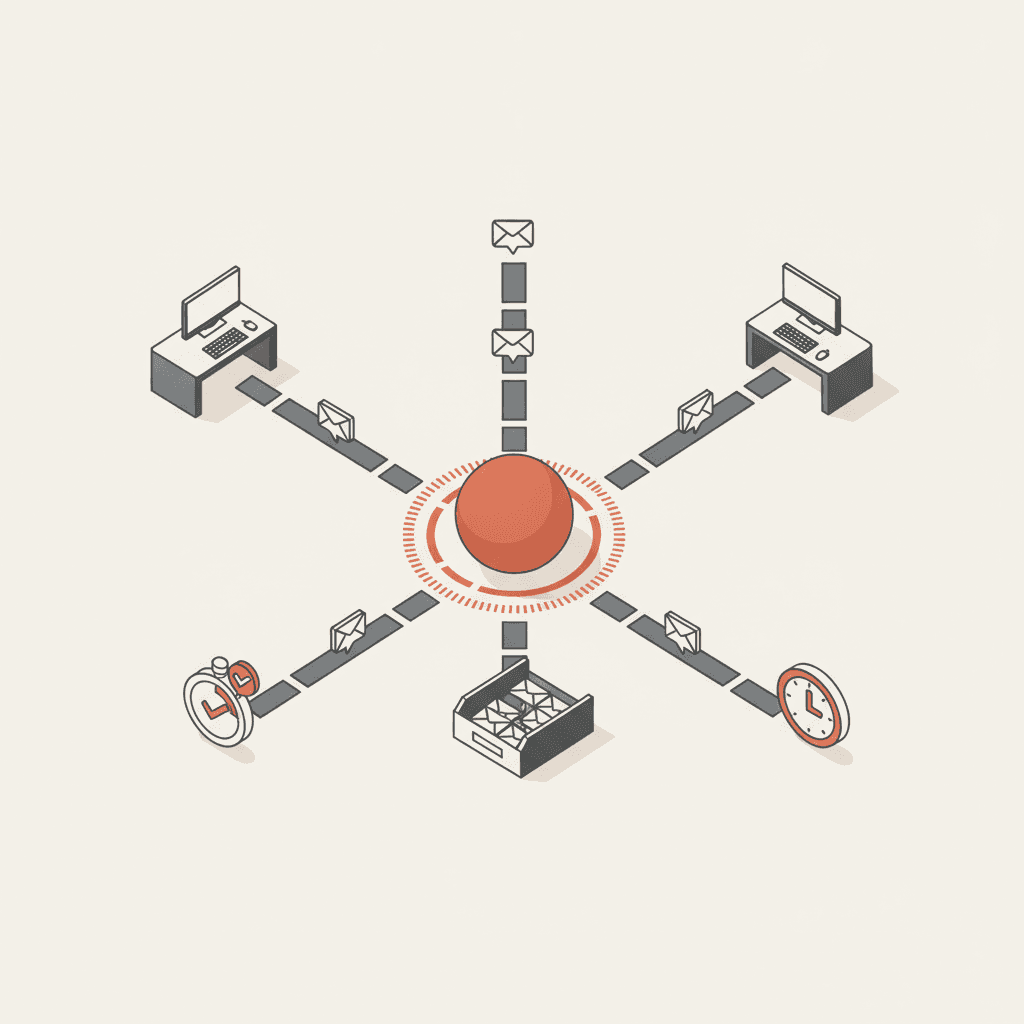
An admissions SLA needs three tiers, not one blanket promise: an instant acknowledgment, a human first-touch window, and an escalation trigger when that window lapses. Each tier has a different owner and a different tool behind it.
The first tier is automated acknowledgment — delivered in seconds by a chatbot or auto-reply confirming the enquiry landed and, ideally, answering the immediate question about a course or intake date. The second tier is human first touch, where a real admissions officer engages with course eligibility or credit-transfer detail, targeted at within the hour for high-intent enquiries during business hours. The third tier is escalation: a qualified enquiry sitting unanswered past its window should reassign automatically to a duty manager, rather than wait for someone to notice it in a shared inbox.
| SLA tier | Response window | Typical channel | Owner |
|---|---|---|---|
| Instant acknowledgment | <10 seconds, 24/7 | Chatbot, auto-reply | Automated system |
| Human first touch (standard enquiry) | Within 4 business hours | Email, CRM task | Admissions officer (rostered) |
| Human first touch (high-intent enquiry) | Within 1 business hour | Phone, live chat | Named admissions officer |
| Escalation on breach | Immediately after window lapses | CRM alert, manager reassignment | Admissions team lead |
| Out-of-hours holding | <10 seconds, then first business hour of reopening | Chatbot + next-day callback | Automated system → officer |
Out-of-hours coverage is not an edge case to bolt on later — it is most of the volume an Australian admissions team actually receives. 67% of prospect activity happens outside business hours, peaking on Sunday evenings between 8 and 9pm (Source: Skolbot interaction logs, 200,000 sessions, Oct 2025–Feb 2026). That share climbs to 81% during exam-results season and 74% during peak admissions season, exactly the windows when a missed SLA costs the most. An SLA built only for 9-to-5 is, by design, absent for the majority of enquiries it needs to cover — a gap we quantify further in why response time is killing your enrolments.
Routing methods: getting the right enquiry to the right officer
Routing decides who receives an enquiry once it lands, and the method matters as much as the raw speed. Four approaches cover most Australian admissions teams, each suited to a different size and structure.
Round-robin distributes enquiries evenly across the team regardless of subject, which is simple and fair on workload but sends a scholarship question to whoever is next in the queue rather than the officer who manages HECS-HELP or FEE-HELP eligibility — workable for a small, generalist team, weak once specialisation matters. Program or campus-based routing sends each enquiry to the officer responsible for that course or campus, and becomes the standard once a team has more than a handful of officers with defined portfolios.
Workload-balancing routing checks each officer's open-enquiry count and assigns the next one to whoever has capacity, preventing the pile-up that round-robin and program-based routing can both create during an ATAR-results spike; it needs a system that tracks live workload, ruling it out for spreadsheet-run teams. Intent or score-based triage ranks incoming enquiries by how close the applicant is to enrolling — a change-of-preference question outranks a general course-guide request — and sends the highest-intent enquiries to senior officers first.
This is where a chatbot earns its place in the routing chain: it can ask two or three qualifying questions (course, intake, funding pathway) before handing off, so the enquiry arrives pre-qualified instead of as a blank message. 72% of prospect questions are simple FAQ enquiries — fees, entry requirements, start dates — that need neither expertise nor judgement, while 21% need institution-specific context and 7% genuinely need a human's judgement (Source: automatic classification of 12,000 Skolbot conversations, 2025). A chatbot that filters the 72% and routes only the 28% needing a person is not replacing admissions staff; it makes sure the officers doing the routing spend their time on enquiries that actually require them.
The tooling spectrum: from shared inbox to chatbot-augmented CRM
The tool an admissions team runs on caps what SLA it can realistically hit — a shared inbox cannot enforce a one-hour window the way a CRM with automated alerts can. Four tiers of tooling map roughly to team size and enquiry volume.
A shared inbox or spreadsheet works for one or two officers handling low volume, but has no timer, no escalation and no record of who last touched a thread — the SLA lives in someone's memory and slips the moment that person is on leave or the inbox floods after a change-of-preference round. A generic CRM (Salesforce, HubSpot, Pipedrive) adds assignment rules, timestamps and reporting, though it has no native concept of a course, an intake or an offer, so admissions teams end up building those structures themselves.
A higher-education-specific CRM — Salesforce Education Cloud is commonly deployed across Australian universities, and platforms such as TechnologyOne's student management suite serve a similar role in the TAFE and dual-sector space — starts from courses, intakes and applications as first-class objects rather than generic sales pipeline stages. EDUCAUSE treats CRM as core administrative infrastructure for higher education, not optional software.
None of those three tiers, on their own, cover the hours when most applicants actually enquire. Chatbot-augmented routing adds an always-on front layer that acknowledges instantly, pre-qualifies, and creates the CRM record before a human ever sees the thread — covering the 67% of activity that falls outside business hours instead of leaving it to queue until Monday morning.
| Tool type | Team size fit | Out-of-hours coverage | SLA-miss risk |
|---|---|---|---|
| Shared inbox / spreadsheet | 1-2 officers, low volume | None | Very high |
| Generic CRM | 3-8 officers | Manual only | Moderate |
| Higher-ed-specific CRM | 5-20 officers, multi-course | Manual only | Low-moderate |
| Chatbot-augmented CRM | Any size, especially peak-load teams | Full, 24/7 | Low |
When an enquiry moves from a chatbot or web form into a CRM, that transfer is personal information handling under the Privacy Act 1988 and the Australian Privacy Principles, and most admissions teams rely on the applicant having reasonably expected that use when they submitted the enquiry — the OAIC's direct marketing guidance is the reference point. This is a routing article, not a compliance one, so treat that as the one line to check with your privacy officer before switching tools, not a full framework to design here.
How to monitor SLA compliance without adding headcount
SLA compliance rate — the share of enquiries answered inside their tier's window — is the number worth a weekly look, not average response time. Averages hide the outliers: a team answering 90% of enquiries in ten minutes and 10% in three days posts a respectable average while still losing every applicant in that slow 10%, disproportionately the ones comparing you against a Go8 or another provider in parallel.
Track compliance by tier and by channel, not as one blended figure. A team hitting 95% on instant acknowledgment but 60% on the one-hour human tier has a resourcing problem at the human handoff, not an SLA-design problem — the fix is workload-balancing routing or extra roster cover, not a longer window. 91% of website visitors leave without making first contact at all, and institutions running an AI chatbot cut that to 76%, generating 167% more first contacts (Source: Skolbot funnel analysis, 30 institutions, 2025-2026 cohort) — a reminder that SLA discipline starts before the enquiry even reaches a human queue.
Re-engagement is a leading indicator that SLA discipline is paying off before enrolment numbers move. Prospects who interacted with a chatbot return within 7 days 34% of the time, against 12% for those who didn't — 2.8 times higher (Source: Skolbot cohort analysis, 8,000 sessions tracked over 90 days, 2025), which is a reasonable proxy for "the applicant still trusts us to respond." Institutions that pair chatbot triage with disciplined routing report 62% more qualified prospects per month and a 38% lower cost per prospect, with open-day registration rising from 6.2% to 18.4% (Source: median results across 18 institutions, 2024-2025) — though that gain reflects the chatbot working alongside parallel funnel improvements, not the chatbot alone. Set a monthly review of SLA compliance by tier alongside re-engagement rate, and the admissions team catches a routing breakdown weeks before it shows up as a smaller applicant pool.