 ChatGPT
 Claude
 Perplexity
 Gemini
 Grok
GrokA contact form tells you who someone is. A conversation tells you what they actually want, and when they wanted it badly enough to ask. Both facts matter to an admissions team, but only one of them tells you what to say next.
This distinction — identity data versus intent data — is easy to skip past because both channels end up producing a row in the same CRM. But the row from a form and the row from a chatbot conversation are not the same kind of object, and treating them as interchangeable is where most of the value of a website chatbot gets left on the table.
What a contact form actually records
A form captures an identity, not a story. Name, email, phone number, a dropdown for "program of interest", occasionally a free-text box that most prospects leave blank or fill with "just looking for information".
That is a snapshot, not a signal. It tells the admissions team a person exists and has a vague area of interest — not whether they are comparing three institutions, whether a parent is filling it in on their behalf, or what specific worry is stopping them from applying. Every prospect who submits a form looks roughly the same on paper: a name, an email, a category.
The admissions officer who opens that form record starts from zero. They have to ask the same opening questions on the phone that the prospect already answered somewhere else in their own head, three browser tabs ago.
What a conversation records instead
A conversation timestamps a question, in context, at the moment it mattered. A chatbot does not just log an outcome ("submitted enquiry about the MBA program") — it logs the path that got there: which page the prospect was on, what they asked first, what they asked next, and when.
Take a concrete example. A prospect visits a business school's funding and awards page at 11:14pm, then opens the chatbot to ask whether it is possible to work part-time off-campus alongside a full-time master's program, and whether that affects the conditions attached to a study permit. That single exchange contains four signals a form would never capture:
- Timing: late evening, self-directed research outside office hours, not during a call or a recruitment fair.
- Sequence: the funding page came first — cost is the live anxiety, not curriculum.
- Specificity: a question about off-campus work rights while studying is a concrete, practical concern, not a generic "tell me more".
- Channel of disclosure: the prospect chose to ask a machine a question they might hesitate to ask a human by phone at first contact.
None of that is guesswork. It is what happened, recorded as it happened. A contact form field for "program of interest: MBA" carries none of it.
Form data versus conversation data, side by side
| What's captured | Contact form | Chatbot conversation |
|---|---|---|
| Identity | Name, email, phone | Same, once the prospect chooses to share it |
| Stated interest | One dropdown selection | Every question asked, in order |
| Timing | Submission timestamp only | Timestamp per message, time of day, session length |
| Context | None | Referring page, prior pages viewed, navigation path |
| Urgency signal | None | Follow-up questions, repeated topics, session return rate |
| Objections or worries | Rarely disclosed | Frequently surfaced directly ("can I still apply if my average is below the admission requirement?") |
| Readiness to act | Unknown | Inferable from specificity and sequence of questions |
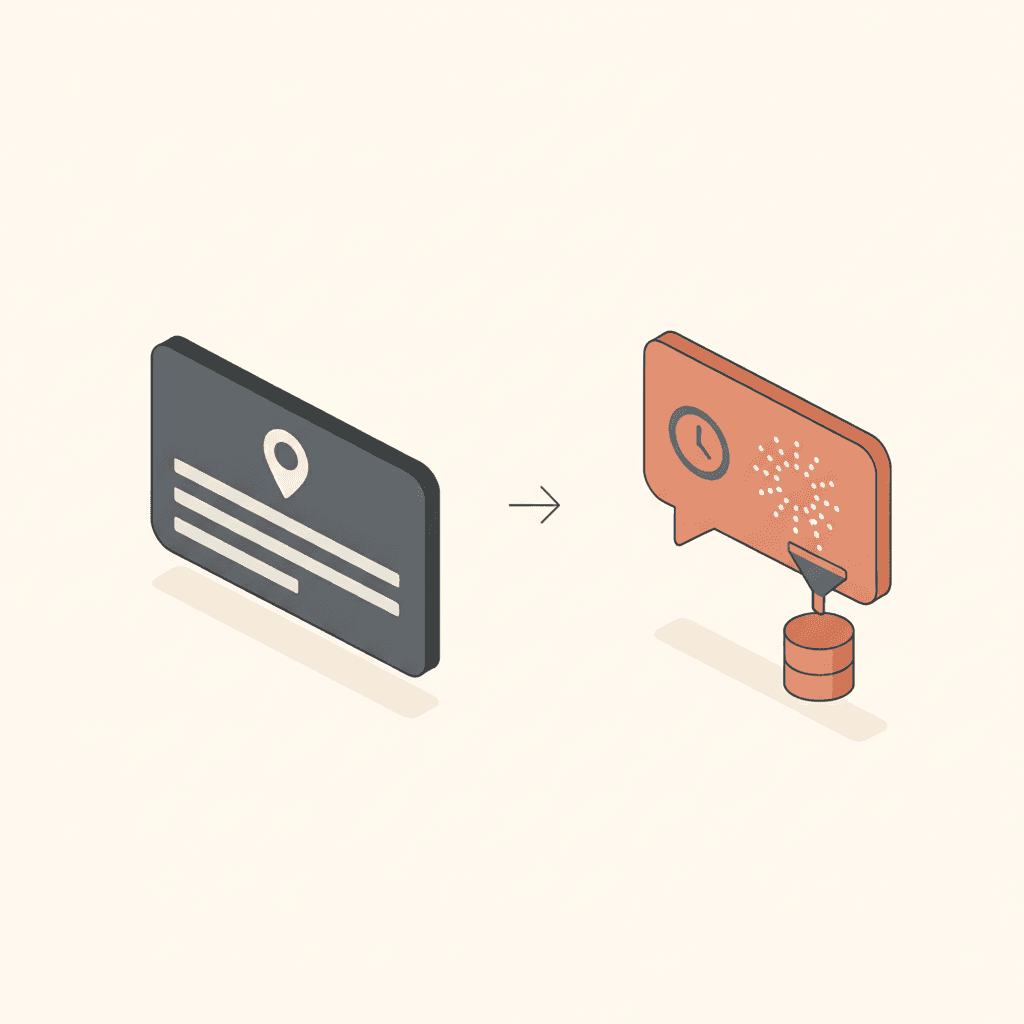
The form column is short because a form is, by design, a static input. The chatbot column is longer because a conversation is a process, and a process leaves a trail. Our comparison of chatbot and contact form performance covers response time, conversion and cost side by side; this is the same channel comparison, narrowed to the one variable that determines what happens after the enquiry lands — the data itself.
Why intent data sharpens follow-up
Intent data tells the admissions team what to say and when to say it, instead of forcing a generic opening line. A follow-up call that starts "I saw you were looking at our funding page late last night and asked about off-campus work rules — happy to talk through that" lands differently from "Hi, I understand you're interested in our MBA program, can I tell you a bit about it?"
The first call answers a question the prospect already asked. The second one restarts a conversation that already happened. Prospects notice the difference, and it shows up as a shorter, more productive call — the admissions officer is not spending the first five minutes re-establishing what the person even wants to know.
Timing follows the same logic. A prospect asking detailed study-permit and funding questions at 11pm is not a prospect who wants to wait for a callback during office hours three days later. Sequencing the follow-up to the moment of engagement, rather than a fixed SLA, is only possible if the system knows the moment happened in the first place.
Why intent data improves lead scoring
Intent data turns lead scoring from a guess based on source into a measurement based on behaviour. A scoring model built only on form fields can rank prospects by program or by how they found the site — paid search, a recruitment fair, a Maclean's rankings listing. That is useful, but it says nothing about how close a specific person is to applying.
A scoring model that reads conversation data can weight urgency and specificity directly: number of questions asked, depth of follow-up (a prospect who asks three clarifying questions about admission requirements is behaving differently from one who asks a single opening question), and topics that correlate with late-stage decision-making — deadlines, tuition, study permits, housing — versus early-stage browsing topics like general course content.
This matters more than it did two years ago, because the research phase has moved earlier and become less visible. Nearly 70% of marketers now report that leads reach them later in their decision journey, having already done their own AI-assisted research before making contact (HubSpot, State of Marketing 2026). Prospects arrive at the first human conversation pre-informed — the form-fill moment increasingly captures someone who has already made most of their decision, and a static form has no way to register that. A chatbot conversation, held earlier in that same research phase, is one of the few places the decision process actually gets recorded.
Why intent data gives admissions a real handoff
Intent data gives the human advisor a starting point instead of a blank page — the definition of what a good handoff looks like. When a chatbot escalates a conversation to a member of the admissions team, it can pass along the full exchange: the questions asked, the pages viewed beforehand, the specific concern raised. The advisor picks up mid-conversation, not at the start of one.
This is not a theoretical benefit. Georgia State University's Pounce conversational assistant, built to answer prospective and admitted students' questions in real time rather than through static web forms, reduced summer melt — admitted students who fail to actually enrol — by 21.4%, and increased overall enrolment by 3.3 to 3.9% (Brookings Institution; Georgia State University enrolment management office). The mechanism was not the chatbot answering faster in isolation — it was that every question captured through conversation became a signal staff could act on before the student disappeared: a missing form, an unresolved funding worry, a deadline they had not registered. A form never surfaces that worry until the student has already gone quiet.
For a Canadian admissions team, the same logic applies to the run-up to OUAC deadlines in Ontario and the equivalent provincial application-centre windows elsewhere — Canada has no single national portal, so each institution is watching a slightly different calendar. A prospect who asks the chatbot repeated questions about a late or supplementary offer, a conditional offer tied to final grades, or residence availability is telling the institution, in real time, exactly where the friction is. That is precisely the moment a human advisor needs to intervene — and precisely the moment a form gives no warning at all.
Where this data needs to live to be useful
Conversation data only creates value if it reaches the CRM record the admissions team actually works from, not a separate chat log nobody checks. A chatbot that qualifies prospects and scores intent, then leaves that intelligence trapped in its own interface, has built a better form — not a better system. Universities Canada research on institutional data practices consistently flags this as the failure point: rich signal that does not integrate cleanly with the system of record ends up ignored within a term.
Skolbot pushes qualified conversations — questions asked, pages viewed, scoring signals, timestamp — directly into the institution's existing CRM, so the admissions team sees the same intent data inside the tool they already use daily. None of this replaces the advisor; it gives them the context a form never provided, before the first call.
Data protection sits alongside this, not after it. Conversational data about prospective students is personal information like any other, and under the federal Personal Information Protection and Electronic Documents Act (PIPEDA), institutions must be able to show a lawful basis, a defined retention period and clear disclosure for a chat transcript, exactly as they would for a form submission. For institutions operating in Quebec, Loi 25 layers on stricter obligations, including a privacy impact assessment before deployment; Alberta and British Columbia apply their own provincial private-sector privacy statutes on top of PIPEDA. There is no UK-style single regulator here — richer collection raises the compliance bar under whichever combination of federal and provincial law applies, it does not lower it. A well-built deployment discloses what it collects, hosts data in Canada, and gives prospects the same rights over a transcript as over any other record.
Institutions weighing whether to deploy a chatbot at all will find the fuller case, including U15 and Universities Canada-relevant considerations, in our complete guide to AI chatbots for student recruitment. For the operational picture beyond admissions — funding, housing, careers, alumni — see conversational AI use cases beyond admissions, several of which generate this same kind of intent signal.