 ChatGPT
 Claude
 Perplexity
 Gemini
 Grok
GrokDigital marketing now drives student recruitment more than any other channel
Institutions that still treat digital marketing as a secondary budget line are losing prospective students to competitors who invest. In 2026, 67% of prospect activity happens outside office hours, peaking on Sunday evenings between 8pm and 9pm Eastern (Source: Skolbot interaction logs, 200,000 sessions, Oct 2025 - Feb 2026). Your digital presence is either working around the clock or it is losing candidates while your admissions team sleeps.
This guide covers the full digital acquisition chain for Canadian higher education: SEO, social media, email nurturing, paid advertising, AI chatbots, and analytics. Every recommendation draws on measured data from institutions across North America and Europe, not recycled conference slides.
For marketing directors and communications heads who want quantifiable results, not jargon.
SEO for higher education: being found before being chosen
Organic search remains the highest-ROI channel
A prospect who types "business school with co-op Toronto" into Google is expressing enrolment intent. That organic traffic is free, qualified, and compounds over time. For well-positioned institutions, SEO accounts for 35 to 50% of total website traffic — a volume no advertising campaign can replicate sustainably.
The problem: most university websites are optimized for accreditation panels, not for prospective students. Program pages overflow with institutional language ("competency-based pedagogy", "holistic learning approach") that nobody searches for.
The 4 pillars of education SEO in 2026
Intent-based keywords — Target the queries your prospects actually type. "Tuition fees [institution name]", "student reviews [program]", "co-op [subject] program Canada" generate higher-quality traffic than generic terms. Tools like Google Search Console and Ahrefs reveal queries where your site already appears on page 2 — those are your quick wins.
Expert content — Google's E-E-A-T framework (Experience, Expertise, Authoritativeness, Trustworthiness) rewards content signed by identifiable experts. For a university, this means publishing articles by named academics, industry placement reports, and sector analyses. A blog fed by generic content no longer ranks.
Technical SEO — Page load under 2 seconds, mobile-first indexing, Schema.org structured data (EducationalOrganization, Course, FAQPage). Institutions with structured data gain an average of +12 visibility points in AI-generated answers (Source: Skolbot GEO monitoring, 500 queries x 6 countries, Feb 2026).
Local SEO — Optimized Google Business Profile with campus photographs, opening hours, and student reviews. Multi-campus institutions need a separate listing per physical site. This is especially important in Canada, where many universities operate satellite campuses across multiple cities.
To understand how SEO intersects with AI answer visibility, read our guide on GEO for schools.
Social media: LinkedIn, Instagram, TikTok — each has a role
LinkedIn: the channel for parents and influencers
LinkedIn is not where your prospects live. It is where their parents, their high school guidance counsellors, and their career advisers spend time. An article published on your institution's LinkedIn page reaches the decision-influencers who shape the final choice.
Content that performs on LinkedIn for higher education: employment outcomes (with figures), corporate partnerships, alumni career testimonials, and thought leadership from senior staff. Recommended frequency: 3 posts per week, alternating between carousels and long-form articles.
Instagram: the shop window for student life
Instagram remains the first social network consulted by 16-to-20-year-olds before visiting a campus. Top-performing content: day-in-the-life stories from current students, reels showing campus events, and carousels ("5 things I wish I'd known before joining [institution]").
The trap to avoid: turning the Instagram account into a program catalogue. Prospects want to see real daily life, not corporate visuals. Accounts run by student ambassadors generate 3 to 5 times more engagement than institutional accounts.
TikTok: the emerging channel you cannot ignore
TikTok has become Gen Z's search engine for life decisions. "How to choose a business school" or "day in the life engineering student" accumulate millions of views. The platform rewards authentic, informative content over polished productions.
Institutions that succeed on TikTok rely on three formats: student-filmed day-in-the-life videos, quick answers to common questions in under 60 seconds, and "myths vs reality" series about their programs.
For a detailed strategy per platform, read our article on LinkedIn and Instagram for student recruitment.
Email nurturing: turning a contact into a candidate
The 5-step nurturing sequence
Email remains the channel with the strongest conversion rate for universities, provided you move beyond the monthly generic newsletter. An effective nurturing sequence guides the prospect from first contact to application submission:
- Email 1 (Day 0) — Confirmation plus a high-value resource (program guide, campus video). Target open rate: 65%+.
- Email 2 (Day 3) — Testimonial from a student on the specific program the prospect explored. Program-level personalization is non-negotiable.
- Email 3 (Day 7) — Open house or webinar invitation with a personalized hook ("Interested in the MSc Finance? Meet the program director on 15 April").
- Email 4 (Day 14) — Reassurance content: rankings, accreditations, employment outcomes. Address objections head-on.
- Email 5 (Day 21) — Gentle nudge with application deadline. Factual urgency, not manufactured scarcity.
The cost per enrolled student ranges from $3,600 to $4,800 CAD in Canada (Source: estimates based on EAB, EduCanada, and Universities Canada data). A well-calibrated nurturing sequence reduces that cost by lifting conversion at every funnel stage.
Do not overlook the prospects already sitting dormant in your CRM: reactivating a dormant student lead database with a targeted 3-email win-back sequence often costs a fraction of acquiring a brand-new contact.
Segmentation: the personalization that makes the difference
Sending the same email to an 18-year-old undergraduate prospect and a mid-career MBA candidate is a mistake that 70% of institutions still make. Minimum segmentation relies on three criteria: program of interest, funnel stage (first contact, application started, incomplete dossier), and source channel (OUAC, website, open house, education fair).
Marketing automation platforms such as HubSpot, ActiveCampaign, or Brevo enable this segmentation without manual intervention. The investment pays for itself from 500 prospects per year.
For a deeper dive into email automation techniques, read our guide on student prospect nurturing.
Paid advertising: Google Ads, Meta Ads, and beyond
Google Ads: capturing intent at the moment of search
Search campaigns on Google Ads remain the most cost-effective paid channel for higher education. The average cost per click on "business school" keywords sits between $3 and $7 CAD in the Canadian market. With a student lifetime value that can exceed $60,000 CAD over a 4-year program at a U15 university (Source: calculation based on average published tuition fees, Maclean's University Rankings, Universities Canada, institutional websites), the investment is easily justified.
The most common mistakes: targeting keywords that are too broad ("management course"), failing to use exclusion audiences (prospects already enrolled), and directing traffic to the homepage rather than a dedicated program landing page.
Meta Ads: interest-based targeting
Facebook and Instagram Ads allow targeting by age, location, interests ("studying abroad", "OUAC", "U15 universities"), and behaviours (parents of teenagers, visitors to ranking websites). The most effective format for education: short video (15-30 seconds) featuring the campus and a student testimonial.
Retargeting is essential: a prospect who visited your program page without registering for an open house should see your institution in their feed within 48 hours.
AI chatbot: the channel that works around the clock
Why the chatbot outperforms every other first-contact channel
The data is unambiguous. Website-to-enrolment conversion rates reach 5.2% for computing programs and 4.1% for engineering programs with an AI chatbot, against sector averages of 1.8 to 3.0% without one (Source: Skolbot analysis, conversion data from 50 partner institutions, 2025-2026 academic year).
The chatbot responds in 3 seconds, at 10pm on a Sunday, in the prospect's language — critical in a bilingual country like Canada where prospects may engage in English or French. No other channel combines immediacy, availability, and personalization at that level.
72% of prospect questions are straightforward FAQ items — fees, dates, entry requirements — that the chatbot handles automatically (Source: automatic classification of 12,000 Skolbot conversations, 2025). The 7% of complex cases are transferred to a human adviser with the full conversation history.
Chatbot analytics: data you did not have before
Beyond conversation, the chatbot captures behavioural data that neither Google Analytics nor your CRM collects. It reveals that 89% of prospects ask about tuition fees, 78% inquire about co-op placements, and 67% ask about international exchanges (Source: analysis of 12,000 Skolbot chatbot conversations, Sept 2025 - Feb 2026).
This data feeds directly into your content strategy, email campaigns, and open house talking points. A chatbot is not just a conversion tool — it is a prospect intelligence tool.
For a detailed return-on-investment analysis, read our article on measuring student acquisition ROI.
Analytics and performance measurement: managing by data
The 5 essential KPIs for education marketing
Too many institutions fly blind. The five indicators that separate high-performing marketing teams from the rest:
- Cost per qualified lead (CPL) — How much you spend to acquire a prospect who has demonstrated genuine interest (program page visit plus contact). Target: under $60 CAD.
- Visit-to-first-contact conversion rate — The percentage of unique visitors who make initial contact. The sector average is 9%; institutions with a chatbot reach 24%.
- Open house registration-to-application rate — Measures the quality of the campus experience. Target: 60%+.
- Average first-response time — The gap between a prospect's question and your first reply. Under 5 minutes puts you in the top 10% of the sector.
- Multi-touch attribution — Which channel sequence (Google, blog, open house, enrolment) produces the most enrolled students? Without attribution, you are optimizing blindly.
Recommended analytics tools
Google Analytics 4 remains the foundation. Supplement with Hotjar for heatmaps and session recordings, and an education CRM (HubSpot, Salesforce Education Cloud) to track the prospect end to end. For a full comparison of CRM platforms for higher education, see our CRM comparison guide for higher education institutions.
The fatal error: collecting data without acting on it. A weekly dashboard shared with the admissions director turns data into decisions. Without a feedback loop, digital marketing remains a cost centre rather than a growth engine.
Omnichannel strategy: orchestrating all the levers
The typical prospect journey in 2026
The average prospect interacts with your institution across 6 to 8 touchpoints before submitting an application. The typical journey:
- Discovery — Google search or TikTok recommendation, website visit, browsing an average of 4.7 pages before asking a first question
- Engagement — Chatbot interaction or form submission, email sign-up, nurturing sequence
- Consideration — Open house visit (in-person or virtual), adviser conversation, viewbook request
- Decision — Application submission via OUAC or institutional portal, interview, enrolment
Each channel plays a specific role in this sequence. SEO attracts, social media reassures, the chatbot qualifies, email nurtures, the open house converts. Removing any link weakens the entire chain.
Digital marketing budget: recommended allocation
Sector reports from Universities Canada and EduCanada suggest that Canadian universities allocate 8 to 12% of tuition fee revenue to marketing and communications. For an institution generating $10M CAD in tuition fees, that represents $800,000 to $1.2M CAD.
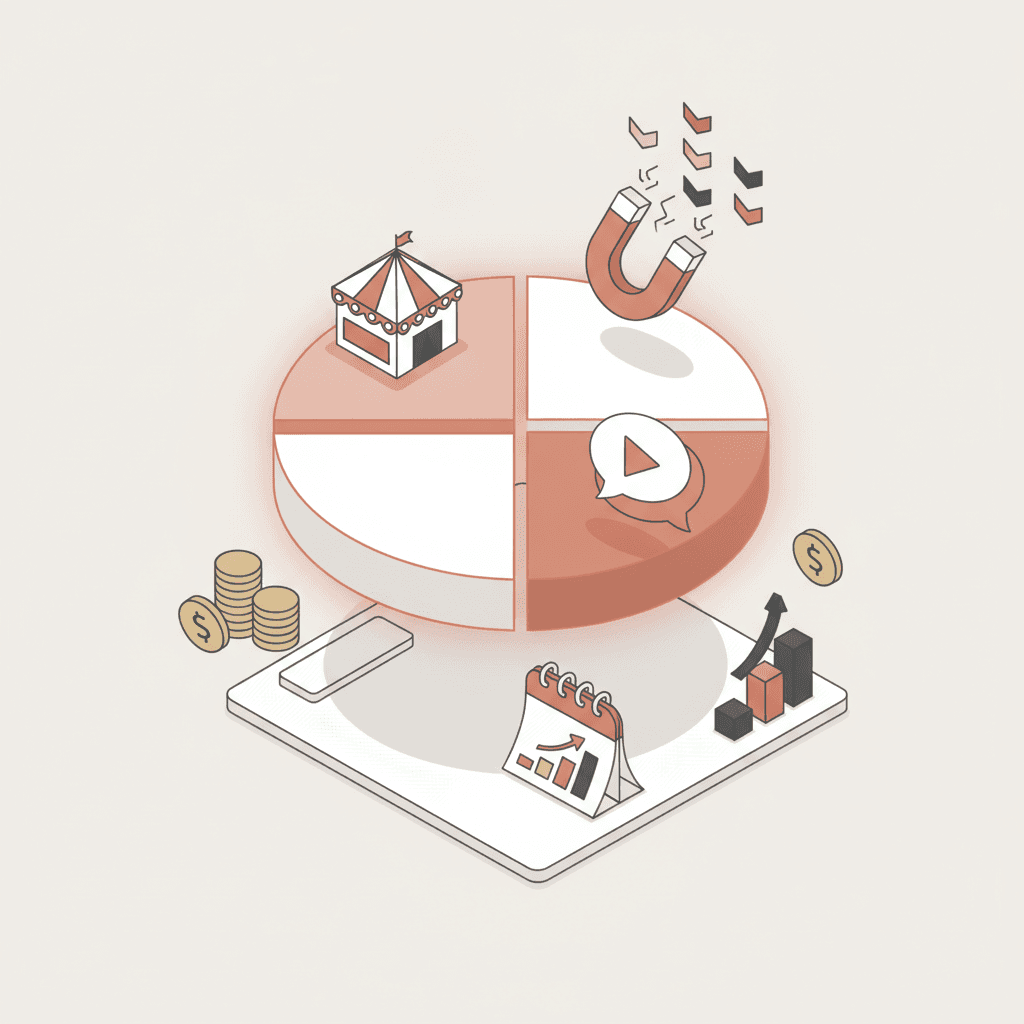
The recommended split for maximum ROI in 2026:
- SEO and content: 25% — investment with compounding returns
- Paid advertising (Google + Meta): 30% — fast results, managed by CPL
- Organic social media: 10% — brand awareness and engagement
- Email marketing + automation: 10% — nurturing and conversion
- AI chatbot: 10% — 24/7 availability and automated qualification
- Digital events (webinars, virtual open houses): 10% — direct conversion
- Analytics and tooling: 5% — data-driven steering