 ChatGPT
 Claude
 Perplexity
 Gemini
 Grok
GrokWhy phone calls fail with international applicants
Phone calls fail with international applicants because the recruiter and the prospect are almost never awake during the same working hours, and because a generation raised on messaging doesn't pick up numbers it doesn't recognize. Add the per-attempt cost of an international call and the math against calling gets hard to ignore for any Canadian admissions office trying to reach applicants in India, Nigeria, Vietnam or the Philippines.
Pew Research Center has documented the underlying behaviour for years: most people don't answer calls from numbers they don't recognize, and the habit has only hardened as spam and robocall volume has grown (Pew Research Center). An applicant scrolling a viewbook at 11 p.m. in Lagos or Hanoi has no reason to trust a Canadian country code, and every reason to let it ring through.
Across Skolbot's partner-school base, phone outreach is answered only 34% of the time, and an answered call still runs 3 minutes 20 seconds on average — a chatbot responds in 3 seconds, 24/7 (Source: Skolbot mystery-shopping audit, 2025, 80 partner institutions). The panel skews French and European, but the underlying dynamic — a phone call needs two people free at the same moment — doesn't change because the applicant is in Mumbai instead of Marseille.
The time-zone math admissions offices tend to skip
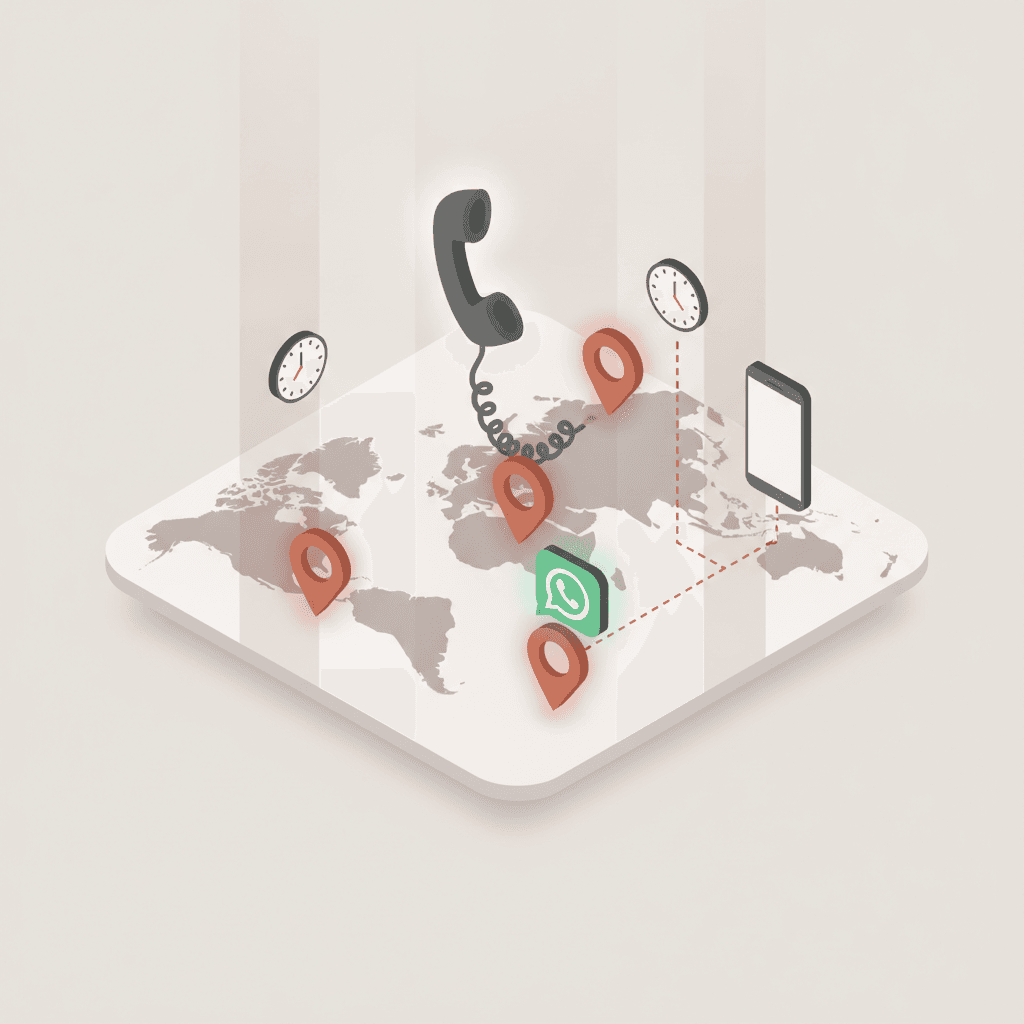
A call placed during a Toronto or Vancouver office's working hours lands at a genuinely bad time for most international applicants, because the standard 9-to-5 window barely overlaps with the day on the other side of the world. New Delhi runs 9.5 to 10.5 hours ahead of Eastern Time depending on the season; Ho Chi Minh City is 11 to 12 hours ahead; Lagos is 5 to 6 hours ahead; Manila is 12 to 13 hours ahead.
Do the arithmetic on a single outbound call slot. An admissions counsellor dialing at 2 p.m. Eastern reaches an Indian applicant close to midnight, a Filipino applicant near 3 a.m., and a Nigerian applicant at a workable 7-8 p.m. — the one region where the window happens to line up. India, Nigeria and Vietnam remain among the largest source countries for Canadian study permits even after the enrolment declines of the past two years, so this isn't an edge case; it's the daily reality of the call list (ICEF Monitor).
Why "just call in the evening" doesn't fix it
Shifting call blocks later helps one region and breaks another, because a recruitment team covering multiple source countries can't align its shift to every time zone at once. The applicant experience — a call at an odd hour from an unrecognized number, going to voicemail or ringing out — repeats regardless of which region the team optimizes for that day.
What a missed call actually costs
A missed call costs more than the three minutes it took to dial, because reaching one applicant by phone typically takes several attempts, and each attempt carries a real cost whether or not anyone picks up. B2B outbound teams using verified contact data report connect rates in the 8-12% range on a generic list, and even mobile direct-dial data tops out around 18-22% — figures compiled from calling activity across sales teams, not admissions specifically, but directly relevant to any office cold-calling a prospect list (ZoomInfo).
At an 8-12% connect rate, reaching ten applicants by phone means dialing somewhere between 80 and 125 times. Add international per-minute charges, staff time spent leaving voicemails that rarely get returned, and the opportunity cost of a counsellor's day going to redials instead of application review, and the phone channel starts to look like the most expensive way to reach the smallest share of a prospect list.
WhatsApp answers when the applicant is actually online
WhatsApp closes the timing gap because it's asynchronous — the applicant reads and replies whenever their day allows, without either side needing to be reachable at the same moment. There's no ringing phone to miss, no voicemail to leave, and no country-code mismatch to trigger a screen-and-ignore reflex.
Meta's WhatsApp Business Platform documentation confirms this is exactly the use case it's built for: businesses (including institutions) can run structured, template-based conversations with international contacts at scale, without needing a local phone presence in each applicant's country (Meta for Developers). A first-response AI layer on top of that channel means the applicant gets an answer the moment they message, not the moment a counsellor's shift starts in Toronto.
That instant layer matters most for the questions that don't need a human yet — tuition ranges, program length, English-proficiency requirements, document checklists. An AI chatbot on WhatsApp handles those in seconds and hands off to a counsellor for anything that needs judgment, the same complementary split covered in our piece on WhatsApp and Gen Z engagement.
Language is the second wall a phone call can't get past
Language stops more international conversations than time zones do, because a counsellor fluent in English and French still can't field a question typed in Mandarin, Arabic or Portuguese without a delay or a handoff. Across Skolbot's partner-school base, 58% of international prospects are non-French-speaking — a figure drawn from a panel of mostly French and European institutions, but the pattern generalizes: any school recruiting outside its home-language market is fielding a majority of conversations in a second or third language (Source: automatic language detection across 8,500 Skolbot conversations, 2025-2026).
A phone call forces a language choice the moment it connects. A WhatsApp chatbot can detect and respond in the applicant's language automatically, then route anything ambiguous to a bilingual counsellor — an architecture detailed in our guide to multilingual AI chatbots for international students and in our breakdown of multilingual chatbots built specifically for international recruitment.
Phone vs. WhatsApp for international outreach
| Factor | Phone call | WhatsApp (AI + human) |
|---|---|---|
| Pickup / response rate | 34% answered, when attempted | Async — read and replied on the applicant's schedule |
| Response time | 3 min 20 s average, only if answered | 3 seconds, 24/7, for AI-handled first response |
| Time-zone coverage | Limited to counsellor's working hours | No overlap required |
| Language handling | Limited to staff's spoken languages | Automatic detection, multilingual first response |
| Cost per successful contact | Rises with each unanswered attempt | Flat platform cost regardless of attempt count |
Adding WhatsApp without adding headcount — and without breaking PIPEDA
Institutions can add WhatsApp to their recruitment stack without hiring more counsellors, because the AI layer absorbs the repetitive first-contact volume and only escalates conversations that need a person. That's the same principle behind the broader recruitment playbook in our pillar guide on recruiting more students: automate the repeatable, protect staff time for the decisions that actually need judgment.
Messaging Canadian and international applicants through WhatsApp still falls under the Personal Information Protection and Electronic Documents Act (PIPEDA), and under Québec's Loi 25 for institutions recruiting there — the same consent, retention and data-handling standards apply regardless of channel. Setting a documented retention window and confirming where conversation data is processed before launch avoids turning a recruitment win into a privacy gap later. Provincial admissions systems like OUAC, ApplyAlberta or EducationPlannerBC still handle the formal application; WhatsApp's job is everything upstream of that submission, where most applicants drop off if nobody answers their questions fast enough.