 ChatGPT
 Claude
 Perplexity
 Gemini
 Grok
GrokParents are co-decision-makers — not bystanders
When a Grade 12 student starts researching universities, they rarely do it alone. Between 65% and 75% of Canadian post-secondary enrolment decisions involve a parent or guardian at a meaningful level — reviewing shortlists, attending open house events, asking about tuition, or effectively exercising a veto. Ignoring this audience is not a neutral choice; it is a conversion loss.
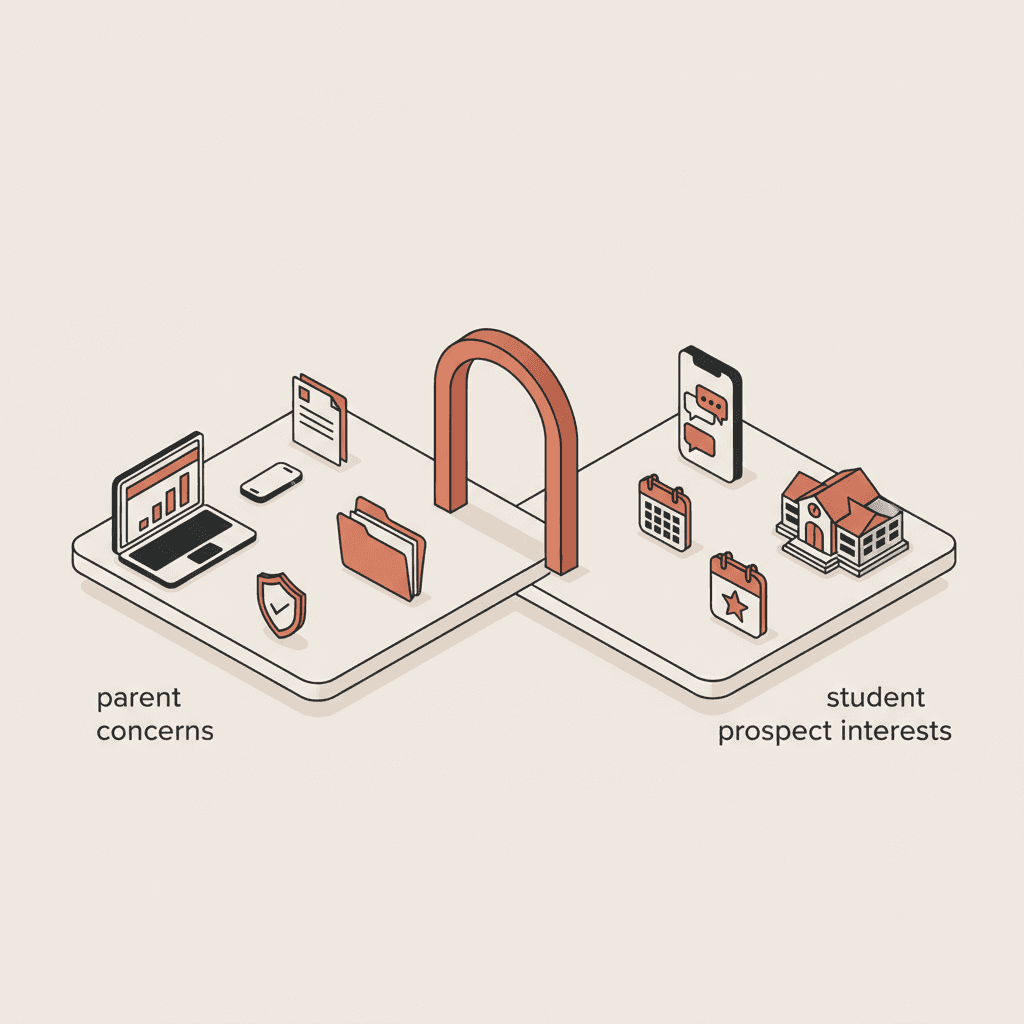
Admissions and enrolment teams spend most of their content energy on the student persona. That is appropriate. But the parent journey runs in parallel, driven by different questions, a different risk tolerance, and a different timeline. A family that arrives at an open house with unresolved concerns about financial aid or institutional safety leaves undecided — regardless of how well the student connected with the program.
This article identifies the five core concerns Canadian parents bring to the university selection process, maps them to content types that address each concern, and explains why most institution websites still fail the parent audience test.
Why parental influence is higher in Canada than admissions teams assume
The tuition-to-household-income ratio is a useful lens. Domestic undergraduate tuition at a Canadian university runs from roughly CAD $6,500 per year at a mid-sized comprehensive to over CAD $30,000 for professional programs at research-intensive institutions. Add residence, transportation, and living costs, and a four-year degree in a major Canadian city can represent CAD $80,000–$120,000 in total family expenditure. That figure makes this a household financial decision, not just a personal one.
89% of prospective students ask about tuition before any other topic (Source: Skolbot analysis, 12,000 chatbot conversations, 2025–2026). Parents ask the same question — but earlier, and with greater anxiety, because they are often the ones covering the cost or co-signing a student loan. They are not looking for inspiration. They are performing a risk assessment.
Provincial student aid programs — most visibly OSAP in Ontario, and equivalent programs in BC, Alberta, Québec, and the Atlantic provinces — partially offset this burden, but navigating eligibility criteria is itself a source of parental stress. Institutions that publish plain-language summaries of available aid, including Canada Student Grants alongside provincial grants, measurably reduce this anxiety before it becomes an objection.
The five concerns parents bring to university selection
Below is a summary of the primary parent concerns and the content formats most effective in addressing each one.
| Parent concern | What they are really asking | Most effective content format |
|---|---|---|
| Financial viability | Can we afford this? Is aid accessible? | Transparent fee pages in CAD, OSAP/provincial aid explainer, total cost calculator |
| Return on investment | Will this degree lead to a job? | Employment rates at 6 months, median starting salary by program, employer partnership list |
| Institutional credibility | Is this a reputable school? | Maclean's University Rankings position, U15 membership, professional accreditations, enrolment figures |
| Campus safety and wellbeing | Will my child be safe and supported? | Campus safety statistics, mental health services, emergency protocols, student support offices |
| Data privacy | What happens to our personal data? | Privacy policy citing PIPEDA compliance, data retention practices, opt-out procedures |
Each of these concerns deserves dedicated content — not a single "Parents" section buried three clicks from the homepage.
Financial transparency is the single highest-leverage page improvement
Parents who cannot find a clear answer to "what will this actually cost?" do not contact admissions to ask. They leave.
91% of website visitors leave without making contact (Source: Skolbot funnel analysis, prospect dropout data, 2025–2026). For the parent segment, fee ambiguity is the leading trigger for silent drop-off. Publishing an honest, complete tuition table — domestic versus international, per year and total program, with mandatory ancillary fees separated out — is the single change most likely to keep a parent engaged.
Three elements make a tuition page work for parents:
1. Tuition in CAD, not percentages. Parents do not need to know that your fees are "22% below the provincial average." They need a number they can put into a spreadsheet. Link to your institution's official tuition schedule and keep it current.
2. A total cost of attendance estimate. Tuition plus residence, meal plan, transit pass, and a standard book allowance. The Universities Canada cost-of-living framework provides national reference points you can adapt for your city.
3. A financial aid section on the same page. Not a separate tab — the same page. List OSAP (for Ontario institutions), provincial equivalents, merit scholarships, entrance bursaries, and co-op earnings estimates. Parents need to see the full financial picture before they can close the cost concern.
Institutions that embed a simple cost calculator — annual tuition minus estimated aid, divided into monthly amounts — report that parents spend significantly longer on program pages after the calculator is added. The calculation does not remove the financial burden; it makes it legible, which is enough to move a parent from anxious to engaged.
Return on investment: what parents mean when they ask about "career outcomes"
Parents consistently rate employment outcomes as their second-highest concern, just after cost. But what they mean by "career outcomes" is more specific than the phrase suggests.
They want three data points: the employment rate at six months post-graduation, the median starting salary in CAD, and recognizable employer names. A paragraph describing "strong industry connections" does not answer the question; it signals that the answer is being avoided.
Statistics Canada publishes the National Graduates Survey, which provides income and employment benchmarks by credential type and field of study. Institutions should cite this data directly on program pages, then add institution-specific outcomes where available. A program that places graduates at RBC, PCL Construction, or Interior Health is more credible to a parent than one that references "leading employers in the sector."
Co-op programs merit particular attention in this context. The co-op model — pioneered in Canada by the University of Waterloo and now offered across dozens of institutions — is a concrete, financially legible form of career preparation that parents understand immediately. If your institution offers co-op streams, the employer placement rate and average co-op earnings belong on the program page alongside tuition.
Research-intensive U15 universities also carry credibility through funded research activity. NSERC, SSHRC, and CIHR grant volumes are public — citing research funding helps establish that faculty are active practitioners in their fields, which indirectly signals teaching quality. For parents choosing between a research university and a teaching-focused college, this distinction matters and should be made clearly.
Institutional credibility: rankings, accreditation, and what parents actually check
Parents validate institutional credibility through external signals — they do not take marketing copy at face value.
The most commonly consulted external sources are:
- Maclean's University Rankings, which provides Canadian-specific rankings across medical/doctoral, comprehensive, and primarily undergraduate categories
- Universities Canada membership lists, which function as a baseline quality signal for degree-granting institutions
- Professional accreditations: AACSB or EQUIS for business programs, Engineers Canada for engineering, CPA Canada for accounting, and law society recognition for law faculties
- OUAC participation, which parents in Ontario read as an indicator of provincial recognition
Your institution does not need to rank first in Maclean's to benefit from this dynamic. Even appearing in a specific category — and acknowledging your ranking openly — communicates transparency. Parents are more suspicious of institutions that omit ranking data than of those that rank mid-table.
A note on the Québec context: for families considering Québec institutions, the CEGEP system introduces an intermediary step that parents outside Québec often do not understand. Domestic Québec students enter university after completing a two-year CEGEP pre-university program rather than directly from secondary school. Institutions recruiting Québec-origin students nationally should briefly explain this transition on their admissions pages — it reduces parental confusion and positions your institution as informed about the full Canadian landscape.
Campus safety and student wellbeing: the concern admissions pages routinely underserve
Parents want to know that their child will be physically safe and emotionally supported. This is not a peripheral concern — it is frequently the deciding factor between two institutions of comparable academic standing.
Content that addresses this concern includes:
- Campus safety statistics: annual crime statistics under provincial campus security reporting requirements, response time benchmarks for campus security, and emergency communication systems (e.g., emergency blue phones, mobile safety apps)
- Mental health services: counselling availability (specifically whether sessions are included in student fees or billed separately), wait time information, and after-hours crisis support lines
- Residence safety: building access controls, residence advisor ratios, and formal roommate matching processes
- Student support infrastructure: international student offices (particularly relevant for families sending a child across provincial or national borders), disability services under provincial accessibility legislation, and food security programs
This content is rarely given its own dedicated page. It is usually scattered across student services subsections. A consolidated "Student Safety and Wellbeing" landing page — indexed in the main navigation — signals institutional seriousness to parents in a way that fragmented sub-pages do not.
Data privacy: PIPEDA compliance as a parent-facing reassurance signal
Parents completing inquiry forms or registering for open house events on behalf of their child are providing personal data — names, email addresses, postal codes, and sometimes academic history. In Canada, the collection and use of this data is governed by the Personal Information Protection and Electronic Documents Act (PIPEDA) at the federal level, and by provincial equivalents including Alberta's PIPA, British Columbia's PIPA, and Québec's Law 25 (Bill 64).
Most institution websites publish a privacy policy. Most parents do not read it. The gap lies in surface-level reassurance: a brief, plain-language statement at the point of data collection explaining what will be done with the information, whether it will be shared with third parties, and how to request deletion.
The Office of the Privacy Commissioner of Canada provides guidance on plain-language privacy notices that institutions can adapt. For institutions using AI chatbots or lead-capture tools, disclosing that automated tools are involved in data processing is both a PIPEDA obligation and a trust signal that increasingly privacy-aware parents appreciate. For a deeper treatment of data privacy in the enrolment context, see our article on AI chatbots, PIPEDA, and data collection in higher education.
Why 91% of visitors leave without making contact — and what it means for parent content
91% of website visitors leave without making contact (Source: Skolbot funnel analysis, 2025–2026). For parents, the trigger is almost always unresolved anxiety about one of the five concerns above — most commonly cost or outcomes data that was either absent or too vague to be useful.
67% of prospect and parent activity happens outside office hours, peaking on weekday evenings and Sunday nights (Source: Skolbot interaction logs, 200,000 sessions, 2025–2026). Parents research after their own workday ends — at 9 pm, when no admissions officer is available to answer the question that would convert their interest into an inquiry. A website that cannot answer "what does OSAP actually cover for your programs?" at 9 pm on a Tuesday is leaving a significant portion of its parent audience in an unresolved state overnight.
The practical implications for enrolment teams:
- Fee and aid information must be self-serve and complete — not dependent on a phone call
- An AI chatbot trained on institutional data can field financial, safety, and admissions questions outside office hours — addressing the gap without increasing staff headcount
- A dedicated "For Parents" section or FAQ does not replace comprehensive program-page content; it supplements it by providing navigation shortcuts for the parent persona
For the parallel student journey and how to address both audiences through a single content strategy, see our article on parents vs. students — two distinct journeys for schools to manage.
The parent journey and the student journey are parallel — not identical
The student and parent journeys share the same destination — a confirmed enrolment — but follow different paths and operate on different timelines.
Students tend to engage first, driven by program curiosity and peer recommendations. Parents engage second, prompted by a conversation at the dinner table or a brochure that came home. By the time a parent visits your website, the student has often already formed a preference — and the parent is performing due diligence on that preference.
This means that parent-facing content has a specific job: not to introduce the institution (the student usually handles that), but to validate it. Reassurance content — financial transparency, safety data, employment outcomes, credible rankings — does the work of converting parental anxiety into endorsement.
Institutions that treat parents as a distinct content audience, with dedicated navigation paths and content formats tailored to their risk-assessment mode, see measurably higher conversion rates among families where parental influence is high. For the full prospect question landscape that precedes this validation phase, see our guide to the questions prospects ask before enrolling.
What high-performing institutions do differently
Across institutions where Skolbot has been deployed, the enrolment teams with the strongest parent engagement share three practices:
First, they publish financial information without friction. Fees, aid eligibility, and total cost estimates are on program pages — not behind a viewbook request form. The admissions team does not treat financial transparency as a risk; they treat fee ambiguity as the actual risk.
Second, they quantify outcomes at the program level. Not institution-wide employment averages — program-specific employment rates and salary ranges, sourced from Statistics Canada's National Graduates Survey or their own graduate outcome surveys. This level of specificity signals that the institution has done the work of tracking its graduates, which is itself a credibility signal.
Third, they make parent-specific content findable. A "For Parents and Families" link in the main navigation — not buried in a footer — with direct access to fee pages, financial aid summaries, campus safety information, and privacy policy.
For context on how Gen Z students are researching alongside their parents, see our pillar article on what Gen Z expects from a school's website.