 ChatGPT
 Claude
 Perplexity
 Gemini
 Grok
GrokHeadcount freezes rarely arrive with a memo that says "do more with less." They arrive as a budget line that stays flat while your Common App submission count climbs 8-12% year over year. By November, the gap between what your team can physically answer and what applicants expect is no longer theoretical — it's a queue.
This article is about that gap: what breaks first when a three- or four-person admissions office runs a full cycle without adding a seat, which tasks are genuinely safe to hand to automation, and how to allocate the humans you do have across August through the summer melt window.
What breaks first when application volume outpaces staff
The first casualty is response time, not decision quality. Counselors keep making sound admit/deny calls under pressure — what collapses is everything upstream of that decision: the inbox, the phone queue, and the "did anyone answer this family's question" layer.
Skolbot's mystery-shopping audit across 80 partner schools found the channel gap is already wide before peak season even starts: email averages a 47-hour response time, a contact form 72 hours, and phone calls get answered only 34% of the time, with a 3-minute-20-second hold when they do connect. Human live chat, where available, averages 8 minutes — but only during business hours. None of that accounts for the volume spike between the November 1 Early Action/Early Decision deadline and the January 1 Regular Decision deadline, when a lean team's per-counselor ticket load can double or triple overnight. A team already stretched at 47 hours in September will not hold that line in December — it slides toward 4, 5, 6 days, right when anxious applicants and parents are checking their portal status daily.
The second casualty is proactive outreach. When a team is purely reactive — fielding whatever comes in — the tasks that don't generate an inbound ticket get dropped: nudging incomplete applications, following up with admitted students who haven't RSVP'd to an admitted students day, checking in on FAFSA verification holds. Those are exactly the tasks that determine your yield in April and May. NACAC has tracked rising application volume per institution for years without a corresponding rise in counselor staffing — a structural mismatch, not a one-cycle anomaly.
What's safe to automate vs. what genuinely needs a person
Not every admissions interaction requires human judgment, and pretending otherwise is what burns out a lean team. The dividing line is context and stakes, not topic.
Skolbot's classification of 12,000 chatbot conversations found a consistent split: 72% are simple FAQ-type questions answerable without school-specific judgment (deadlines, required test scores, fee waivers, program names), 21% need school-specific context a well-trained chatbot can still resolve (aid estimates for a specific program, transfer credit rules, housing timelines), and only 7% genuinely require a human — appeals, extenuating-circumstance requests, a family in crisis, or a nuanced program comparison. That 7% is where counselors should spend their attention during peak season, not on "what's the SAT code for your school" for the ninth time that day.
| Task category | Automate | Keep human |
|---|---|---|
| Deadline, fee, and document-status FAQs | Yes — chatbot, 24/7 | — |
| Application status confirmation | Yes — self-service portal + chatbot | Escalate if discrepancy reported |
| Financial aid estimate (general) | Yes — chatbot with program-specific data | — |
| Financial aid appeal or special circumstance | — | Yes — financial aid counselor |
| Admitted student event registration and reminders | Yes — chatbot + SMS sequence | — |
| Waitlist decision communication | — | Yes — admissions officer |
| Program comparison for an undecided applicant | Partial — chatbot for factual comparison | Yes — counselor for fit conversation |
| Privacy-sensitive record requests | — | Yes — registrar/admissions staff only |
The practical effect shows up immediately in top-of-funnel numbers. Across 30 schools tracked in the 2025-2026 cohort, the drop-off between a website visit and a first contact averages 91% — most prospective students never take the first step of reaching out. Schools running an AI chatbot cut that to 76%, or 167% more first contacts generated from the same traffic, without adding a counselor. That's the direct consequence of a visitor at 9:40pm getting an answer in 3 seconds instead of a contact form that won't get a reply for three days.
For a deeper breakdown of which repetitive questions eat the most staff time and how to quantify the hours, see our analysis of admissions team workload and hours lost to repetitive questions.
Structuring staff time across the August-May cycle
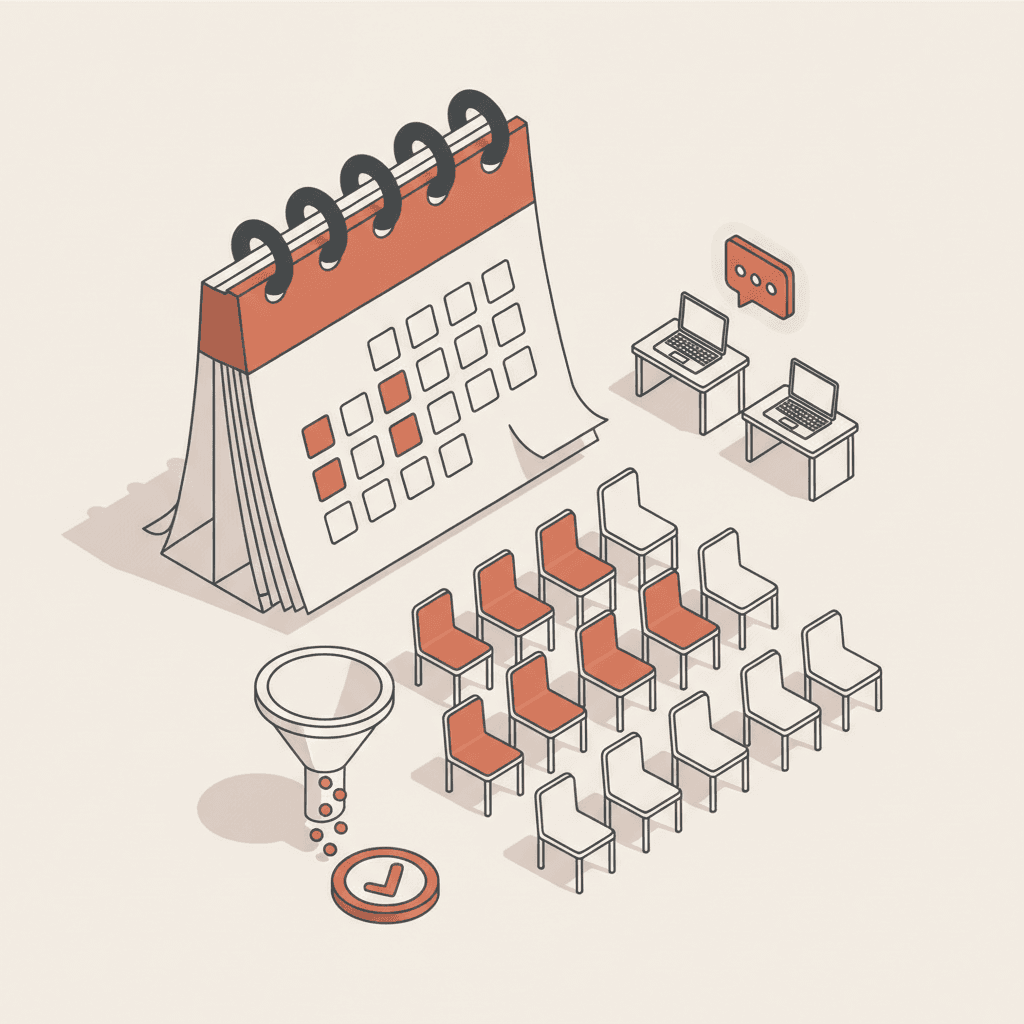
A lean team survives peak season by pre-allocating attention before volume hits, not by reacting week to week. Map your calendar to three load spikes: the November Early Action/Early Decision push, the January 1 Regular Decision crunch, and the March-April decision release through May 1 National Decision Day.
August-October (build phase). This is when a lean team has the most slack — use it to configure automation, not to coast. Load your chatbot with program pages, tuition figures, and FAQ content before the Common App opens in August, so it's answering accurately by the time Early Action inquiries start. Counselors should spend this window on relationship-building outreach — campus tours, high school visits, webinars — because they won't have the bandwidth once November hits.
November-December (Early Decision/Early Action surge). Application volume spikes hard around the November 1 deadline. This is the first real stress test of whatever automation you set up over the summer. Keep at least one counselor dedicated to ED/EA file review with minimal interruption — route routine inquiries to the chatbot so the file readers aren't context-switching every ten minutes.
January (Regular Decision crunch). The January 1 deadline produces the single largest inbound volume spike of the cycle, often 3-4x a normal week's inquiries, landing in the first two weeks of January when staff are also finishing winter break. College Board data on score-sending timelines confirms the pattern — a large share of score reports arrive in the final weeks before Regular Decision, exactly when document-status inquiries spike hardest. A chatbot handling routine "did you receive my transcript" questions is the difference between counselors reading files and counselors triaging an inbox.
March-April (decision release). Once decisions post, inbound shifts from application-status questions to program, financial aid, and comparison questions from admitted students. This is a different conversational load than January's — more nuanced, higher-stakes for yield — and it's where your 21% "needs context" tier matters most.
May-August (National Decision Day and summer melt). May 1 doesn't end the cycle; it starts the yield-management phase, where deposited students still need to complete housing, orientation, and FAFSA verification before showing up in the fall. For the full year-round cadence, see the 12-month admission campaign timeline, and for the yield-specific playbook, see turning admits into enrolled students.
Admitted students day and the May 1 no-show problem
A lean team's biggest silent leak isn't unanswered emails — it's admitted students who register for a campus visit and never show up. No-shows waste staff hours, campus resources, and the one in-person moment most likely to convert a hesitant admit.
Tracking of 4,200 event registrations across 12 schools between October 2025 and February 2026 found events with no follow-up had a 52% no-show rate. Combining a chatbot reminder with SMS brought that down to 14%, and a personalized reminder referencing the applicant's intended major — not a generic "see you Saturday" — got it to 11%. For a lean team, that's the difference between an admitted students day that justifies the staff hours spent planning it and one that doesn't, because the reminders run on a schedule instead of requiring a counselor to manually track who confirmed.
Where the ROI shows up for a frozen headcount
The financial case for automating the routine layer isn't about replacing staff — it's about making a frozen headcount cover a growing applicant pool without the response-time collapse described above. Median results across 18 schools that deployed a chatbot alongside parallel funnel optimizations: qualified prospects per month rose from 120 to 195 (+62%), cost per qualified prospect dropped from $42 to a $26-equivalent (-38%), and event registration rate climbed from 6.2% to 18.4%. Median payback was around 5 months, with 12-month ROI around 280%.
Those numbers combine the chatbot's effect with concurrent improvements to landing pages, forms, and follow-up cadence — don't read them as the chatbot alone accounting for every point of lift. What they show reliably: schools that automate the 72% FAQ layer free enough staff time to run those parallel optimizations in the first place. A team drowning in "what's the deadline" emails in December isn't testing a new landing page. McKinsey's research on higher education operations makes a similar point at a sector level — institutions that automate routine administrative workflows redirect staff capacity toward higher-judgment work rather than simply adding cost. See how the response-time gap maps to lost prospects in the college response time benchmark.
Getting buy-in without asking for headcount
Framing automation as a response-time fix rather than a staffing replacement is what gets a frozen-headcount budget approved. Admissions leadership and finance committees respond to "our applicants wait 47 hours for an email reply and 66% of our calls go unanswered" far better than an abstract efficiency pitch.
Present the case in three parts: your office's current channel-response data (most CRMs report average first-response time by channel), the categories of question staff answer most repeatedly (a two-week ticket log surfaces this fast), and the projected time recovered by automating the routine 72%. For institutions weighing whether automation compromises the personal feel applicants expect from private colleges, automating student recruitment without losing the human touch covers keeping the tone right while routine work moves off staff's plate. For the broader strategy this fits into, see the pillar guide to recruiting more students in higher education.
A frozen headcount only holds up if the workload inside the team is structured to prevent burnout, not just automated. See our guide on preventing admissions team burnout during peak season for how to rotate coverage across the Early Decision and Regular Decision crunch without losing staff.