 ChatGPT
 Claude
 Perplexity
 Gemini
 Grok
GrokWhat AI lead qualification means for a business school
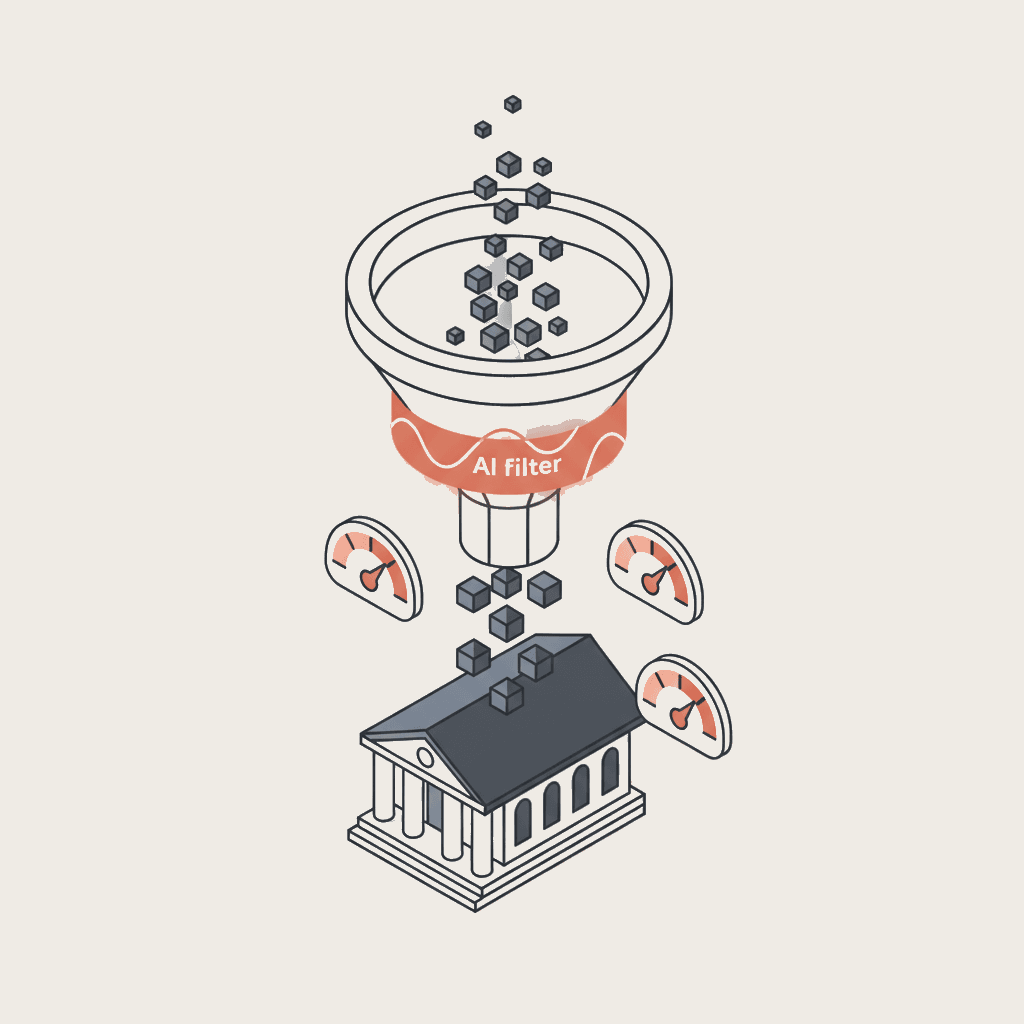
AI lead qualification is the automated scoring and routing of prospective applicants based on their fit for a specific program, using a chatbot or scoring engine to replace the manual triage that admissions officers currently do in spreadsheets. Instead of a counselor calling 200 MBA inquiries to work out which 30 are worth a conversation, the AI does that filtering in real time, the moment the prospect lands on the website or downloads a brochure.
For a US business school running MBA, MS Finance, Executive MBA, or undergraduate BBA pathways through the Common App or direct application, the qualification question is rarely "is this person interested." It is "does this person have the GMAT or GRE score we require, the budget for a <$100,000 program, and the timeline that matches our intake?" AI handles those four checks in under two minutes of conversation.
The practical effect: admissions teams stop spending their day on unqualified inquiries and spend it on candidates who are genuinely close to converting.
Why manual qualification breaks at business school scale
A typical US business school receives between 3,000 and 15,000 inquiries per intake cycle across its portfolio of programs. According to AACSB and GMAC data, applications to graduate management education remain a major flow into US institutions, with leading programs receiving thousands of applications for a few hundred seats. That means admissions teams are already working against volume they cannot absorb.
Manual qualification collapses for three reasons:
- Response time. The first school to reply wins. A 24-hour delay on an MBA inquiry drops conversion by roughly 40%.
- Counselor bandwidth. A single admissions counselor can hold 8-12 meaningful conversations per day. Beyond that, depth suffers.
- Inconsistent scoring. Two counselors rating the same prospect on a BANT-style grid (Budget, Authority, Need, Timeline) will disagree around a third of the time.
AI qualification solves none of these problems alone, but it removes them as bottlenecks so human counselors can focus on the prospects that actually need a person.
Four approaches to lead qualification, compared
US business schools historically use one of four models. The differences matter because the cost, accuracy, and integration effort vary by an order of magnitude.
| Approach | Monthly cost (mid-size school) | Time-to-qualify | Accuracy vs human baseline | Integration effort | Best for |
|---|---|---|---|---|---|
| Manual spreadsheet | $0 direct, ~$5,500 in admissions FTE time | 24-72 hours | 100% (baseline) | None | <500 inquiries/month |
| CRM rule-based (Salesforce, HubSpot, Slate) | $1,000-$3,000 | 1-6 hours | 78-85% | Medium (rules + forms) | Schools with clean CRM hygiene |
| AI chatbot qualification | $750-$2,200 | <2 minutes | 88-93% | Low-medium (website + CRM sync) | High-volume recruitment |
| Hybrid (AI + counselor review) | $1,500-$3,800 | Real-time + same-day | 95%+ | Medium | Premium programs (MBA, EMBA) |
The hybrid model is what most AACSB-accredited flagship MBA programs end up adopting, because an Executive MBA prospect paying $150,000 expects human contact at some point. AI handles the first 80% of the journey; an admissions director picks up the last 20%.
What AI actually scores: the qualification framework
AI qualification for a business school prospect runs against six criteria, not the generic BANT grid that B2B sales teams use. The criteria map to what your admissions committee would check on a full application, compressed into a 90-second chatbot conversation.
| Criterion | What the AI extracts | Signal quality | Example question the bot asks |
|---|---|---|---|
| Academic prerequisites | Undergraduate GPA, GMAT/GRE/EA score, prior degree, coursework | High | "What was your undergraduate GPA, and have you taken the GMAT, GRE, or Executive Assessment?" |
| Program fit | Desired specialization, career goal, industry experience | High | "Are you looking at the MS Finance, full-time MBA, or Executive MBA?" |
| Budget signals | Funding source (self-funded, employer sponsorship, federal Grad PLUS, private loan), scholarship interest | Medium-high | "Are you exploring scholarships, employer sponsorship, or federal student loans?" |
| Intent signals | Pages visited, brochure downloads, session time, return visits | Medium | Passive — measured, not asked |
| Timeline | Target intake (Fall 2026, Spring 2027), decision horizon | High | "Which intake are you aiming for?" |
| Geography & visa | US/international, F-1 visa requirements, English-language certification | Medium | "Are you applying as a domestic or international student?" |
Each answer feeds a weighted score. A prospect scoring above a configurable threshold (typically 70/100) gets routed to a human counselor immediately. Below that threshold, they enter a nurture sequence — which is exactly the email nurture flow that complements the chatbot handover.
The scoring model should be retrained quarterly against actual enrollment data. If your MBA cohort consistently converts from prospects with 5+ years' work experience, the score weight for that field should rise.
The ROI case for AI qualification
"Qualified leads/month increased from 120 to 195 (+62%). Cost per lead dropped from $48 to $30, a 38% reduction. Campus visit registration rate rose from 6.2% to 18.4%. Payback occurred at month 5. 12-month ROI: 280%." (Source: Skolbot median results across 18 partner schools, with concurrent funnel optimizations, 2024-2025.)
These numbers are not unique to Skolbot. Gartner research on AI in sales and service reports comparable efficiency gains across B2B sectors, with the largest ROI component being "freed counselor capacity" rather than raw conversion lift.
The mechanics are straightforward:
- Volume lift: the chatbot answers every inquiry within seconds, 24/7, which captures the evening and weekend traffic that forms ~40% of business school inquiries.
- Triage accuracy: counselors spend time on 195 genuinely qualified prospects instead of wading through 600 mixed inquiries.
- Cost compression: the marginal cost of an extra qualified inquiry is near zero once the bot is deployed.
For a school admitting 400 MBA students at $80,000 tuition, a 10% lift in conversion from qualified inquiries represents $3.2M in additional annual revenue — against a chatbot cost of around $20,000-$32,000 per year.
Where AI stops and humans start
AI qualification is not a replacement for admissions directors. It is a filter that makes their time valuable. The dividing line, in practice, runs along four question types:
| Question type | AI handles | Human handles |
|---|---|---|
| "What are your admission requirements for the MS Marketing?" | Yes | — |
| "Can I pay tuition in installments?" | Yes | — |
| "Does my 3.0 GPA in Engineering make me ineligible for the MBA?" | Partial | Yes |
| "I'm worried about leaving my job for the EMBA — what do alumni say?" | — | Yes |
The third row is where most schools get the handoff wrong. The bot should flag complexity and pass to a human, not try to bluff. The chatbot vs human agent comparison covers the handoff mechanics in detail.
Business schools with AACSB, EQUIS, or AMBA triple accreditation face an additional wrinkle: applicants to these programs often have specific questions about accreditation recognition in their home country, which the chatbot should escalate rather than answer generically.
Real examples from the US and global market
Wharton, Stanford GSB, Harvard Business School, MIT Sloan, Chicago Booth, Kellogg, Columbia Business School, NYU Stern, Berkeley Haas, Michigan Ross — every school in the Bloomberg Businessweek MBA ranking and US News Best Business Schools now runs some form of automated lead scoring. INSEAD, IESE, and London Business School operate equivalent large-scale AI qualification for their pre-experience Masters programs, because the applicant pools are genuinely global and 24/7 response is a baseline expectation.
What separates the strong implementations from the weak ones is not the technology — the chatbot models are comparable. It is the depth of the qualification scenarios and the quality of the CRM sync. A chatbot that qualifies beautifully but drops the record into a Salesforce or Slate queue nobody checks is worth less than a well-maintained spreadsheet.
Implementation: the shortest path to value
The fastest deployment pattern for a US business school:
- Week 1-2: map the six qualification criteria to your program portfolio. A single set of criteria does not work for the full-time MBA and the BBA — weight them differently.
- Week 3-4: write the conversation flows. Start with your top three programs by inquiry volume.
- Week 5: connect to CRM (Salesforce Education Cloud, Slate by Technolutions, HubSpot, or sector-specific tools). Push structured data, not conversation transcripts.
- Week 6-8: pilot on one program. Measure qualification accuracy against your admissions team's manual scoring. Tune.
- Week 9+: roll out to the full portfolio. Add the bot to brochure-request pages, campus visit landing pages, and the main program pages.
The US Department of Education and the Federal Trade Commission have both published guidance on consumer-facing automation: the short version is that transparency matters. The chatbot should identify itself as a chatbot, and applicants should have a clear path to a human. This is also a state privacy law requirement (CCPA, CDPA, CPA, etc.) when the output materially affects the applicant, and is required under Colorado's SB 24-205 for high-risk AI systems used in education.
For a complete view of how qualification fits into the wider recruitment stack, the pillar guide on AI chatbots for student recruitment sets out the full architecture.