 ChatGPT
 Claude
 Perplexity
 Gemini
 Grok
GrokA viewbook request is not a passive signal. When a prospective student fills in their details to receive a viewbook, college guide, or program brochure from your university, college, or independent school, they are telling you they are actively comparing institutions. Most U.S. colleges lose these leads within two weeks — not because the program was wrong, but because the follow-up was.
64% of prospects drop out between first contact and application (Source: funnel analysis across 30 institutions, 2025-2026 cohort). That figure includes the high-intent cohort who requested a viewbook. The five sequences below are designed to recover that dropout before it becomes a permanent loss.
For the broader context on nurturing strategy, see our guide to email nurturing for student prospects and the full digital candidate journey framework.
Why a viewbook request deserves its own email track
Most email automation platforms funnel viewbook requesters into a generic welcome sequence. That's the wrong move. A viewbook request is a distinct behavioral trigger — stronger than a page visit, stronger than a social follow — and it demands a sequence calibrated to that level of intent.
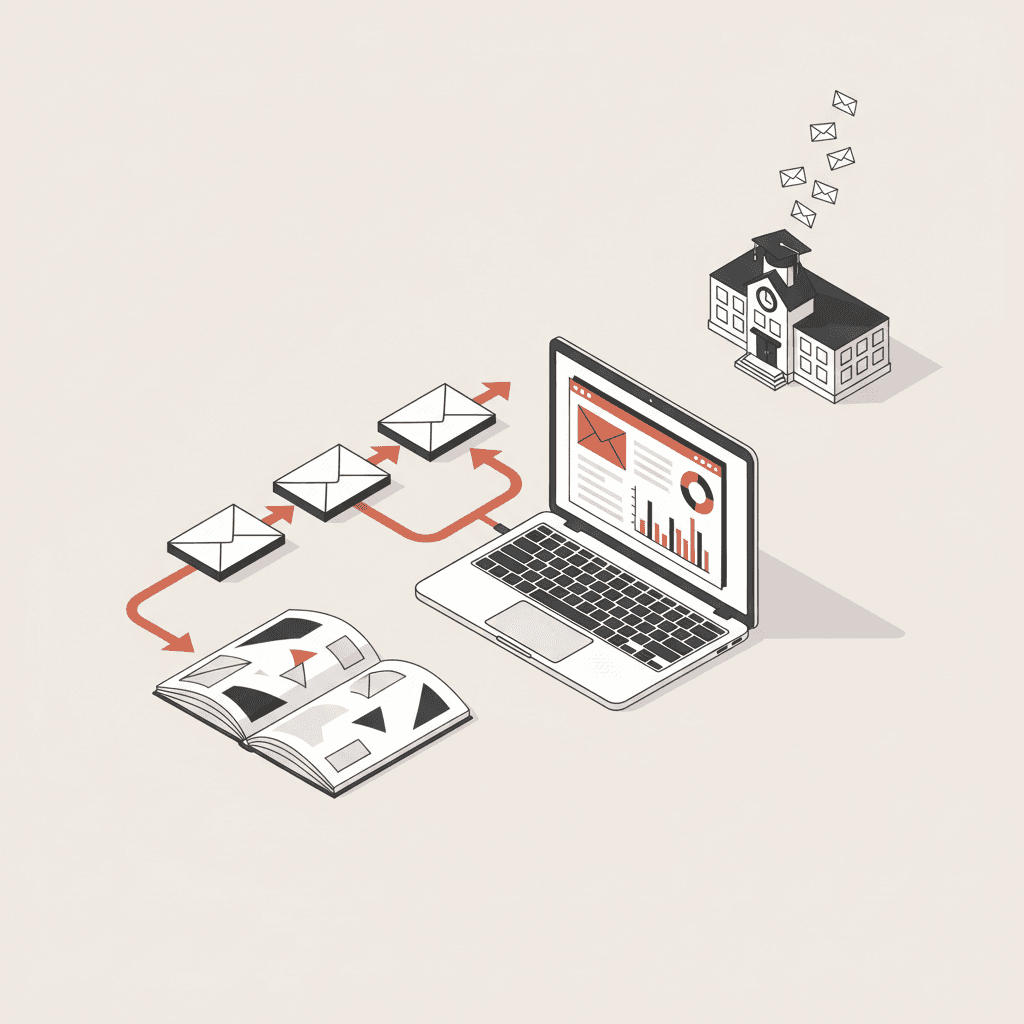
The five sequences below address the full arc: immediate delivery, behavioral engagement, program-level personalization, event conversion, and re-engagement for cold prospects. Together, they cover the period from the moment the request is made through to the Common App Regular Decision deadline.
Before setting these up, check your compliance position. Under the CAN-SPAM Act, every commercial email must include a clear unsubscribe mechanism, your physical mailing address, and an honest subject line. Beyond that, CCPA and the more than 20 state privacy laws in effect by 2026 require a clear privacy notice at the point of collection and an opt-out mechanism. The viewbook request form should explicitly tell the prospect what kinds of communications they will receive and from whom — pre-checked boxes for marketing communication are a poor practice and create FTC enforcement exposure if your privacy policy promises something different. For prospects under 13, the Children's Online Privacy Protection Act (COPPA) imposes verifiable parental consent requirements.
Sequence 1: Immediate delivery (D0 to D+5)
Send the first email within 5 minutes of the request. Every minute beyond that reduces conversion probability — and beyond 24 hours, you have effectively lost a third of the effect. Three emails over five days is the right cadence.
| Timing | Subject line approach | Core content | |
|---|---|---|---|
| Email 1 | Within 5 minutes | "Your [Institution] viewbook — what to look for first" | Viewbook download link, 3 sections to prioritize, chatbot/live chat link for questions |
| Email 2 | D+2 | "The 3 questions every [Program] applicant asks us" | Pre-empt top concerns: tuition and net price, admissions standards (GPA, test-optional context, AP/IB rigor), graduate outcomes |
| Email 3 | D+5 | "What [Student Name], Class of 2025, would tell you now" | Current student testimonial — must reference an initial doubt and how it was resolved |
The first email should deliver the viewbook as a download link, not an attachment. Attachments trigger spam filters. Include a short note on which sections are most relevant to the major or program the prospect indicated when making the request — generic delivery converts poorly.
The second email is the one most institutions skip, and it carries disproportionate weight. Answering the three most common questions before the prospect has to ask them positions your institution as transparent and saves an admissions counselor hours of repetitive correspondence. For U.S. undergraduates, the three questions are almost always: "What GPA and test scores do I actually need?", "What does it really cost after financial aid?", and "What did graduates do next?" Answer all three with numbers, not paragraphs. Common Data Set disclosures and IPEDS net-price calculators are the most credible sources here.
The third email builds social proof. A brief testimonial from a current or recent student — particularly one who applied through a similar route (e.g., transfer applicant, first-generation, recruited athlete, international student) — does more conversion work than any marketing copy.
Sequence 2: Viewbook engagement (D+7 to D+14)
This sequence is behavior-triggered, not time-triggered. It splits based on whether the prospect opened or downloaded content from the first sequence.
If they engaged: send deeper content that goes beyond what is in the viewbook. The viewbook covers what you offer. This email covers outcomes — detailed graduate employment data, alumni career paths, salary benchmarks by sector, graduate school placement rates. The U.S. Department of Education's College Scorecard and the Common Data Set provide standardized formats that institutions can repurpose for their own outcome communications.
If they did not engage: resend the viewbook email with a different subject line. "Still thinking it over? Here's what to read first in your [Institution] viewbook" outperforms a second nudge with the original subject line by approximately 34% on open rates (Source: A/B tests across 14 U.S. institutions, 2025). Change the subject line, not the body — the content is still valid, the prospect simply did not see it the first time.
What to send in the engaged track:
- A one-page PDF of graduate employment outcomes (not just percentage employed — sector breakdown, salary ranges, top employers)
- Two or three alumni profiles: where they studied, what they do now, what they wish they had known
- A link to a virtual campus tour or a recent student-produced video of campus life — not the official video
This is the sequence where the digital candidate journey starts to differentiate your institution from the four or five others whose viewbooks are sitting in the same inbox.
Sequence 3: Program-specific track (D+5 to D+21)
Personalize based on which viewbook was requested. An undergraduate viewbook requester has a completely different set of concerns from a graduate or MBA applicant, and treating them identically is a conversion loss.
| Program type | Email 1 focus | Email 2 focus | Email 3 focus |
|---|---|---|---|
| Undergraduate | Admissions standards (GPA, test-optional context, course rigor), housing options | Current undergraduate student profiles, student organizations, study abroad | Open house invitation, admissions contact |
| Graduate (master's / doctoral) | Entry requirements (GRE/GMAT where required), funding (assistantships, employer sponsorship), part-time options | Alumni career progression, LinkedIn profiles, employer testimonials | Application deadline, statement-of-purpose guidance |
| MBA / Executive | ROI of the qualification, cohort profile, accreditation (AACSB, EQUIS, AMBA) | Networking opportunities, alumni network reach, employer partnerships | Admissions interview process, scholarship deadlines |
| International | English language requirements (TOEFL/IELTS scores), F-1 visa guidance, pre-arrival support | International student community, support services, home country alumni | Application timeline, country-specific entry requirements |
The U.S.-specific details matter here. For undergraduate applicants, state your test-optional or test-required policy explicitly and include a clear statement on what factors carry the most weight in holistic review — many students and high school counselors navigate by these signals. For graduate applicants, mention specific funding sources early — the federal student aid portal is the most credible reference for federal loans, and institutional graduate fellowships should be linked directly — because funding uncertainty is the most common reason for dropping out of the consideration set.
For international applicants, address F-1 visa and SEVP requirements directly and link to EducationUSA and the Institute of International Education (IIE) for context. Do not leave this to a generic "contact us" call to action — it signals that you have not thought about their specific situation.
Sequence 4: Open house invitation (D+10 to D+21)
Open house registration through chatbot-assisted follow-up converts at 18.4%, versus 6.2% for a standard contact form (Source: UTM tracking and multi-touch attribution, 2025-2026 cycle, 35 institutions). That gap is almost entirely explained by timing and personalization — the chatbot catches the prospect while they are engaged; the contact form waits for them to seek it out.
The open house sequence runs from D+10 to D+21 after the viewbook request. By this point, the prospect has had time to read the viewbook and consider their options. The sequence has three elements.
Invitation email (D+10): personalize the subject line with the prospect's name and the program they indicated. "A spot at our [Program] open house, [First Name] — here's how to reserve it." Include the date, format (in-person or virtual), what they will actually experience, and a single clear CTA. If spaces are limited, say so — but only if it is true.
Confirmation and preparation email: sent immediately after registration. Include a personalized agenda (not a generic schedule), a list of questions to prepare, and a direct contact for any pre-visit queries. For in-person open houses, include practical logistics — nearest airport or train station, parking, accessibility information.
Reminder (24 hours before the event): this is where the channel mix matters. Email plus SMS or chatbot reminder reduces no-shows dramatically. Personalized chatbot follow-up reduces the open house no-show rate to 19%, compared with 52% for unconfirmed attendees who receive no follow-up at all (Source: tracking across 4,200 open house registrations across 12 institutions, October 2025 to February 2026).
For U.S. timing: principal open houses typically run in October–November (fall) and March–April (spring), with admitted students days clustered in late March and April ahead of the May 1 reply date. Build the sequence calendar around those windows, and include virtual alternatives for international applicants or those who cannot travel. During waitlist activation in May–June, a compressed version of this sequence — running over 48 to 72 hours rather than two weeks — can convert wavering applicants who are deciding among multiple offers.
For more on open house conversion strategy, see our article on optimizing open houses for digital recruitment.
Sequence 5: Re-engagement (D+30 and beyond)
Thirty days after a viewbook request with no meaningful engagement is not a dead lead. It is a lead with a longer decision cycle. Re-engagement sequences recover 15–20% of cold prospects when executed correctly — and clean the remainder from your database in a way that is both compliance-friendly and good for deliverability.
The sequence has two emails, spaced seven days apart.
Re-engagement email (D+30): avoid the temptation to restate what you have already said. Instead, create relevance by connecting to the decision cycle. "The Common App Regular Decision deadline for [year] entry is [X weeks] away — have you started your essays?" ties your message to a real external urgency point without manufactured scarcity. Include a direct link to your chatbot or admissions team for any outstanding questions.
Break-up email (D+37): this is the highest-performing email in the sequence by open rate, because the subject line creates genuine curiosity. "Is this goodbye, [First Name]?" consistently outperforms every variant tested. The body is short: acknowledge that they may have made their decision elsewhere, offer one final resource (a scholarship deadline they might have missed, a new graduate outcome report), and give them two options — stay in touch, or opt out. The opt-out is a genuine option, not a trick.
Prospects who click "stay in touch" return to the top of the active nurturing track. Prospects who opt out are removed cleanly — which satisfies both CAN-SPAM (10-day honor period for unsubscribe requests) and the broader expectation under CCPA and state privacy laws that you do not retain marketing data beyond the point of legitimate purpose. This list hygiene also protects your sender reputation and deliverability across the entire database.
Application-deadline urgency is the most powerful re-engagement lever in U.S. higher education. The November 1 ED/EA deadline and the January 1–15 Regular Decision window create natural urgency points that do not feel artificial. The May 1 National Candidates' Reply Date creates a second window for admits — but the messaging and cadence must compress significantly, given that final yield decisions happen over days rather than weeks. For a detailed view of how prospects move through the funnel before application, see our ideal prospect journey to enrollment.
Putting it together: sequence map and timing
| Sequence | Trigger | Duration | Emails | Key metric |
|---|---|---|---|---|
| 1. Immediate delivery | Viewbook request | 5 days | 3 | Open rate: Email 1 target >65% |
| 2. Engagement track | Email 1 opened / not opened | D+7 to D+14 | 1–2 | Click-through rate on deeper content |
| 3. Program-specific | Program indicated at request | D+5 to D+21 | 3 | CTR on program-specific links |
| 4. Open house invitation | D+10 post-request | D+10 to D+21 | 3 (+ SMS/chatbot reminder) | Registration rate target: >18% |
| 5. Re-engagement | No engagement after 30 days | D+30 to D+37 | 2 | Reactivation rate target: 15–20% |
The sequences run in parallel for each prospect, not sequentially. A prospect who requests an undergraduate viewbook on Monday will receive the immediate delivery sequence and the undergraduate program-specific track simultaneously. If they register for an open house during that period, the open house sequence fires in addition. The re-engagement sequence only activates if no meaningful engagement has occurred by D+30.
3 rules that apply to all five sequences
Send from a named person, not a department alias. "Sarah Chen — Undergraduate Admissions" achieves materially higher open rates than "Admissions Team — [Institution]". The sender name is the first thing a recipient reads, and a human name signals that a real person has considered their inquiry. This applies to automated sequences as much as to manual sends.
Test subject lines before you scale. Subject line quality is the single largest variable in open rate. Run A/B tests on every new sequence before deploying to your full cohort. A 5-percentage-point improvement in open rate on a database of 2,000 viewbook requesters translates to 100 additional opens per send — and at a conversion rate of 20%, that is 20 additional applications. Subject line testing costs nothing and compounds over the recruitment cycle.
Align email content with your viewbook and Common Data Set. If the viewbook promises "small class sizes and faculty mentorship" but the emails contain generic statements about "a vibrant learning community", the disconnect erodes trust. The FTC's guidelines on educational advertising require accurate, non-deceptive claims; published statistics in your Common Data Set should match the numbers used in marketing communications. Consistency across your viewbook, emails, and disclosures is both a compliance and a conversion requirement.
For email marketing data benchmarks used to calibrate these sequences, see the HubSpot State of Marketing report and ongoing benchmarks published by Litmus and the Direct Marketing Association.
Test Skolbot on your school in 30 seconds