 ChatGPT
 Claude
 Perplexity
 Gemini
 Grok
GrokWhy the digital candidate journey is non-negotiable in 2026
A fully digital candidate journey is no longer a differentiator for US higher education — it's the baseline expectation of every high school senior comparing their college choices at 11pm. By the time a prospective student fills in a Common App or Coalition App application, they have typically spent weeks researching, comparing, and forming opinions about institutions without ever speaking to an admissions officer.
The numbers tell a stark story: 91% of visitors leave a higher education website without making any contact, dropping out between their first visit and a first inquiry (Source: funnel analysis across 30 institutions, 2025-2026 cohort). That's not a problem of program quality — it's a journey design problem. Colleges and universities that build a coherent, available-24/7 digital candidate journey are the ones capturing applicants that others lose.
This guide walks through the six stages of a digital candidate journey, with tools and benchmarks drawn from institutions that consistently outperform the sector average.
The 6 stages of the digital candidate journey
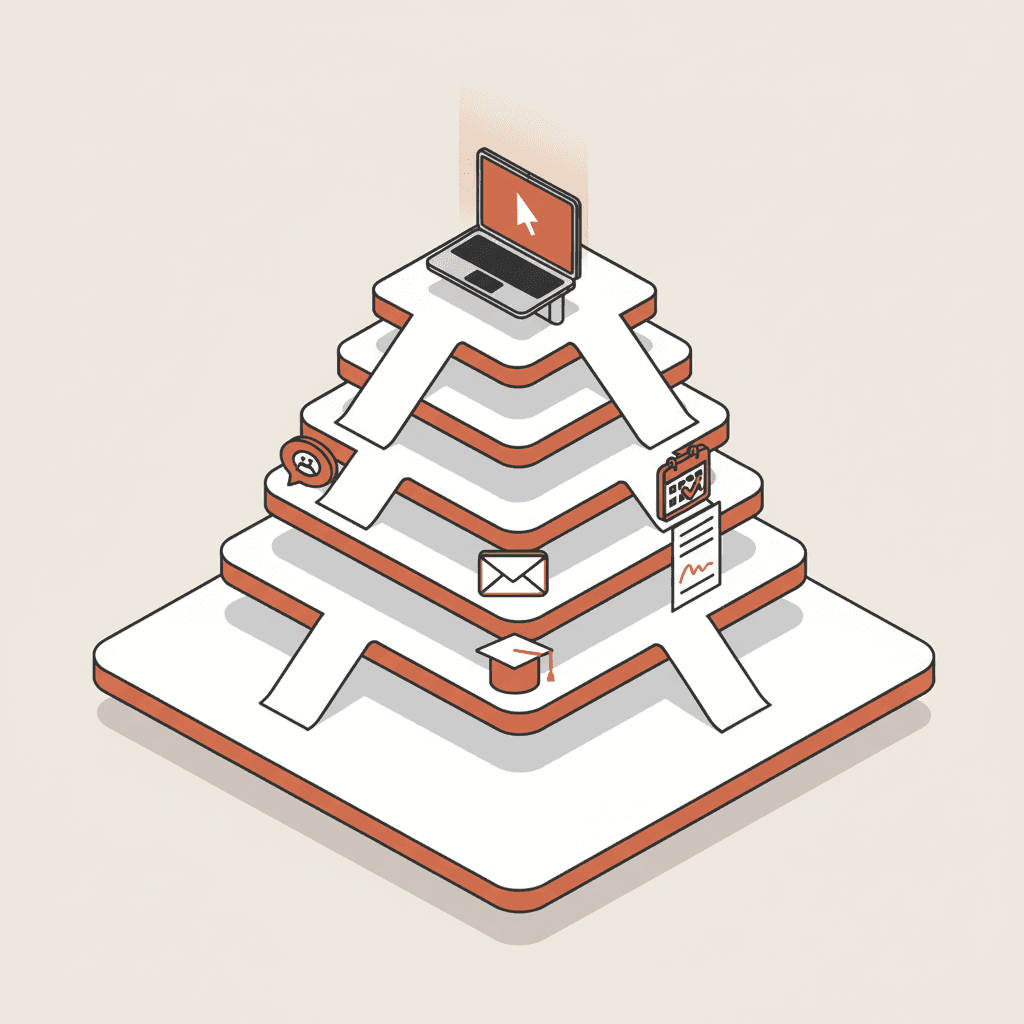
Every well-structured digital candidate journey passes through six distinct moments, each with its own conversion challenge.
| Stage | Objective | Primary channel | Average drop-off |
|---|---|---|---|
| 1. Discovery | Generate visibility | SEO, social, GEO | — |
| 2. Exploration | Capture intent | Website, landing pages | 68% bounce rate |
| 3. First contact | Convert curiosity | Chatbot, inquiry form, live chat | 91% drop-off |
| 4. Nurturing | Qualify and keep warm | Email, SMS, chatbot | 64% drop-off |
| 5. Campus visit / virtual event | Confirm the choice | Event, webinar | 35% no-show |
| 6. Application → enrollment | Close | Application portal, CRM | 18% final drop-off |
Stage 1: Discovery — being found before being chosen
The candidate journey starts long before the prospective student reaches your website. They search Google, ask ChatGPT which business schools offer good placement rates, or scroll through Instagram and TikTok for student life videos. If your institution doesn't appear in those moments, it doesn't exist for them.
In 2026, GEO (Generative Engine Optimization) matters as much as traditional SEO. AI engines like ChatGPT, Perplexity and Gemini answer questions like "which US colleges offer part-time MBA programs?" directly in their responses. Only 29% of US higher education websites appear in ChatGPT responses on sector-specific queries (Source: Skolbot GEO monitoring, 500 queries × 6 countries × 3 AI engines, Feb 2026).
Discovery strategy rests on three pillars: SEO content targeting real prospect questions (tuition, admission requirements, career outcomes, accreditation), Schema.org EducationalOrganization structured data for AI engines, and authentic short-form social content where prospective students look for peer proof — not institutional broadcasts. Niche, BigFuture by College Board, and College Scorecard listings should also be claimed and optimized — these third-party platforms feed both human and AI search.
Accreditation status (regional accreditors such as SACSCOC, HLC, MSCHE, WASC, NEASC, NWCCU; programmatic accreditors where applicable), IPEDS data, and Carnegie Classification are increasingly referenced by AI engines when recommending institutions. Making sure these credentials are findable and cited on your site materially improves GEO visibility.
Stage 2: Exploration — turning a visit into intention
A prospective student who lands on your site has a question. Usually several. The quality of your digital journey is measured by your ability to answer those questions before they leave to find an answer elsewhere.
The average bounce rate on a higher education website without chat is 68%, falling to 41% with an AI chatbot — a 39.7% reduction (Source: A/B test across 22 partner institution websites, Sept–Dec 2025). The difference isn't the quality of the design — it's the availability of answers. An AI chatbot visible on the homepage, program pages and tuition pages intercepts intent before it evaporates.
The pages that matter most are the ones 92% of prospective students visit before asking their first question: the program/major page, the tuition and financial aid page, and the admissions/admission requirements page (Source: analytics + session replay, 15,000 prospect journeys, 2025-2026 cycle). Every gap in those pages — an unlisted concentration, a vague "contact us for tuition" — is an exit point.
Stage 3: First contact — available when students actually search
67% of prospect activity happens outside working hours, with the absolute peak on Sunday evenings between 8pm and 9pm (Source: Skolbot interaction logs, 200,000 sessions, Oct 2025–Feb 2026). An inquiry form with a 48-hour response time doesn't fit the decision pace of a high school senior weighing up their college options at midnight.
First contact must be instant, available 24/7 and precise enough to add real value. AI chatbots respond in 3 seconds, compared to 47 hours for email (Source: mystery shopping audit, 80 institutions, 2025). They can initiate campus visit registration, collect qualifying information and hand over to a human counselor for the 7% of complex inquiries that genuinely require intervention (Source: automatic classification, 12,000 Skolbot conversations, 2025).
The conversion difference is clear: 18.4% of campus visit registrations come through the site chatbot, compared to just 6.2% via the traditional contact form (Source: UTM tracking, 2025-2026 cycle, 35 institutions). During the May 1 decision period — where students make high-stakes decisions in hours — a 3-second response versus a 48-hour email response is the difference between securing an enrollment and losing it.
Stage 4: Nurturing — staying relevant without becoming noise
Between first contact and a firm decision to apply, prospective students consult an average of 7 to 12 sources. Nurturing is about staying present in their deliberation without being intrusive.
An effective digital nurturing sequence combines three streams: personalized emails based on the specific program consulted (not a generic newsletter), SMS reminders for events, and chatbot follow-ups for incomplete applications. The goal isn't to push a decision — it's to make sure your institution is still on the list when the student is ready to commit.
Personalization drives the difference: an email referencing "your interest in our BS Business Administration program" converts 3–5× better than a generic "Discover our university" communication. The Common App and Coalition App are touchpoints many institutions underuse — a coordinated digital presence that extends beyond the application form itself, into the nurturing that happens before and after submission.
Stage 5: The campus visit — where decisions crystallize
The campus visit (in-person, virtual, or hybrid) and the admitted students day remain the highest-converting events in the recruitment cycle. The average no-show rate without any reminder is 52%, but a personalized chatbot follow-up reduces it to 19% (Source: tracking 4,200 open day registrations across 12 institutions, Oct 2025–Feb 2026).
The digital journey should prepare the visit, not just announce it. Sending a registered student the specific session schedule relevant to their major interest, the campus map, and the name of their dedicated counselor — these micro-touchpoints turn a registration into actual attendance.
For virtual visits, experience quality matters as much as in-person. Live-chat webinars, 360° virtual campus tours, and real-time student panel Q&As convert significantly better than pre-recorded video libraries.
Stage 6: Application to enrollment — don't lose at the finish line
The final stage is the most neglected. 18% of students who have submitted an application don't reach final enrollment (Source: funnel analysis, 30 institutions, 2025-2026 cohort). This is late-stage attrition on candidates who have already been qualified, nurtured and convinced — what the sector calls "summer melt" when it occurs between deposit and matriculation.
The causes are predictable: a lengthy enrollment form, missing documents not flagged in time (FAFSA verification, final transcripts, immunization records, housing forms), or a post-admission communication blackout that feels like being forgotten. A complete digital candidate journey automates reminders for incomplete documents, confirms each step via email or SMS, and maintains a chatbot contact thread until the student matriculates.
For institutions that recruit through Common App, Coalition App, and direct entry channels, the challenge is maintaining a consistent digital experience across all pathways — Common App applicants need the same quality of nurturing and responsiveness as direct applicants and transfer students.
Tools for a digital candidate journey in 2026
| Tool | Function | Common platforms | Integration |
|---|---|---|---|
| Education CRM | Candidate tracking | Slate, Salesforce Education Cloud, TargetX, HubSpot | API |
| AI chatbot | 24/7 contact, campus visit registration | Skolbot, Intercom | JS widget |
| Email automation | Sequenced nurturing | Mailchimp, HubSpot, Constant Contact | Native CRM |
| SMS / WhatsApp | Event reminders | Twilio, Mongoose CampusESP | API |
| Application portal | Document submission and tracking | Common App, Coalition, direct portal | Web / API |
| Webinar / live event platform | Virtual visits | Zoom, Hopin, Teams | CRM integration |
The most common mistake is deploying these tools in silos. A CRM that doesn't talk to the chatbot, an email automation tool disconnected from application tracking — every break in the system becomes a break in the candidate experience. Integration is as important as the quality of individual tools.
Benchmarks: what does a strong digital candidate journey look like?
An optimized journey achieves these thresholds across a recruitment cycle:
| Metric | Sector average | Optimized benchmark |
|---|---|---|
| Website bounce rate | 68% | < 45% |
| Visit-to-inquiry conversion | < 1% | 2–4% |
| Campus visit no-show rate | 52% | < 20% |
| First contact response time | 47h (email) | < 5 min (chatbot) |
| Application to enrollment drop-off | 18% | < 10% |
| Chatbot ROI at 12 months | — | 280% |
For more on conversion benchmarks by institution type, see our analysis of website conversion rates for higher education.
FAQ — Digital candidate journey for US higher education
How long does it take to digitize a candidate journey?
A minimum deployment — chatbot, email automation and CRM — can be live in 4 to 8 weeks. A complete journey including Common App integration, virtual campus visits and advanced analytics typically takes 3 to 6 months. The median payback period for an AI chatbot investment is 5 months (Source: median results across 18 institutions, 2024-2025).
Does digital replace admissions staff?
No — it extends them. 72% of prospect questions are answerable FAQs: tuition, admission requirements, term dates, accreditation. The chatbot handles those in 3 seconds, around the clock. The 7% of complex cases — application essays, extenuating circumstances, bespoke financial aid inquiries — still require human interaction (Source: automatic classification, 12,000 Skolbot conversations, 2025). Digital frees up admissions teams for those high-value conversations.
How does the May 1 decision deadline fit into a digital journey?
May 1 — the National College Decision Day — is the highest-stakes moment in US recruitment alongside the waitlist and summer melt windows. Students make decisions in hours, not weeks. Institutions that have AI chatbots active during the run-up to May 1 capture inquiries that a phone-only approach misses. Real-time chatbot availability during the final weeks before deposit deadline consistently generates enrollments that would otherwise go to faster-responding institutions.
What data protection rules apply to chatbot conversations?
In the US, FERPA, CCPA (California), and a growing patchwork of state privacy laws (Virginia, Colorado, Connecticut, Texas, and 20+ others enacted by 2026) apply to personal data collected via chatbots. Institutions must provide a clear privacy notice, offer prospects the right to access and delete their data where state law applies, and limit data collection to what's necessary for the stated purpose. The FTC also enforces against unfair or deceptive practices in privacy policies — promises made on the chatbot or website are effectively binding.
How do we measure ROI on digital candidate journey investment?
Three key metrics: cost per enrolled student (sector benchmark: $3,000–$5,000 at private four-year institutions), visit-to-enrollment conversion rate (optimized benchmark: 2–4%), and campus visit no-show rate (optimized: < 20%). Reducing no-shows alone through chatbot reminders can translate to dozens of additional enrollments per cycle without increasing the marketing budget.
See how Skolbot builds the digital candidate journey for US higher education — test it on your institution in 30 seconds
Building your digital candidate journey and want to see how Skolbot performs in practice? Request a personalized demonstration
Further reading: our complete guide to recruiting more students in higher education and what Gen Z actually expects from a school website.