 ChatGPT
 Claude
 Perplexity
 Gemini
 Grok
GrokA structured RFP eliminates 80% of selection mistakes
Most universities choose their chatbot after a 30-minute demo and a pricing negotiation. Six months later, the tool gives irrelevant answers, nobody checks the analytics, and the admissions team goes back to the contact form.
The problem is not the chatbot. It is the absence of a proper specification document. Without formalized criteria, every stakeholder evaluates the solution against their own priorities — IT looks at integration, the VP of Enrollment wants leads, the CFO compares prices. The result is a decision by default, not by method.
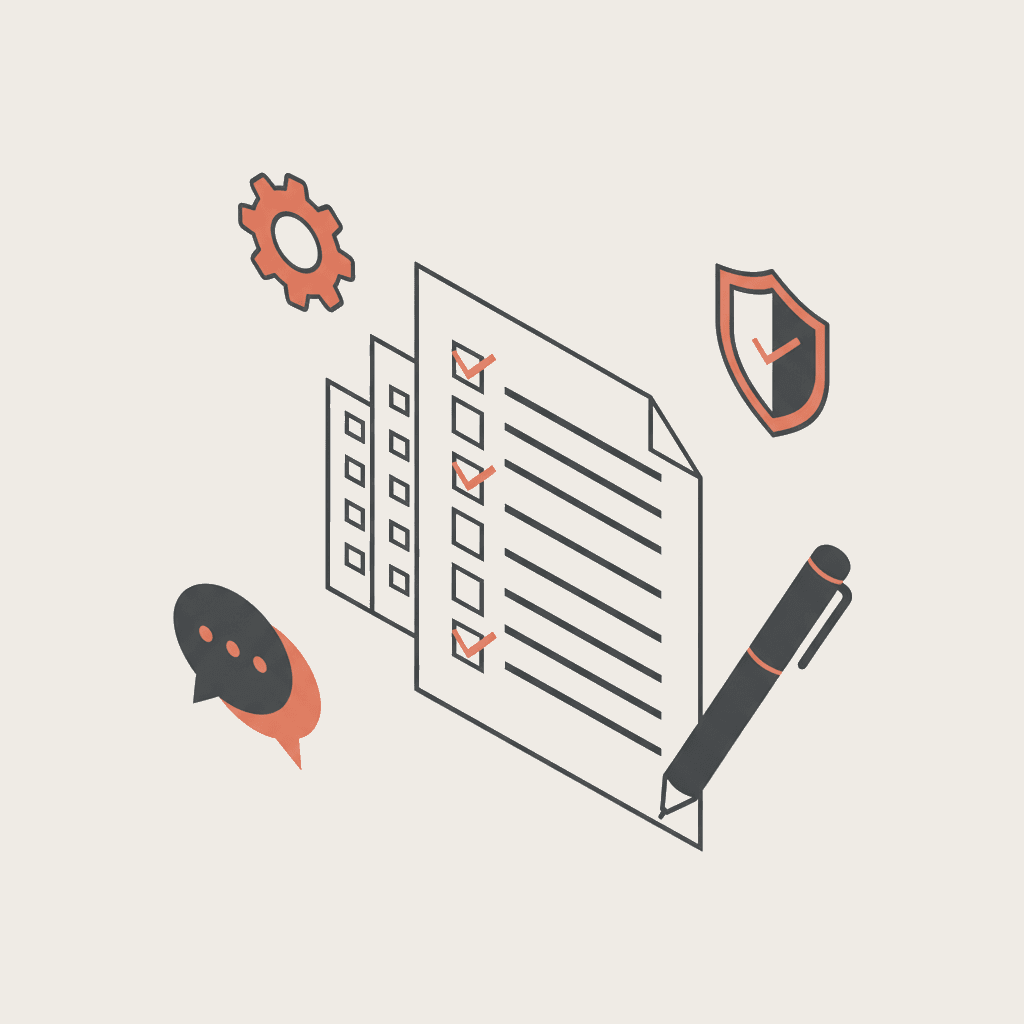
This guide provides the 12 criteria to include in your chatbot RFP, organized into four blocks: functional, technical, compliance and support. Each criterion includes a concrete acceptance threshold and a recommended weighting for the evaluation grid.
The benchmarks cited come from the analysis of 200,000 chatbot sessions across 50 partner institutions between October 2025 and February 2026 (source: Skolbot internal data).
The 12-point checklist: overview
Before diving into the detail, here is the full grid. Each criterion is grouped by block and weighted according to its impact on student recruitment.
| # | Block | Criterion | Weight |
|---|---|---|---|
| 1 | Functional | Training on institution-specific data | 15% |
| 2 | Functional | Native multilingual support | 12% |
| 3 | Functional | Automatic campus tour registration | 10% |
| 4 | Functional | Analytics and reporting | 8% |
| 5 | Technical | CMS / CRM integration | 10% |
| 6 | Technical | Deployment timeline | 8% |
| 7 | Technical | Uptime SLA | 5% |
| 8 | Technical | Performance and response time | 5% |
| 9 | Compliance | FERPA and data privacy | 10% |
| 10 | Compliance | AI transparency and governance | 5% |
| 11 | Support | Onboarding and training | 7% |
| 12 | Support | Support SLA and dedicated CSM | 5% |
The total reaches 100%. Adjust the weightings to match your institution's priorities — but do not remove any criterion. A chatbot that excels functionally but fails on compliance exposes the university to real legal risk.
Functional requirements: what the chatbot must do
1. Training on institution-specific data (15%)
The chatbot must answer questions specific to your institution, not sector generalities. Analysis of 12,000 Skolbot conversations (Sept 2025 — Feb 2026) reveals that 89% of prospects ask about tuition costs and 78% about internship and co-op programs. A chatbot that does not know your tuition rates or your internship offerings fails on the most frequent questions.
Acceptance threshold. The chatbot must correctly answer 90% of the top 10 prospect questions (tuition and fees, career outcomes, internships and co-ops, housing, study abroad, admissions requirements, financial aid and scholarships, degree recognition, campus life, AP/transfer credit policies) within 48 hours of deployment.
Question to ask the vendor: "How is the chatbot fed content? Automatic scraping, manual import, or both? What is the update lag when a program changes?"
2. Native multilingual support (12%)
58% of international prospects are not native speakers of the institution's primary language (source: language detection, 8,500 Skolbot conversations, 2025-2026). A monolingual chatbot cuts access to more than half of the international pipeline.
Acceptance threshold. Automatic language detection, response in the same language, coverage of at least 10 languages without quality degradation.
Common trap. "Automatic translation" is not "native multilingual." A chatbot that translates its English response into Mandarin or Spanish produces approximate content and misses the nuances of local education pathways. International students need answers that reflect their specific admissions path — whether that involves I-20 forms, SEVP requirements, or credential evaluation through WES or ECE.
3. Automatic campus tour registration (10%)
The chatbot must detect visit intent and offer registration within the conversation, not simply link to a form. Tracking data across 35 institutions (2025-2026) shows a campus tour registration rate of 18.4% via chatbot versus 6.2% via form — a 3x factor.
Acceptance threshold. In-conversation registration (no external redirect), instant confirmation, personalized reminders at D-7 and D-1 with a no-show rate below 20%. For reference, the no-show rate without any reminder reaches 52% (source: tracking of 4,200 campus event registrations across 12 institutions, 2025-2026).
4. Analytics and reporting (8%)
Without data, the chatbot is a black box. The dashboard must provide at minimum: conversation volume, top questions, resolution rate, human handoff rate, and conversions (campus tours, inquiry forms, applications).
Acceptance threshold. Dashboard accessible without technical skills, CSV/API export, segmentation by program/campus/language, and alerts on anomalies (spike in questions on a topic = problem on the site or program change).
Technical requirements: how the chatbot integrates
5. CMS / CRM integration (10%)
The chatbot must integrate with your existing ecosystem, not replace it. Critical integrations: CMS (WordPress, Drupal, headless), CRM (Salesforce Education Cloud, Slate by Technolutions, HubSpot, Ellucian Banner, Jenzabar), and marketing automation tools.
Acceptance threshold. JavaScript snippet for the CMS (deployment without a developer), webhook or REST API for the CRM (real-time lead synchronization), and complete technical documentation.
Question to ask: "Does your chatbot push leads into our CRM in real time or in batch? Which fields are synchronized?"
6. Deployment timeline (8%)
The seasonality of student recruitment makes timing critical. A chatbot deployed after the Common App Regular Decision deadline (January) or after National College Decision Day (May 1) has missed its value window.
Acceptance threshold. Less than 2 weeks from contract signature to production, including training on institution content. Education-specialist solutions achieve 48 hours; generic solutions require 4 to 8 weeks of configuration.
7. Uptime SLA (5%)
67% of prospect activity occurs outside office hours, peaking on Sunday evenings (source: 200,000 Skolbot sessions, 2025-2026). A chatbot that goes down at weekends cancels the main competitive advantage.
Acceptance threshold. SLA of 99.9% minimum (less than 8h45 of downtime per year), with real-time monitoring and alerts.
8. Performance and response time (5%)
Acceptance threshold. Response time below 5 seconds for 95% of queries. Field data shows a median of 3 seconds for education-specialist AI chatbots, versus 47 hours for email and 72 hours for contact forms (source: mystery shopping audit across 80 institutions, 2025).
Compliance: what the law requires
9. FERPA and data privacy (10%)
Any chatbot that collects prospect data — including data from minors — must comply with FERPA (Family Educational Rights and Privacy Act) once a student enrolls, and with applicable state privacy laws (such as CCPA in California, VCDPA in Virginia, CPA in Colorado) from the first interaction.
Acceptance threshold. Data hosted in the United States on SOC 2 Type II certified infrastructure, signed data processing agreement, operational right to data deletion within 72 hours, and clear consent mechanisms before any data collection. The US Department of Education's Student Privacy Policy Office publishes specific guidance on the intersection of AI and student records. Additionally, the FTC regulates deceptive practices related to AI tools marketed to consumers.
Critical question: "Where is conversation data hosted? Who has access? What is the deletion process upon request? Are you SOC 2 compliant?"
10. AI transparency and governance (5%)
The Executive Order on AI (14110) and the NIST AI Risk Management Framework establish expectations for responsible AI use. While not as prescriptive as the EU AI Act, institutional accreditation bodies and state legislatures are increasingly requiring transparency when AI interacts with students.
Acceptance threshold. Explicit notice "You are chatting with an AI assistant" at the start of every conversation, accessible technical documentation of the AI system, and a mechanism to transfer to a human at any time. Your institution's accreditor (whether SACSCOC, HLC, MSCHE, WASC, NEASC, or NWCCU) may have additional guidance on AI use in student-facing processes.
Support: what makes the difference after signing
11. Onboarding and training (7%)
A high-performing chatbot poorly configured produces the same results as a mediocre chatbot. Onboarding must include: assisted initial setup, admissions team training, and content validation before go-live.
Acceptance threshold. Dedicated training session (not a generic webinar), joint validation of the chatbot on the 20 most frequent questions, and customized internal documentation.
12. Support SLA and dedicated CSM (5%)
Acceptance threshold. Support response time below 4 hours on business days, a dedicated CSM (Customer Success Manager) with higher education sector knowledge, and quarterly performance reviews with optimization recommendations.
Evaluation grid: the ready-to-use template
Use this matrix to score each candidate solution. Each criterion is rated from 1 (insufficient) to 5 (excellent), then multiplied by its weight.
| Criterion | Wt. | Solution A | Solution B | Solution C |
|---|---|---|---|---|
| 1. Institution-specific training | 15% | _/5 x 0.15 = _ | _/5 x 0.15 = _ | _/5 x 0.15 = _ |
| 2. Native multilingual | 12% | _/5 x 0.12 = _ | _/5 x 0.12 = _ | _/5 x 0.12 = _ |
| 3. Campus tour auto-registration | 10% | _/5 x 0.10 = _ | _/5 x 0.10 = _ | _/5 x 0.10 = _ |
| 4. Analytics | 8% | _/5 x 0.08 = _ | _/5 x 0.08 = _ | _/5 x 0.08 = _ |
| 5. CMS/CRM integration | 10% | _/5 x 0.10 = _ | _/5 x 0.10 = _ | _/5 x 0.10 = _ |
| 6. Deployment timeline | 8% | _/5 x 0.08 = _ | _/5 x 0.08 = _ | _/5 x 0.08 = _ |
| 7. Uptime SLA | 5% | _/5 x 0.05 = _ | _/5 x 0.05 = _ | _/5 x 0.05 = _ |
| 8. Response time | 5% | _/5 x 0.05 = _ | _/5 x 0.05 = _ | _/5 x 0.05 = _ |
| 9. FERPA / Data privacy | 10% | _/5 x 0.10 = _ | _/5 x 0.10 = _ | _/5 x 0.10 = _ |
| 10. AI transparency | 5% | _/5 x 0.05 = _ | _/5 x 0.05 = _ | _/5 x 0.05 = _ |
| 11. Onboarding | 7% | _/5 x 0.07 = _ | _/5 x 0.07 = _ | _/5 x 0.07 = _ |
| 12. Support / CSM | 5% | _/5 x 0.05 = _ | _/5 x 0.05 = _ | _/5 x 0.05 = _ |
| TOTAL | 100% | _/5 | _/5 | _/5 |
How to interpret the score. Below 3/5, the solution has structural gaps. Between 3 and 4, it works with trade-offs. Above 4, it covers the needs of an American higher education institution.
For a detailed comparison of market solutions, see our AI chatbot comparison for higher education. To understand why chatbots outperform contact forms, read our chatbot vs form analysis. You can also explore all our head-to-head analyses on our comparison page.