 ChatGPT
 Claude
 Perplexity
 Gemini
 Grok
GrokOpen days still reign — but most institutions waste them
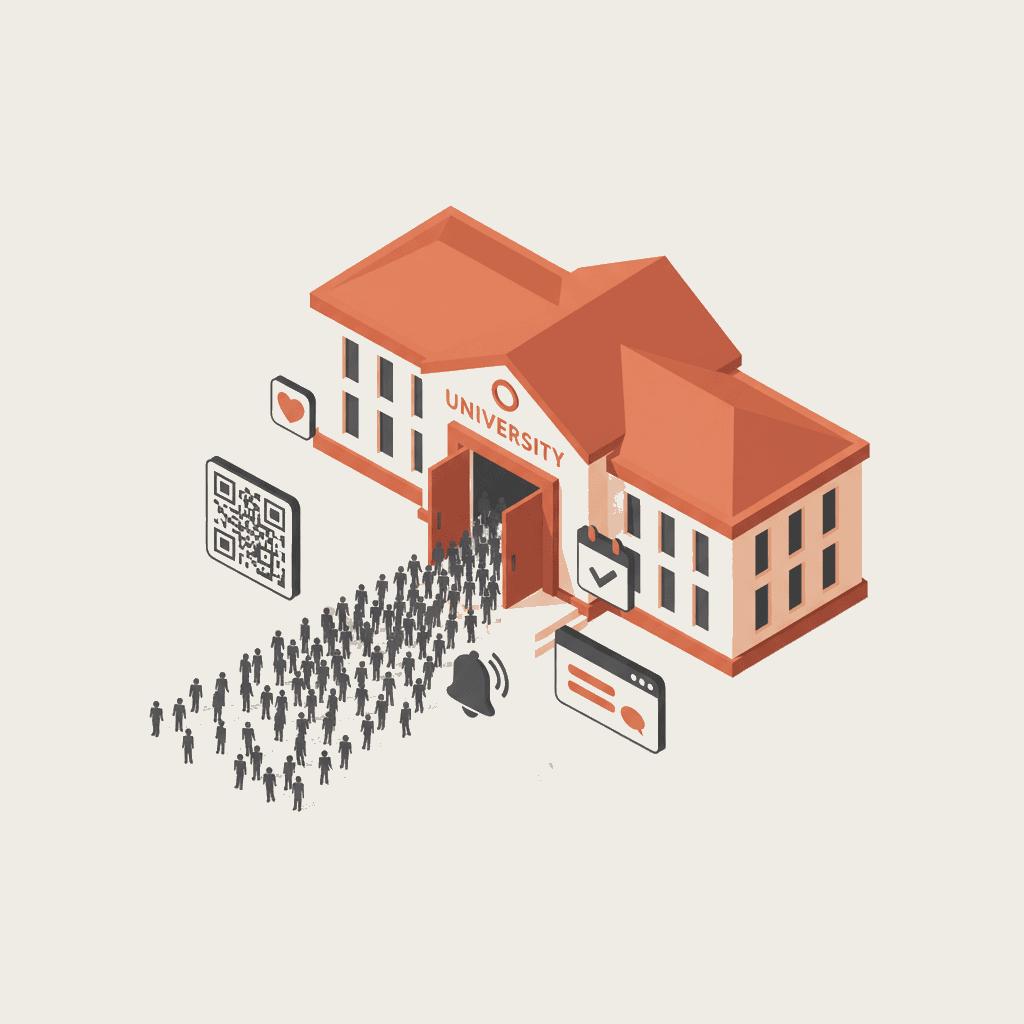
Open days remain the single most powerful conversion channel in higher education. A visitor who attends an open day is 4.8x more likely to enrol than one who only browses the website (Source: Skolbot conversion analysis, 40 partner institutions, 2025-2026 cycle). No other channel — website, education fair, paid advertising — comes close.
Yet the typical open day journey at Australian universities still looks like this: a registration page (sometimes a bare Google Form), a confirmation email, the event itself, then radio silence for five to fifteen days before a generic follow-up. The result: only 23% of open day visitors go on to submit a preference through UAC, VTAC, QTAC, SATAC, TISC or a direct application (Source: Skolbot cohort tracking, 40 institutions, 2024-2025 and 2025-2026 cycles).
That figure can be tripled. The eight institutions in our panel that digitised the entire journey — before, during and after the event — achieve an average 61% conversion from open day visitor to submitted application or preference. For a university welcoming 500 visitors, that gap means the difference between 115 and 305 applications.
This guide breaks the open day journey into three phases and identifies the digital levers that move the needle at each stage.
Phase 1 — Before the event: maximising qualified registrations
The registration page problem
In Australia, the open day season peaks between July and September — after mid-year exams and before the ATAR crunch in November-December. During this window, the open day registration page is often the most visited page on a university website. It is also one of the least optimised. The average conversion rate of an open day registration page is 31% — meaning 69% of interested visitors leave without signing up (Source: Skolbot analytics, 40 institution websites, 2025-2026 cycle).
The causes are predictable:
- Too many form fields — Every field beyond five reduces completion rates by 7-11% (HubSpot research)
- No social proof — No testimonials from previous visitors, no satisfaction figures
- No automated reminders — 38% of registrants forget or change their mind without follow-up
The levers that work
Three-field forms. Name, email, course of interest. Everything else can be collected afterwards. Institutions that cut from eight fields to three saw registration rates climb from 31% to 52% — a 68% uplift (Source: Skolbot A/B tests, 12 institutions, Oct 2025 — Jan 2026).
Pre-qualification chatbot. A chatbot on the open day page answers the recurring questions ("Can my parents come?", "How long does the visit last?", "Is there parking?", "Can I get a campus tour of the residence halls?") and nudges visitors to register in the same flow. Institutions using a chatbot on their open day page achieve a 47% registration rate versus 31% without — a 52% improvement (Source: Skolbot data, 22 institutions with/without chatbot, 2025-2026 cycle).
According to Skolbot tracking data across 35 institutions (2025-2026 season), chatbot-initiated registrations account for 18.4% of all open day sign-ups, compared to just 6.2% for standard web forms and 4.8% for email campaigns. Word-of-mouth (declarative attribution) still drives 12.6%, but the chatbot channel outperforms every other digital source.
Three-touch reminder sequence. An immediate confirmation email, an SMS 48 hours before, and a morning-of reminder. This sequence cuts no-show rates from 52% (no reminder at all) down to 14% when combining chatbot reminders with SMS (Source: Skolbot tracking, 4,200 registrations across 12 institutions, Oct 2025 — Feb 2026). SMS is the standout channel: 97% open rate versus 42% for email (Mobilesquared data).
In the Australian context, where open days compete with trial HSC exams in NSW, VCE practice exams in Victoria, and footy finals across the country, timing reminders strategically is critical. The best-performing institutions in our panel add a personalised programme reminder the evening before, which brings no-shows down to just 11%.
Phase 2 — During the event: capturing engagement data
The day itself is a goldmine of untapped data
Most institutions treat the open day as a purely physical event. The visitor arrives, tours the campus, asks questions, leaves. The only data captured is the entrance log — often a paper sign-in sheet or a basic QR code. Everything else — which stands they visited, what questions they asked, how long they stayed — is lost.
Institutions that digitise the on-site experience capture engagement data that transforms the follow-up phase.
Per-stand tracking QR codes
Each stand (course, student life, scholarships, accommodation, international exchange) has a unique QR code the visitor scans to access supplementary content: a detailed course sheet, a student testimonial video, a HECS-HELP calculator. Each scan is logged and linked to the visitor's profile.
Institutions using tracking QR codes capture an average of 4.3 interactions per visitor, compared to 1.2 for institutions using entry badges alone (Source: Skolbot data, 8 institutions with tracking vs 32 standard, 2025-2026 cycle). This data is invaluable for follow-up: a visitor who scanned the "work-integrated learning" and "scholarships" stands has an identifiable needs profile.
The chatbot as a visit companion
A chatbot accessible via QR code or short URL lets visitors ask questions during the visit, even when stands are crowded. Data shows that 27% of open day visitors ask at least one question via chatbot during the event when it is available (Source: Skolbot logs, 8 equipped institutions, 2025-2026 cycle).
Questions asked during an open day are qualitatively different from those asked online: they are more specific and further along the decision cycle. "What percentage of the Bachelor of Commerce is taught through industry placements?" versus "How much is the course?" These questions signal high intent and deserve personalised follow-up.
The satisfaction micro-survey
Sent by SMS within two hours of the visit ending, a three-question survey (30 seconds to complete) captures a hot impression. Response rate: 64% by SMS versus 18% by email (Source: data from 12 institutions, 2025-2026 cycle). The key question: "Would you like to be contacted by an adviser?" — asked within two hours, the "yes" rate is 41%, compared to 22% at Day+3.
Phase 3 — After the open day: the nurturing that converts
The post-event abyss
The most critical moment is the first 72 hours after the visit. The visitor's enthusiasm is at its peak but declines rapidly. Beyond 72 hours without contact, the visitor-to-application conversion rate drops from 47% to 19% (Source: Skolbot cohort tracking, 40 institutions, 2025-2026 cycle). This is consistent with broader data on response time impact on enrolments.
Yet the average first follow-up after an open day takes 8.4 days. Eight days during which the visitor has had time to attend two competitor events, receive their follow-ups, and move on.
The five-touch nurturing sequence
The highest-converting institutions follow a structured sequence:
Day+0 (that evening) — Personalised thank-you email. Not a generic blast. An email mentioning the course of interest identified during registration or via QR code scans. With a link to the UAC/VTAC/QTAC preference guide for the relevant programme and a video testimonial from a graduate of the relevant course.
Day+1 — SMS with targeted resource. A link to the course handbook or an upcoming Q&A webinar. SMS creates a touchpoint without being intrusive — it fits in 160 characters.
Day+3 — "Answers to your questions" email. A round-up of frequently asked questions from the open day with detailed answers. If the visitor asked questions via chatbot, the email answers them directly. Open rate: 48% with personalisation versus 22% without (Source: Skolbot data, 8 institutions).
Day+7 — Targeted phone call. Only for high-intent visitors (score 4-5/5 plus callback request). Conversion rate from this call: 67% (Source: data from 5 institutions).
Day+14 — Invitation to next step. Webinar, one-to-one appointment, or preference submission deadline reminder depending on profile. In Australia, this often coincides with the critical ATAR period in November-December — making timely contact even more important.
The cumulative impact
The eight institutions applying this full sequence reach a 61% open day visitor-to-application conversion rate, compared to 23% for those using standard follow-up. The breakdown:
Phase 1 (before): +68% registrations through simplified forms and chatbot. Phase 2 (during): 4.3 interactions captured per visitor through QR codes. Phase 3 (after): application conversion x2.6 through nurturing within 72 hours.
Five mistakes that kill open day conversion
Mistake 1: the over-long registration form
Every field beyond three is friction. Name, email and course of interest are enough for registration. The rest (phone number, Year 12 subjects, postcode) can be collected after the visit, once engagement is established.
Mistake 2: no follow-up within 72 hours
An average delay of 8.4 days is commercial suicide. Automate at least a thank-you email on the evening of the event. If you take only one action from this article, make it this one.
Mistake 3: generic follow-up
An identical email sent to every visitor ("Thanks for attending, here's our prospectus") achieves a 22% open rate. A personalised email by course of interest reaches 48%. Personalisation is not a luxury — it is a conversion multiplier.
Mistake 4: capturing no data during the event
Without on-site engagement data, follow-up is necessarily generic. QR codes, the chatbot and tracking badges transform the open day from a static event into an actionable data source.
Mistake 5: not measuring ROI
74% of institutions do not measure the conversion rate from open day visitor to submitted application (Source: Skolbot survey of 40 admissions directors, Jan 2026). Without this metric, it is impossible to know whether your open days are effective. For a framework to structure this measurement, see our chatbot ROI calculation method — the methodology applies equally to events.
Explore more resources on student recruitment and digital engagement