 ChatGPT
 Claude
 Perplexity
 Gemini
 Grok
GrokThe questions institutions do not hear
University websites answer the questions admissions teams think prospects ask. Not the ones they actually ask. The gap between the two is considerable — and it costs enrolments.
We analysed 200,000 chatbot conversations conducted via Skolbot between March 2025 and February 2026, across a panel of 65 institutions including Group of Eight universities, regional universities, and private providers. The goal: identify the questions that consistently go unanswered on institutional websites, despite being asked repeatedly.
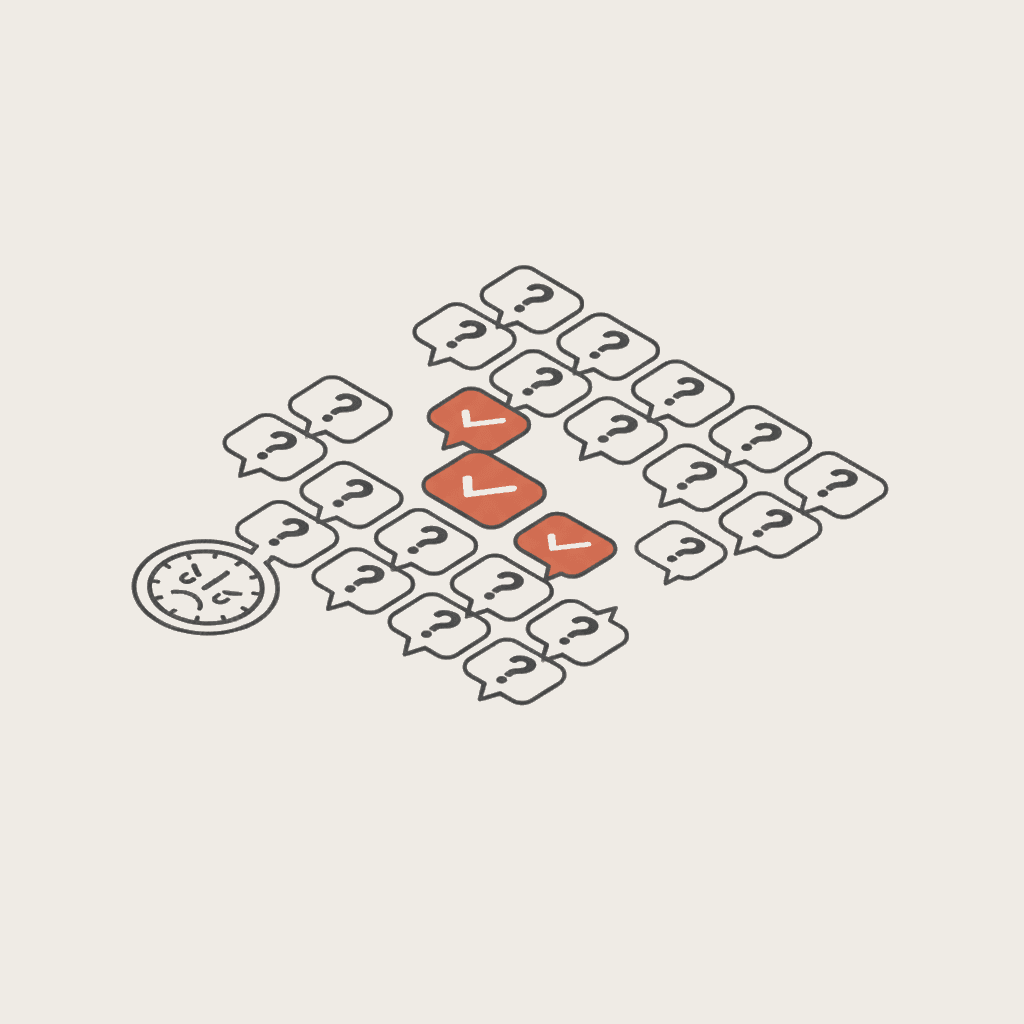
The result: 34% of questions asked by prospects have no accessible answer on the institution's website (Source: cross-referencing Skolbot chatbot logs with content audits, 200,000 conversations, 65 institutions). No dedicated page, no paragraph in the FAQ, no mention in the course guide. These questions exist in a blind spot — asked constantly, but the institution does not even know they go unanswered.
The ten questions below are those institutions avoid addressing publicly — out of awkwardness, habit, or simple unawareness.
The top 10 unanswered questions
1. "Is the degree actually worth the price?" — Site answer rate: 4%
This is the most taboo question. 47% of prospects phrase it in one way or another during their research journey (Source: Skolbot logs, 200,000 conversations). They are not asking "how much does it cost" — most websites answer that. They are asking: does the return on investment justify the spend?
The question takes many forms: "Is it worth $30,000 AUD a year?", "How long until I pay off my HECS-HELP debt?", "My parents are hesitant about the cost — what do I tell them?"
Why institutions do not answer: Addressing value for money means admitting price is an obstacle. Marketing teams prefer to discuss "value" without quantifying it.
How to answer: Publish a concrete ROI calculation. Median salary at graduation multiplied by 5 years versus total cost. If a graduate earns a median of $65,000 AUD per year and the total HECS-HELP debt is $28,000 AUD for a Commonwealth Supported Place, the return on investment is clear and quantifiable. The Graduate Outcomes Survey (QILT) publishes median salaries by field of study — use them. Prospects do not flee high prices — they flee ambiguity.
2. "What is the actual dropout / repeat rate?" — Site answer rate: 2%
31% of prospects ask this in some form (Source: Skolbot logs). "How many students don't finish?", "Is it hard to pass?", "What's the real success rate?"
Institutions readily publish their completion rates (the flattering mirror) but almost never their attrition rates (the truthful one). The prospect knows this and suspects it. The Department of Education publishes attrition and completion data — your prospect can find it themselves. Better they find your transparent version first.
How to answer: Publish both the completion rate AND the attrition rate with context. "91% of our students graduate on time. 5% repeat a year and graduate the following year. 4% leave the program, mostly in the first year." Transparency is a trust signal that AI engines also value.
3. "What do former students really think?" — Site answer rate: 11%
38% of prospects seek "authentic" reviews outside the official website (Source: Skolbot logs). Curated testimonials are perceived as such.
How to answer: Link to third-party sources: Google Business reviews, QILT Student Experience Survey results, GoodUniversitiesGuide ratings. Publish testimonials that also mention areas for improvement — a nuanced review is 3x more credible than a uniformly positive one (Northwestern/PowerReviews study).
4. "Are placements really available or just advertised?" — Site answer rate: 8%
Work integrated learning has become a standard marketing claim in Australian higher education. Every institution advertises it. But 29% of prospects doubt the reality behind the promise (Source: Skolbot logs). "How many students actually get a placement?", "Does the uni help find one or are you on your own?", "What percentage of programs include industry experience?"
How to answer: Publish concrete figures. "340 students on placement in 2025-2026 out of 1,200. 82% found their placement through our network of 150 employer partners. Median placement start time: 6 weeks after the search begins." Numbers disarm scepticism.
5. "What makes you different from [competitor]?" — Site answer rate: 3%
26% of prospects ask this question (Source: Skolbot logs). "Why you over [competitor]?", "Melbourne vs Monash — what's the difference?", "UNSW vs UTS — which is better for engineering?"
How to answer: Create a page titled "How to choose between [discipline] courses in [city/state]". List objective criteria (TEQSA registration, QILT employment rates, placement availability, fees, ATAR cut-offs) without disparaging competitors. The prospect is already comparing — give them a structured framework. This is also a strong GEO page: AI engines favour structured comparative content.
6. "What does a typical week look like?" — Site answer rate: 7%
24% of prospects ask what a week of study actually involves (Source: Skolbot logs).
How to answer: Publish a typical timetable by program and year. A simple table has more impact than a descriptive paragraph. Add the annual contact hours and the ratio of lectures to independent study. Many Australian universities now offer flexible delivery — clarify how much is on-campus versus online.
7. "Which employers recruit your graduates?" — Site answer rate: 14%
22% of prospects want concrete employer names (Source: Skolbot logs).
How to answer: Publish the top 20-30 employers with recruitment numbers. "In 2025, our top 5 graduate recruiters: Deloitte (28), Commonwealth Bank (19), BHP (15), PwC (14), NSW Health (12)." The prospect wants proof of employability, not a logo carousel.
8. "What happens if I'm rejected?" — Site answer rate: 1%
19% of prospects ask this (Source: Skolbot logs), yet virtually no website answers it. The prospect asking this question is engaged — they are managing their risk before committing to apply.
How to answer: "If your application is unsuccessful, you can apply through change of preference rounds or reapply in the next cycle. Feedback is available on request. 34% of applicants who missed out in the first round were admitted through late offers or mid-year intake." This transparency reassures and increases applications.
9. "Do international students integrate well?" — Site answer rate: 6%
18% of prospects ask about cross-cultural integration (Source: Skolbot logs). For a deeper dive into international recruitment specifics, our dedicated guide covers the topic in detail.
How to answer: "42 nationalities on campus. 31% international students. Buddy system with 200 pairs in 2025-2026. Dedicated International Student Support team. Active multicultural student associations." Australia's strong international education reputation — promoted through Study Australia and Austrade — is worth reinforcing with campus-level evidence.
10. "What if I change my mind during the course?" — Site answer rate: 2%
16% of prospects ask this (Source: Skolbot logs). "Can I switch majors?", "What if the course isn't for me — do I get a refund?"
How to answer: Detail internal transfer options and refund conditions. "Change of major possible until census date in Semester 1. Transfer to a different program available from Year 2 subject to meeting prerequisites. Full fee refund available if you withdraw before census date under the Higher Education Support Act." Making census dates and their implications clear is essential — Australian students are uniquely sensitive to the HECS-HELP liability trigger.
The impact of unanswered questions on conversion
Prospects who do not find an answer do not come back
62% of prospects who ask a question without receiving an answer within 5 minutes leave the site and never return (Source: Skolbot cohort analysis, 200,000 conversations, March 2025 — Feb 2026). They do not leave an email, do not fill in a form, do not call back. They vanish.
On a website receiving 10,000 visitors per month, 34% unanswered questions x 62% permanent departure represents approximately 2,100 lost prospects every month. At an average conversion rate of 3%, that is 63 potential enrolments evaporating — per month.
According to Skolbot data, 72% of prospect questions are simple FAQ-level queries that could be answered automatically (Source: automatic classification of 12,000 Skolbot conversations, 2025). Only 7% of questions truly require human intervention. The remaining 21% need institution-specific context. This means the vast majority of the information gap can be closed with structured content or an AI chatbot — freeing admissions staff for the complex 7% that genuinely need a human touch.
The cost of silence is measurable
If your cost per acquisition is $500 AUD (average for a private higher education provider, Source: Skolbot data), 63 lost enrolments represent a shortfall of $31,500 AUD per month, or over $375,000 AUD per year — not counting the associated tuition fees.
The response time dimension compounds this problem. Skolbot data shows that the average response time by channel varies dramatically: email takes 47 hours, phone calls average 3 minutes 20 seconds when answered (but only 34% are answered), web forms take 72 hours, human chat takes 8 minutes during office hours only, while an AI chatbot responds in 3 seconds around the clock. 67% of prospect activity occurs outside office hours — the gap between prospect availability and institutional responsiveness is the root cause of most lost conversions.
How to close these blind spots
Step 1: Audit your blind spots
Compare the questions your prospects ask (chatbot logs, incoming emails, open day questions) with your website content. For each of the 10 questions above, check whether an answer is accessible within 2 clicks from your homepage. If the answer to the fees question requires downloading a PDF course guide, it is not "accessible".
Step 2: Create the missing content
Prioritise by question volume. Questions 1 to 5 address the needs of 26-47% of prospects — they must be tackled first. For each question, create either a dedicated section on an existing page (admissions page, program page) or a targeted blog article.
Step 3: Make answers findable
Content exists but the prospect cannot find it? That is a navigation problem, not a content problem. Three solutions: restructure the main menu, add a dynamic FAQ to key pages, and deploy an AI chatbot that answers the most frequent questions instantly — including those your website does not yet address.
Step 4: Measure the impact
Institutions that closed their top 5 blind spots observed a 22% reduction in bounce rate and a 31% increase in first-contact rate within 8 weeks (Source: Skolbot A/B tests, 12 institutions, Oct 2025 — Feb 2026).