 ChatGPT
 Claude
 Perplexity
 Gemini
 Grok
GrokWhy structured data has become essential for Australian universities
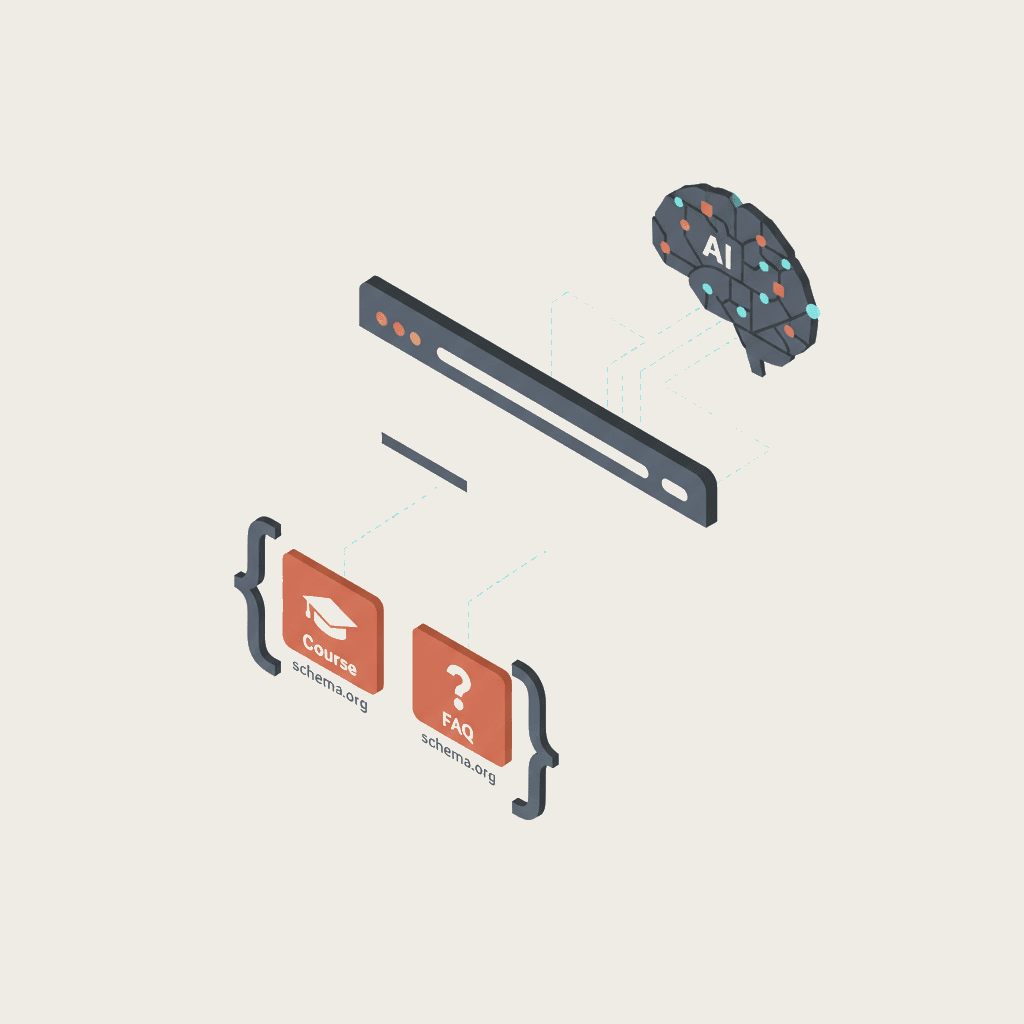
AI engines do not read your website like a human. ChatGPT, Perplexity and Google AI Overviews parse your source code looking for machine-extractable signals: entities, relationships between entities, verifiable attributes. Schema.org structured data is exactly that — markup that translates your content into machine language.
Universities that have implemented complete Schema.org markup achieve an average of +12 points of GEO visibility compared to those without (Source: Skolbot GEO monitoring, 500 queries x 3 AI engines, Feb 2026). Across a panel of 120 institutions analysed, only 18% have Schema.org markup covering at minimum the EducationalOrganization and Course schemas. The remaining 82% are leaving a major competitive advantage on the table.
This is not a classic SEO problem. Google displays your pages even without structured data. But AI engines work differently: they need to identify your institution as an entity, link it to programs, accreditations and reviews. Without markup, your university is a block of text among billions. With markup, it is a structured entity the engine can name, compare and recommend.
The four essential schemas for an Australian university
EducationalOrganization: your institution's identity card
The EducationalOrganization schema is the foundation. It tells the AI engine: "This is a university, with a name, an address, accreditations, a website." Without it, the engine must guess — and it regularly gets it wrong.
Here is a minimal JSON-LD example:
{
  "@context": "https://schema.org",
  "@type": "EducationalOrganization",
  "name": "University of Melbourne",
  "alternateName": "Melbourne Uni",
  "url": "https://www.unimelb.edu.au",
  "logo": "https://www.unimelb.edu.au/logo.png",
  "address": {
    "@type": "PostalAddress",
    "streetAddress": "Grattan Street",
    "addressLocality": "Parkville",
    "addressRegion": "VIC",
    "postalCode": "3010",
    "addressCountry": "AU"
  },
  "accreditation": ["AACSB", "EQUIS", "AMBA"],
  "memberOf": {
    "@type": "Organization",
    "name": "Group of Eight"
  },
  "foundingDate": "1853",
  "numberOfStudents": 55000
}
The critical fields are accreditation, memberOf and numberOfStudents. These are the data points AI engines cross-reference with other sources to validate your institution's standing. If your university holds AACSB accreditation and this information appears in your markup, on the AACSB directory, and in TEQSA listings, the AI engine has three converging sources — a strong reliability signal.
Course: each program becomes an identifiable entity
The Course schema (or EducationalOccupationalProgram for vocational programs) turns each program into an entity the AI engine can recommend independently. It is the difference between "this university offers courses" and "this university offers a two-year MBA, taught in English, AMBA-accredited, with a 94% employment rate."
{
  "@context": "https://schema.org",
  "@type": "Course",
  "name": "Master of Business Administration",
  "description": "Two-year full-time MBA with global exchange options",
  "provider": {
    "@type": "EducationalOrganization",
    "name": "University of Melbourne"
  },
  "educationalLevel": "Master",
  "inLanguage": ["en"],
  "timeRequired": "P2Y",
  "occupationalCategory": "Management, Finance, Strategy",
  "offers": {
    "@type": "Offer",
    "price": "48000",
    "priceCurrency": "AUD",
    "description": "Annual tuition fee (full-fee place)"
  },
  "hasCourseInstance": {
    "@type": "CourseInstance",
    "courseMode": "onsite",
    "startDate": "2026-02-01"
  }
}
Including tuition fees in your Course markup is a powerful differentiator. Across 120 institutions analysed, only 7% include fees in their structured data (Source: Skolbot technical audit, Jan 2026). Yet fees are the first piece of information searched for by 89% of prospects. An AI engine that has the price in the markup can formulate a complete answer without requiring the prospect to click through. In Australia, distinguishing between Commonwealth Supported Place (CSP) contributions and full-fee prices is particularly important for prospective students comparing domestic and international fee structures.
FAQPage: your answers delivered directly into the AI
The FAQPage schema is the most directly exploitable by AI engines. When a prospect asks ChatGPT "What are the entry requirements for [your university]?", the engine looks for a structured answer. A marked-up FAQ serves it on a plate.
{
  "@context": "https://schema.org",
  "@type": "FAQPage",
  "mainEntity": [
    {
      "@type": "Question",
      "name": "What are the tuition fees for the MBA?",
      "acceptedAnswer": {
        "@type": "Answer",
        "text": "The full-time MBA tuition fee is $48,000 AUD per year for a full-fee place. Scholarships covering up to 50% of fees are available for exceptional candidates. FEE-HELP is available for eligible domestic students."
      }
    },
    {
      "@type": "Question",
      "name": "What is the graduate employment rate?",
      "acceptedAnswer": {
        "@type": "Answer",
        "text": "92% of the 2025 graduating class secured full-time employment within four months of graduation (QILT Graduate Outcomes Survey 2025). The median starting salary is $85,000 AUD."
      }
    }
  ]
}
The effect is twofold. First, Google displays your FAQs as rich snippets, increasing your CTR by 15 to 25% according to Google Search Central. Second, AI engines use these FAQs as direct citation sources. A marked-up FAQ is 2.4x more likely to be cited in an AI response than an unmarked FAQ (Source: Skolbot GEO monitoring, Feb 2026).
AggregateRating: verifiable social proof
The AggregateRating schema displays a consolidated score based on verifiable evaluations. For an Australian university, legitimate rating sources include QS, THE, the Good Universities Guide, QILT student experience survey scores and Google Business reviews.
{
  "@context": "https://schema.org",
  "@type": "EducationalOrganization",
  "name": "University of Melbourne",
  "aggregateRating": {
    "@type": "AggregateRating",
    "ratingValue": "4.3",
    "bestRating": "5",
    "ratingCount": "1247",
    "reviewCount": "892"
  }
}
Important: Google and AI engines verify rating consistency. If your markup shows 4.8/5 but your Google reviews give 3.6, the trust signal collapses. Only use AggregateRating if your scores are real and verifiable. Fabricated data is worse than no data.
Mistakes that cancel the effect of structured data
Mistake 1: Markup without matching visible content
Schema.org markup must reflect content visible on the page. If your markup declares a fee of $48,000 AUD but the page says "fees on request", search engines and AI detect the inconsistency and penalise trust. Google calls this "structured cloaking" and may strip your rich results.
Mistake 2: Incomplete or outdated markup
An EducationalOrganization schema containing only a name and URL is virtually useless. The minimum exploitable set includes the address, at least one accreditation and the programs offered. A markup showing "2024 intake" in March 2026 sends a staleness signal.
31% of universities with Schema.org have not updated their markup in over 12 months (Source: Skolbot technical audit, Jan 2026). Stale markup is worse than no markup: it feeds AI engines false information.
Mistake 3: Duplicate markup
Each page should contain only one JSON-LD block per entity type. Multiple EducationalOrganization blocks on the same page create ambiguity that AI engines cannot resolve. The Google Rich Results Test detects these duplications.
Mistake 4: Ignoring program pages
85% of universities that have markup only have it on the homepage (Source: Skolbot audit, 120 institutions). That is insufficient. AI engines formulate recommendations at the program level ("best part-time MBA in Melbourne"), not the institution level. Every program page needs its own Course markup.
Technical implementation: where to start
Audit what exists
Start by checking what already exists on your site. The Google Rich Results Test and the Schema Markup Validator analyse any URL. Test your homepage, your programs overview page and a specific program page.
Prioritisation: the 80/20 of markup
The optimal implementation order for maximum impact:
- EducationalOrganization on the homepage and the "About" page — one day of development
- Course on every program page — two to three days depending on program count
- FAQPage on admissions, fees and student life pages — one day
- AggregateRating on the homepage if scores are verifiable — two hours
Total estimated effort: four to five days of development. The ROI is immediate and lasting. It is the best effort-to-result ratio in GEO.
CMS and tools
- WordPress — Yoast SEO Premium and Rank Math Pro offer native support for
EducationalOrganizationandCourse - Custom CMS / Next.js / Nuxt — Use the schema-dts library or generate JSON-LD blocks in the head section
- HubSpot / Squarespace — Inject JSON-LD via custom HTML modules
Validation
Validate with the Rich Results Test and the Schema Markup Validator. Then monitor the "Enhancements" tab in Google Search Console. Schedule a quarterly audit.
The measurable impact on AI visibility
The results of Schema.org implementation are measurable within weeks. Across a panel of 15 institutions that deployed complete markup between October 2025 and January 2026, the following results were observed:
+12 points of average GEO visibility (from 14% to 26% mention rate in AI responses). +34% organic click-through rate thanks to Google rich results. 2.4x more citations in AI engines' FAQ-style responses.
These figures align with observations from Merkle/Dentsu, which reports that pages with structured data achieve 20 to 40% higher CTR in classic Google results.
For a full overview of GEO strategy applied to higher education, see our complete GEO guide for universities. And to understand the criteria AI engines use to select which institutions they recommend, our article on AI recommendation criteria for universities details the mechanisms at play.
Book a demo