 ChatGPT
 Claude
 Perplexity
 Gemini
 Grok
GrokDisclaimer: This article is for informational purposes only. The legal landscape described here is accurate as at June 2026 but does not constitute legal advice. Consult your institution's privacy officer or qualified legal counsel for advice specific to your situation.
Australia's international student sector is worth AU$38 billion annually and draws candidates from dozens of countries speaking dozens of languages. 58% of prospects engaging with Australian higher education providers are non-native English speakers — and the AI-powered tools schools rely on to serve them (multilingual chatbots, targeted ad platforms, automated CRMs) are overwhelmingly US-based services that route personal information to servers outside Australia. (Source: Automatic language detection across 8,500 Skolbot conversations, 2025–2026.)
That routing is not just a technical footnote. Under the Privacy Act 1988, every cross-border disclosure of personal information triggers a discrete compliance obligation. Institutions that treat a vendor's standard subscription agreement as sufficient cover for those obligations are exposed to enforcement action by the OAIC (Office of the Australian Information Commissioner) and, increasingly, to regulatory scrutiny from TEQSA.
What data your prospect-facing tools collect and where it goes
Before a prospective student has ever spoken to an admissions officer, your school's digital infrastructure has already processed a substantial volume of personal information about them. Every tool in the recruitment stack contributes to that profile.
Google Workspace and Google Analytics collect IP addresses, device identifiers, search queries, and behavioural data from website visitors. When a prospect completes an enquiry form hosted in Google Forms, their name, email address, and programme interest flow into Google's infrastructure — which may be served from US, Singapore, or other non-Australian data centres depending on your account configuration.
Meta Ads (Facebook and Instagram) receive pixel data every time a prospect lands on your programme pages or submits a lead form. Meta's pixel transmits browser fingerprints, URL paths, and conversion events to Meta's servers in the United States in real time — before any enquiry has been submitted and before any consent notice specifically covering Meta has been displayed to the prospect.
OpenAI and other AI tools are increasingly embedded in admissions workflows: chatbots on school websites, AI-assisted email drafting, multilingual translation of prospect communications. Every prompt sent to OpenAI's API containing prospect identifiers — name, country of origin, intended programme, visa status — is personal information being disclosed to an overseas recipient under Australian privacy law.
The common thread is that none of these disclosures are visible to the prospect, and none are adequately governed by standard subscription terms. The Privacy Act requires more.
Privacy Act 1988 and APP 8: the rules on cross-border data disclosure
The Privacy Act 1988 and its 13 Australian Privacy Principles (APPs) apply to all organisations with annual turnover above $3 million — a threshold virtually every TEQSA-registered higher education provider exceeds. The OAIC administers the Act and has the power to investigate complaints, conduct assessments, accept enforceable undertakings, and seek civil penalties of up to $50 million AUD for serious or repeated breaches following the 2022 enforcement amendments.
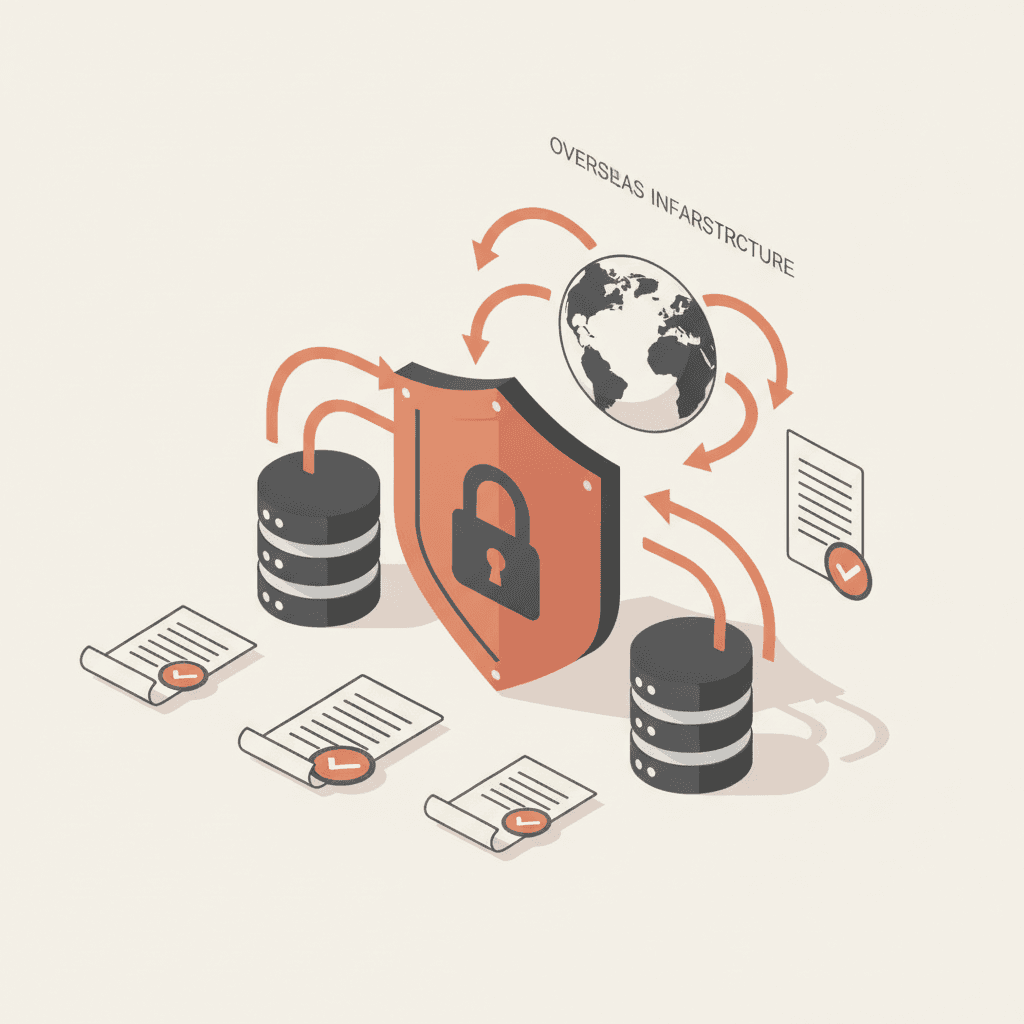
APP 8 governs cross-border disclosure specifically. APP 8.1 imposes an obligation on the disclosing entity — your school — to take reasonable steps to ensure that the overseas recipient will not handle the personal information in a way that would breach the APPs. Crucially, if the overseas recipient does breach the APPs, your institution remains accountable as if it had committed the breach itself.
There are three pathways to compliance with APP 8:
1. Contractual accountability (APP 8.1). Your institution executes a data processing agreement with the overseas vendor that requires the vendor to handle personal information in a manner consistent with the APPs. Your institution accepts ongoing accountability if the vendor fails to meet those standards. This is the appropriate path for Google Workspace, Meta, and OpenAI.
2. Express consent (APP 8.2(a)). The individual expressly consents to the cross-border disclosure after being clearly informed that the APP 8.1 protections will not apply to that disclosure. This is not operationally viable at scale: obtaining genuine informed consent from thousands of prospects for every US-based tool your institution uses is not feasible, and the OAIC's guidance makes clear that consent must be specific and unbundled.
3. Binding scheme (APP 8.2(b)). The overseas recipient is subject to a law or binding scheme that has the effect of protecting the information in a way that is, overall, substantially similar to the APPs. Unlike the EU GDPR adequacy framework, Australian law has no formal list of approved countries. The US does not qualify under this pathway.
Unlike the EU GDPR, Australian privacy law does not have a mechanism equivalent to Standard Contractual Clauses or Binding Corporate Rules. The accountability approach under APP 8.1 — supported by a written data processing agreement — is the primary compliance tool for Australian institutions using US-based cloud services.
The Privacy Act reform process adds urgency. The Privacy and Other Legislation Amendment Act 2024 introduced a statutory tort for serious invasions of privacy, significantly increasing civil exposure for institutions that experience a data breach caused by a poorly governed overseas vendor. Proposed further amendments — not yet enacted as at June 2026 — would introduce mandatory Transfer Impact Assessments for overseas disclosures, bringing Australia closer to the EU model. Institutions that implement rigorous APP 8.1 vendor diligence now are well positioned regardless of whether those reforms pass.
The Notifiable Data Breaches (NDB) scheme (Part IIIC of the Privacy Act) also intersects directly with overseas vendors. If an overseas processor experiences a data breach affecting your institution's prospect records — a ransomware attack on a US-based CRM provider, for example — and the breach is likely to result in serious harm, your institution has an obligation to notify the OAIC and the affected individuals. Your contract with the vendor must require prompt notification to your institution to enable you to meet that obligation.
Google Workspace, Meta Ads, OpenAI — compliance for Australian schools in 2026
The table below summarises the compliance posture of the three most common US-based tools used in Australian higher education prospect recruitment as at June 2026.
| Tool | Personal information processed | Australian DPA / APP 8 instrument | Data residency option | Key residual risk |
|---|---|---|---|---|
| Google Workspace for Education | Enquiry forms, email, Drive, Analytics, Ads | Yes — Google Cloud APAC Data Processing Addendum; Australian-specific APP compliance information published by Google | Yes (Sydney region available for Workspace data; requires admin configuration) | US parent retains access to administrative metadata and support data; CLOUD Act exposure remains even with Sydney hosting |
| Meta Ads (Facebook/Instagram Pixel) | IP addresses, browser fingerprints, URL paths, lead form submissions, custom audiences | Meta's Data Processing Terms include Australian provisions; Standard Contractual Clauses referenced | No — Meta processes pixel data in the US | Real-time pixel transmission occurs before any consent notice is displayed; requires consent mode configuration and updated privacy policy disclosure |
| OpenAI (API and ChatGPT Enterprise) | Conversation transcripts, prospect identifiers, programme enquiries, any data included in prompts | Enterprise DPA available; Australia-specific provisions included | European data residency available as a partial mitigation; no Australian data centre | Default API usage may use inputs for model improvement; Enterprise tier includes training-use prohibition; CLOUD Act exposure persists for US-domiciled entity |
A note on the CLOUD Act. The US Clarifying Lawful Overseas Use of Data Act 2018 (CLOUD Act) permits US law enforcement to compel US-based technology companies to produce data held on their servers, including servers physically located in Australia. Activating a Sydney-region Google Workspace deployment or an OpenAI European data residency option does not eliminate this exposure. Institutions handling sensitive categories of prospect data — visa status, health conditions disclosed during applications, financial hardship information — should factor CLOUD Act risk into their privacy impact assessments.
OAIC cloud computing guidance confirms that using a cloud service constitutes a disclosure of personal information to the cloud provider. The cloud provider is an overseas recipient under APP 8 if data is processed or stored outside Australia. The OAIC guidance identifies five considerations for APP-compliant cloud procurement: the nature and sensitivity of the information, contractual safeguards, the provider's security practices, the ability to audit or inspect, and the consequences of a breach.
5 steps for your Australian school's privacy compliance
These five steps reflect the minimum operational standard for an Australian TEQSA-registered provider using US-based cloud tools in its prospect recruitment activities.
Step 1: Map your cross-border data flows. List every tool in your admissions and marketing stack that holds or processes personal information about prospective students. For each tool, document: the categories of personal information processed, the country where processing occurs, whether an Australian-specific DPA or APP 8-compliant agreement is in place, and whether the vendor prohibits using your data to train AI models. Your output is a cross-border disclosure register — a document the OAIC can request during a compliance investigation.
Step 2: Execute APP 8-compliant DPAs for all US-based vendors. Request and execute the Australian-specific data processing agreement for Google Workspace (the Cloud Data Processing Addendum for APAC), the Meta Data Processing Terms, and the OpenAI Enterprise DPA. Verify that each agreement: restricts the vendor to processing personal information only for the contracted purpose; requires notification of eligible data breaches within 24 hours; prohibits use of personal information for AI model training; and mandates return and destruction of personal information on contract termination.
Step 3: Update your Privacy Collection Notice and Privacy Policy. Your Privacy Collection Notice (displayed at the point of data collection, required by APP 5) must identify: the categories of personal information collected, the primary purpose of collection, any overseas recipients and the countries in which they are located, and the reasonable steps taken under APP 8.1 to ensure those recipients handle the information consistently with the APPs. Generic statements such as "your data may be sent overseas" do not satisfy this obligation. Your school's Privacy Policy must be updated to reflect the current tool stack accurately.
Step 4: Configure Meta Consent Mode and audit your pixel deployment. Meta's pixel transmits data to US servers in real time on page load. Consent Mode configuration delays the transmission of personalised data until after the user has actively accepted tracking. Implement Consent Mode across your website, audit whether your cookie banner meets APP 3 collection requirements (the consent must precede the data transmission it authorises), and update your privacy policy to name Meta as an overseas recipient of pixel data.
Step 5: Establish NDB scheme readiness for vendor breaches. Every US-based vendor contract must include a clause requiring the vendor to notify your institution within 24 hours of any actual or suspected eligible data breach affecting your prospect data. Assign internal responsibility for assessing NDB eligibility and prepare a breach response procedure that covers: scoping the affected individuals and data categories, assessing the likelihood of serious harm, and notifying the OAIC and affected individuals within the timeframes the scheme requires. Do not wait for a breach to establish this process.