 ChatGPT
 Claude
 Perplexity
 Gemini
 Grok
An AI agent covers the gap between the first inquiry and a usable CRM record
In Canadian higher education, an AI agent is software that answers prospects on your website and other channels, collects what your recruitment team needs, and writes it into the CRM. It does not run your campaigns or decide who is admitted. Its job is the gap where inquiries cool off: after the visit, before a recruiter has seen anything.
Marketing pays for the traffic and admissions inherits the record. In between, a student in Calgary asks about co-op at nine at night and gets a contact form. An agent answers first, then builds the record from the conversation.
This article follows the path from inquiry to CRM for Canadian universities and colleges, shows what an agent can safely do at each step, and lists what to verify before it writes into your systems. For the wider picture, see our guide to AI agents for student recruitment.
The inquiry-to-CRM path in five steps
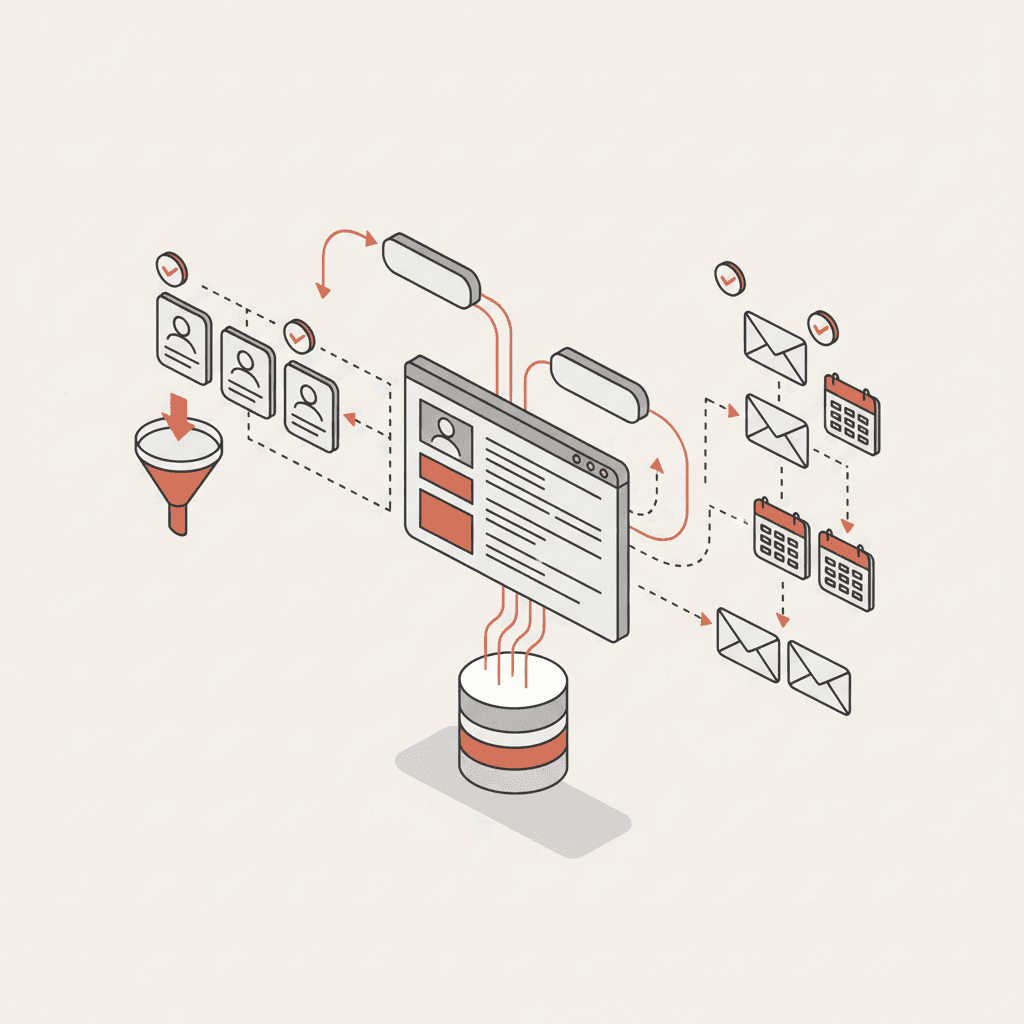
An agent can help at each of five steps without touching the admission decision.
| Step | What the prospect does | What the agent can do | What stays with staff |
|---|---|---|---|
| 1. Inquiry | Asks about a program, co-op or residence | Answers from your published pages | Anything unpublished |
| 2. Qualification | Mentions province, prior study, start term | Asks the missing two or three questions | Judging fit |
| 3. Record | Shares an email or phone number | Creates or updates the CRM record and logs consent | Duplicate merge decisions |
| 4. Handoff | Wants to talk | Books an open house slot or passes the chat to a recruiter | The conversation |
| 5. Measurement | Applies, or does not | Supplies source and conversation data | Reading the results |
Step three is usually where a weak setup shows. A chatbot that stores an email address gives the recruiter a name and nothing to say. An agent that also records the program of interest, applicant pathway and questions asked gives the recruiter a way in.
Steps 1 and 2: answer first, then qualify
The agent should answer before it asks for anything, because a form-first experience loses the visitor. Canadian prospects arrive with specific questions: does this program accept my Grade 12 courses, how do I apply from another province, what is the route from a college diploma.
Answers must come from your own published content. Admission requirements differ by province and by program, and an agent that improvises one creates a complaint. Link each factual answer to its source page, and let the agent say "I don't know, let me connect you with a recruiter" rather than guess.
Keep qualification conversational. Three questions are usually enough:
- Are you coming from high school, a CEGEP or college, another university, or abroad?
- Which program or field interests you?
- Which start term do you have in mind?
Our guide to AI lead qualification for student recruitment covers scoring and routing. One caution applies from the start: qualification is a sorting step for follow-up. It must never become a hidden decision about who deserves an offer.
Step 3: write the record your CRM can use
A good agent record is small, consistent and traceable. The agent should write to the fields your team already uses.
Useful fields are program of interest, applicant pathway, target term, source page, consent status and a summary or link to the conversation. Free-text notes go in a labelled field so recruiters can tell what the student said from what the agent inferred.
Three rules keep the CRM clean:
- Limit the writable fields. List them in the contract and test that nothing else changes.
- Match before you create. Check for an existing record by email, or you build the duplicates you later pay to remove. Our guide to cleaning a student lead database explains the clean-up.
- Keep a log. Each write needs a timestamp and the conversation behind it so a bad record can be traced and reversed.
The CRM remains the source of truth. If you are still choosing a platform, our CRM comparison for higher education covers the main options.
Step 4: the handoff decides whether it paid off
A handoff works when the recruiter opens the record and already knows what the student asked. It fails when they have to start over, which cancels the time the agent saved.
Test three things before launch. Does the whole conversation travel with the record? Does the student see when a person will reply? Does a request the agent cannot handle, such as an accessibility accommodation or a complaint, route to a named office and not a general inbox?
Open house bookings are the most dependable first action to automate. The agent offers a slot, logs it and sends the confirmation. Risk is low and the result is easy to check. Follow-up messages are similar: welcome when sent to someone who asked, a problem when sent to everyone.
Privacy: PIPEDA, Quebec's Law 25 and provincial rules
In Canada the privacy picture depends on province and institution type. The Office of the Privacy Commissioner of Canada oversees PIPEDA, which applies to private-sector organizations handling personal information in the course of commercial activity. Public universities are often covered instead by provincial public-sector or university-specific statutes, so confirm which regime governs your institution before you assume.
Quebec adds Law 25, overseen by the Commission d'accès à l'information. If you recruit Quebec residents, check its requirements on consent, transparency about automated processing, privacy impact assessments and incident handling, and take advice from counsel on how they apply to you. Alberta and British Columbia also have their own private-sector acts.
Whatever the regime, five practices hold:
- Tell the prospect at the start that they are talking to an AI, and say what you do with their details.
- Record consent to be contacted separately from consent to answer a question.
- Observe Canada's anti-spam rules before sending any follow-up message.
- Set a retention period for conversations and records, and apply it.
- Check where the provider hosts and processes data, and whether it trains models on your prospects' messages.
Minors deserve extra care, since many prospects start researching before they turn eighteen. If you also recruit in the EU, Annex III of the EU AI Act lists systems that decide access to education as high risk. An agent that answers questions and books events is a different thing from one that ranks applicants.
OUAC, provincial centres and CEGEP pathways
The agent informs prospects about how to apply and does not replace the application. In Ontario the OUAC handles university applications, and other provinces run their own application services. Quebec students typically arrive through CEGEP, which changes the questions an agent should ask.
Give the agent a clear map of these routes. It should send a prospect to the correct provincial application centre and describe your program in the right language, English or French, without promising an outcome.
How to measure it without inventing numbers
Measure the agent on the steps it controls, using your own data. Conversations that end in a complete record, recruiter response time against your own target, and open house bookings are all countable today.
Enrolment is a long chain with many causes. Our guide to marketing attribution in higher education explains why crediting the agent with every enrolment misleads. Run it through a full cycle, compare against the same period a year earlier, and say what else changed. For channel context, see the digital marketing guide for higher education.
Five questions to ask any provider
Ask these before you sign, including of us.
- Which CRM fields can it write, and can we restrict them?
- Can we see a log of every write and undo one?
- Where is data processed, and is it used to train a model? Canadian institutions often care about data residency.
- How is the handoff tested on real conversations?
- What does the agent say when it does not know?
Be skeptical of any case study with a headline percentage and no method. No public benchmark defines a normal result for a recruitment agent.
Where Skolbot fits
Skolbot deploys AI agents connected to the institution's CRM. The website agent answers from the institution's own content and passes the conversation and its qualification into the CRM. The CRM remains the source of truth, and the admissions team stays in control of the cases that need it.