 ChatGPT
 Claude
 Perplexity
 Gemini
 Grok
GrokWhy one follow-up process for every purchased lead is quietly destroying your CAC
Because a blended process spends the same staff minutes on a bulk name-and-email list as on a prospect a call centre confirmed wants to hear from your school. Purchased-lead programs almost always report one blended cost per lead and one blended conversion rate — both numbers hide where the money actually goes.
This is a companion piece to our coverage of where to source purchased leads — portals, aggregators, fairs, paid social. Here, the leads have already landed in your CRM, and a phone-verified inquiry and a bulk aggregator name-buy are not the same asset even at the same per-unit cost.
Take a hypothetical intake of 1,000 purchased leads a month at CAD 30 each — CAD 30,000 monthly. One speed-to-lead standard and one drip sequence applied to all 1,000 spends identical staff hours chasing a raw aggregator name unlikely to enrol and a phone-verified inquiry several times more likely to convert. The blended cost-per-lead figure stays flat while cost per enrolled student — the number a budget committee cares about — climbs, because staff time and nurture spend go disproportionately to the tier least likely to pay it back.
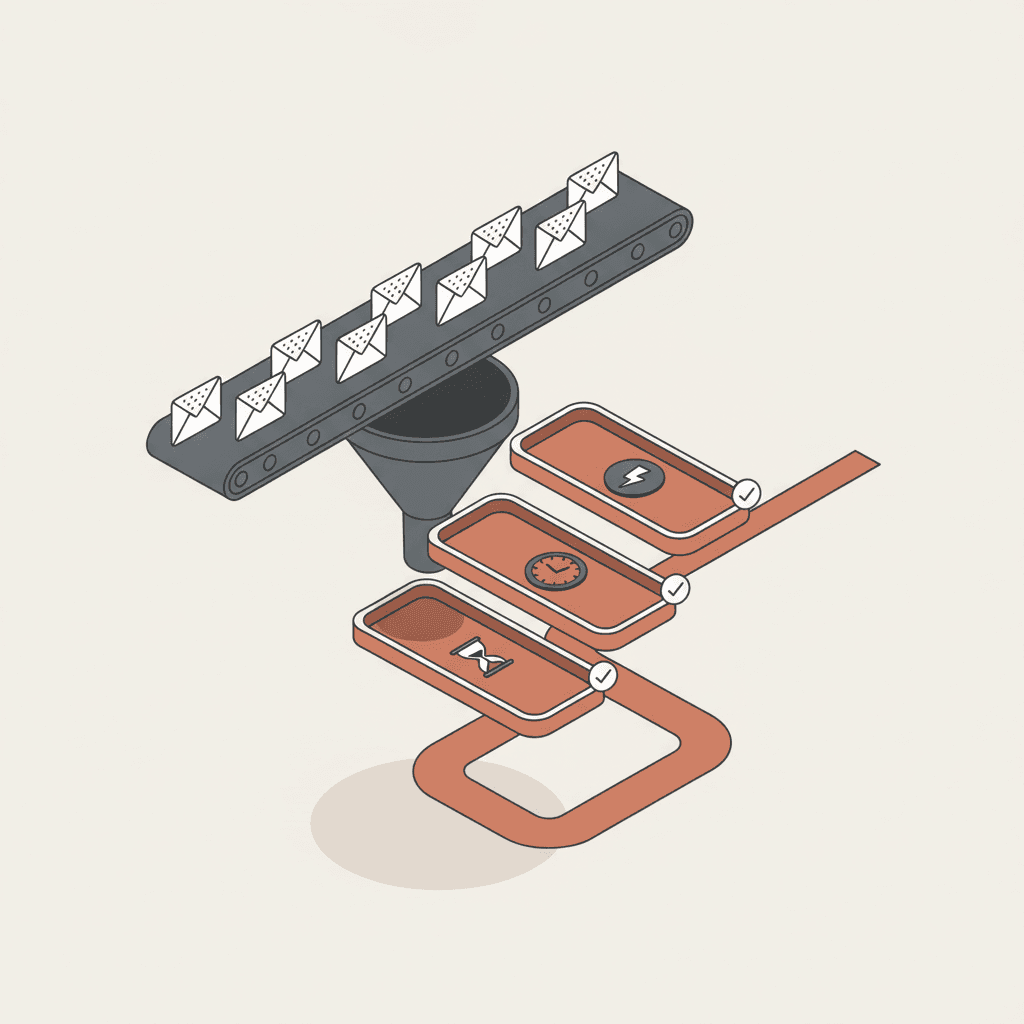
Build a source-quality tier at intake, before a single follow-up email goes out
The fix starts the moment a lead lands, not after weeks of unread emails prove it was low quality. Sort every purchased lead into one of four tiers based on how it was acquired.
| Source tier | Typical origin | Verification signal at intake | Realistic enrolment likelihood |
|---|---|---|---|
| Tier 1 — Phone-verified | A vendor call centre phones the prospect and confirms interest before selling the record | Logged conversation, named program, confirmed contact details | Highest — closest to a self-generated inquiry |
| Tier 2 — Fair or salon walk-up scan | Badge scanned at a fair or open-house booth, with a conversation logged by staff | In-person contact, but scan volume includes brief passers-by | Moderate-high, hinging on whether a real conversation happened |
| Tier 3 — Paid social or lead-gen form | A Meta, Instagram, or TikTok lead ad; a quick in-platform form fill | Self-reported interest, no human confirmation | Moderate — real but unconfirmed intent |
| Tier 4 — Raw aggregator name-buy | A bulk name-email-phone list purchased from a data aggregator | Minimal or no direct interaction with your institution | Lowest — intent unconfirmed |
This tiering is distinct from lead scoring. Scoring models weigh behaviour after contact — pages viewed, emails opened, application stage. Source tier is set once, at the door, before any of that behaviour exists, and should feed into your scoring model as one input rather than replace it. If your institution already runs a numeric scoring system, add source tier as a starting-point modifier instead of building a second ranking your team has to reconcile by hand.
Two Canadian privacy notes apply at intake, not later. Under PIPEDA, your institution is responsible for confirming a vendor obtained meaningful consent to sell or share the record — that obligation doesn't transfer away because your team didn't collect the data directly. If recruitment reaches Quebec residents, Loi 25 requires explicit, purpose-specific consent rather than the implied consent PIPEDA tolerates elsewhere — a Tier 4 aggregator list rarely meets that bar, which is one more reason to route it through a lighter qualification step before a full campaign.
Match your speed-to-lead SLA to the tier, not to a single office-wide target
The fastest response should go to the tier most likely to enrol, and a flat SLA for every purchased lead sends staff hours to the wrong place at the wrong moment. Skolbot's channel audit across 80 institutions found first-reply averages of 47 hours for email, 72 hours for contact forms, and 3 minutes 20 seconds for phone calls when answered — which happens only 34% of the time. Human live chat, staffed business hours only, averages 8 minutes; an AI chatbot answers in 3 seconds, around the clock. That variance only becomes useful once you decide which tier deserves which channel first.
| Tier | Speed-to-lead SLA | First-touch goal |
|---|---|---|
| Tier 1 — Phone-verified | Human callback attempt <5 minutes during business hours; instant automated acknowledgment 24/7 | Confirm fit, offer an interview slot or open-house seat |
| Tier 2 — Fair/salon scan | Same business day, <4 business hours | Reference the specific conversation logged at the booth |
| Tier 3 — Paid social/lead-gen | <24 hours for human follow-up; instant automated acknowledgment | Confirm program fit before committing counsellor time |
| Tier 4 — Raw aggregator | No individual human SLA; enters an automated qualification sequence first | Confirm the person actually wants information from your institution |
HubSpot's research on response expectations found 82% of prospects rate an immediate response as important or very important — a bar Tier 1 and Tier 2 prospects expect, and one a raw aggregator name never agreed to in the first place. For the routing mechanics underneath these SLAs — round-robin, program-based, intent-based triage — see our lead routing and SLA guide for Canadian admissions, which covers "who answers" so this article can focus on "which tier gets which speed."
Differentiate nurture cadence and content by tier — and by declared program
A single nurture template sent to all four tiers wastes the trust a Tier 1 prospect has extended and wastes budget chasing a Tier 4 name that never asked for contact. Cadence and content should split two ways at once: by source tier and by the program the prospect declared.
Tier 1 (phone-verified): high-touch sequence from a named counsellor, two to three touches in week one, a direct invitation to an interview or open house built around the program discussed on the verification call.
Tier 2 (fair/salon scan): a warm sequence referencing the actual conversation logged at the booth — program, question, concern raised — then an invitation to a program-specific information session. Generic "thanks for visiting" copy squanders the credibility the in-person moment created.
Tier 3 (paid social/lead-gen): a value-first drip over roughly three weeks — tuition and aid detail, a viewbook, answers to the questions prospects ask most — segmented by the declared program rather than sent as one institution-wide newsletter.
Tier 4 (raw aggregator): a single qualification touch before any full sequence, confirming the person actually requested information about your institution and program. Suppress non-responders after two attempts; anyone who replies gets promoted into the Tier 2 or Tier 3 cadence.
The program split matters as much as the tier split: a nursing-interested prospect and a business-interested one should never receive the same generic third email. Canadian prospects and parents frequently cross-reference Maclean's university rankings before applying, so program-specific content — placement rates, co-op availability, accreditation — outperforms general reputation messaging.
Before Tier 4 gets a full sequence, confirm the record isn't a duplicate or attached to an invalid phone number — our database hygiene guide covers this, and it catches a meaningful share of aggregator name-buys before a single nurture touch is wasted. The same qualification-first logic applies to purchased names that already went cold; our dormant lead reactivation guide sets return-rate expectations by disengagement segment.
Measure profitability per source at cost per enrolled student, not cost per lead
Cost per lead tells you what you paid for a name; cost per enrolled student tells you whether that name was worth buying. The two can differ by a factor of ten or more once you account for how differently each tier converts, and a purchasing decision built on cost per lead alone routinely favours the cheapest, worst-converting source. A 2026 industry benchmark review put average higher-education cost per lead at roughly USD 982, with cost per enrolled student closer to USD 2,849 — a gap wide enough to invert the correct budget allocation (SearchInfluence, 2026 Higher Education Marketing Benchmarks). Our own Canadian analysis puts fully loaded cost per enrolled student at a private institution in the CAD 2,200–3,500 range; untiered purchased-lead programs tend to sit at or above the top of that band, because Tier 4 volume dilutes the average without producing proportional enrolments.
We cover the full CAC formula, cost blocks, and channel benchmarks in our student CAC guide for Canadian institutions; the mechanics don't repeat here. The point specific to purchased leads is narrower: track cost per enrolled student by tier, not just by vendor. Two schools buying from the same aggregator can see very different results depending on whether they tier and route what that vendor produces, or treat it all the same.
Where an AI chatbot fits: the always-on first responder that applies tiering instantly
A chatbot's job in this system is to apply the differentiated routing the moment a purchased lead engages, regardless of tier or hour. Because 67% of prospective-student activity happens outside office hours, a Tier 1 prospect calling back at 9pm on a Sunday still needs an instant, program-aware response — not a 47-hour wait for an email reply after a competing school has already answered.
Institutions running an AI chatbot see qualified inquiries climb from 120 to 195 a month (+62%), open-house registration rise from 6.2% to 18.4%, and a median 280% return within twelve months. Schools with a chatbot cut first-contact drop-off from 91% to 76%, or 167% more first contacts from the same purchased-lead volume. The chatbot doesn't replace the tiering logic above — it enforces it at 3am and 3pm alike, on every tier at once, freeing counsellors for the Tier 1 and Tier 2 prospects who genuinely need a human judgment call instead of the Tier 4 names a short automated step could screen out first.