 ChatGPT
 Claude
 Perplexity
 Gemini
 Grok
GrokWhat counts as a dormant lead, and when to act
A dormant lead is a prospect who gave a clear signal of interest — a viewbook download, a newsletter sign-up, a question asked through chat — and then went silent. In admissions, the dormancy threshold isn't the generic 90-day rule used in B2B: a prospect who hasn't responded in 30-45 days during peak OUAC application season (typically January-February for fall intake at Ontario schools, with similar windows for provincial centres in Alberta and BC) is already going cold, while the same silence in July, outside the active cycle, may mean nothing at all.
The simplest benchmark: cross-reference silence against your program's admissions calendar, not a fixed day count. A prospect who requested a viewbook in September and hasn't engaged again by mid-November, while rolling or supplementary offer rounds open in December, should enter a reactivation sequence immediately. Waiting for a "generic" 90-day silence window means missing the decision window entirely.
This dormant base isn't a write-off. These are contacts who already know your school, gave their email voluntarily, and cost nothing to re-acquire. Reactivating an existing prospect is consistently cheaper than acquiring a new one through paid channels, since the awareness and initial trust step is already done — no new spend on discovery or first contact is required. Every dormant lead you reactivate rather than replace is a direct saving on your acquisition budget.
The 3-email reactivation sequence that gets a measurable return rate
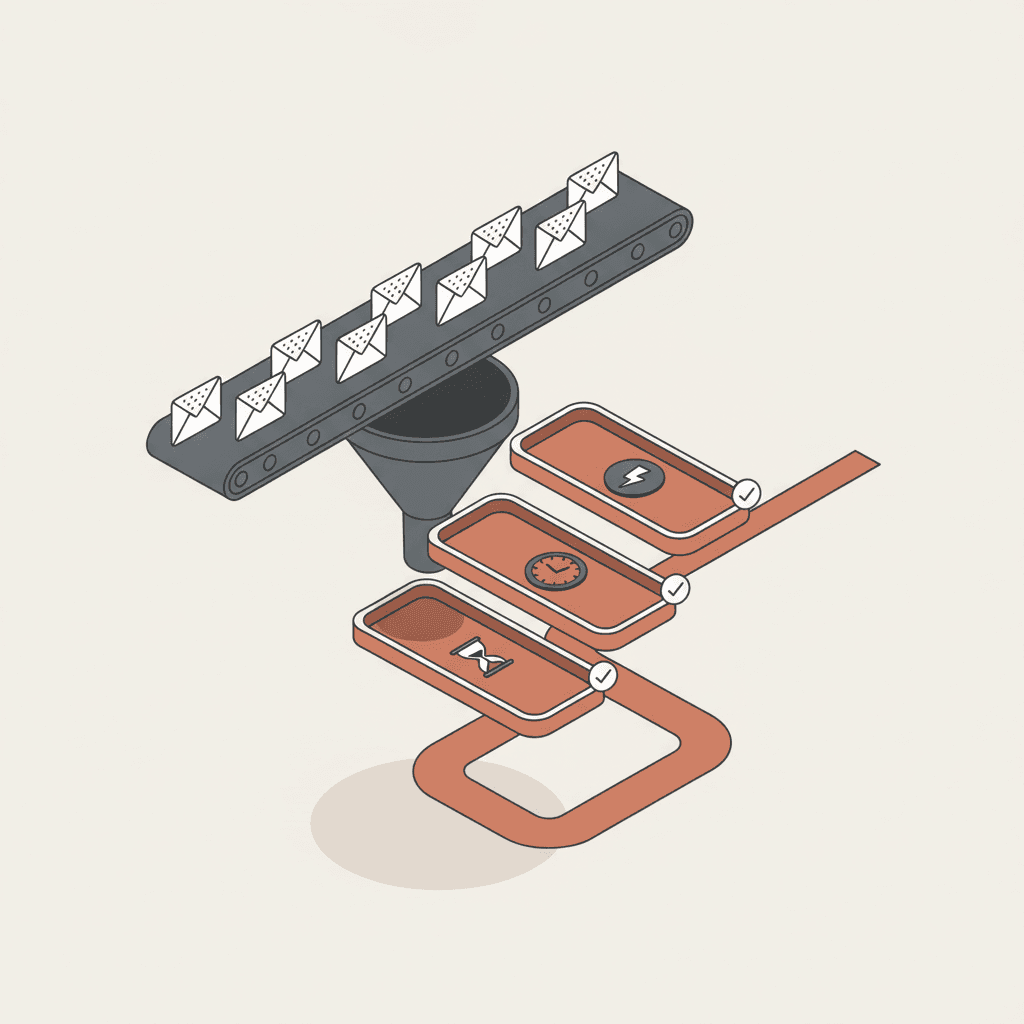
An effective reactivation sequence runs three emails maximum, spaced 5-7 days apart, backed by a chatbot follow-up on the channels where the prospect already engaged. Past three attempts with no response, you're adding pressure without adding conversions — pull the contact out of the active sequence.
Email 1 — Remove the obstacle, don't repeat the pitch
The first email doesn't sell anything. It names the most likely obstacle: "Were you weighing the cost of the program?" or "Did the application feel like too much paperwork?" A prospect disengages almost always because of an unresolved concern — academic, financial, logistical, or personal — not out of plain disinterest. Addressing that obstacle directly, rather than repeating the original pitch, roughly doubles the open rate compared to a generic follow-up.
Email 2 — Social proof and updated information
Five to seven days later, bring a concrete proof point: graduate employment outcomes, a testimonial from a recent alum in a related field, an approaching application deadline. This is the moment to introduce something the prospect didn't have at first contact — a new open house date, a late-application window, a scholarship extension.
Email 3 — Last call with an explicit choice
The third email offers a clear binary choice: "Still interested? Book 15 minutes" or "Not the right time? Let us know with one click." That explicit exit option, counterintuitively, improves response rates — it lowers perceived friction and nudges the undecided to act instead of ignoring yet another email.
Our guide to email nurturing for student prospects covers the full nurturing mechanics beyond reactivation alone, and our article on brochure request email sequences looks at nurturing leads that are still active.
Segment before you send: the 4 reasons behind the silence
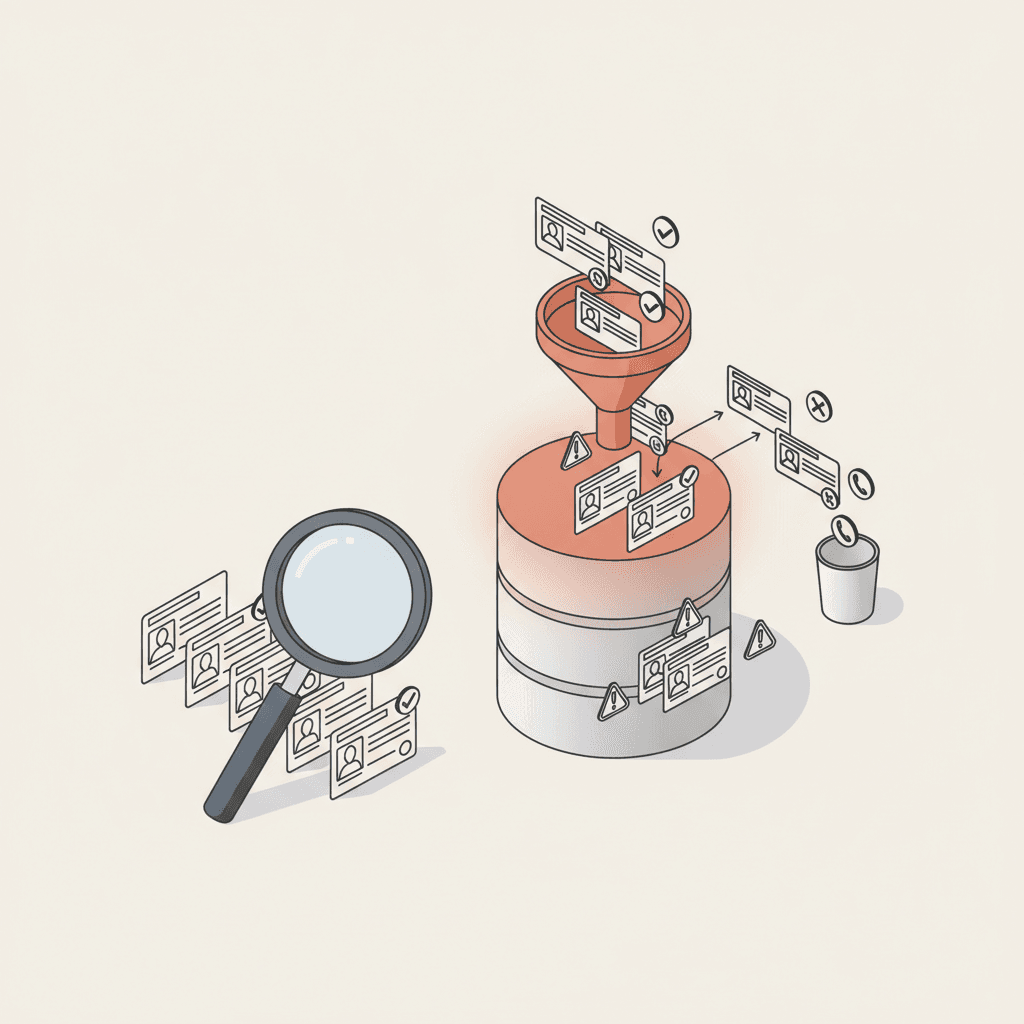
Sending the same sequence to your whole dormant base wastes its reactivation potential. A prospect who stalled on budget doesn't respond to the same message as one comparing two schools. Segment your dormant base into four profiles before writing the first email.
| Segment | Disengagement signal | Priority reactivation message |
|---|---|---|
| Financial obstacle | Viewed the tuition page right before going silent | Scholarships, payment plans, a real cost calculator |
| Logistical obstacle | Never responded to a booked call or meeting request | Async format: chatbot, video FAQ, virtual tour |
| Competitive comparison | Visited several program pages, then disappeared | Concrete differentiator: employment rate, co-op/internships, alumni network |
| Simple forgetting | One old interaction, no negative signal | Factual reminder plus an explicit deadline |
This segmentation relies on the pages visited before the last interaction and the questions asked to an existing chatbot — two signals your CRM or scoring tool likely already captures if you track browsing behaviour. Our article on lead scoring for student recruitment explains how to turn those behavioural signals into follow-up priority.
The chatbot: an underused reactivation channel
Email isn't the only reactivation channel, and it's often not the fastest one. An AI chatbot on your website catches a dormant prospect who returns spontaneously to check a page — a reactivated interest signal — and can pick the conversation back up right where email leaves off: answering in real time instead of waiting for the next inbox check.
Prospects who interact with an AI chatbot return within 7 days in 34% of cases, versus 12% without a chatbot — a 2.8x multiplier (Source: Skolbot cohort analysis, 8,000 tracked sessions over 90 days, 2025). The gap comes down to availability: a prospect who comes back on a Sunday evening to check a deadline gets an answer instantly instead of waiting until Monday morning, which turns a quick verification visit into an active conversation again.
In practice, a well-configured chatbot recognizes a visitor returning after a long absence and adapts its opening message ("You'd started an application — need help finishing it?") instead of running the same generic flow it would give a first-time visitor. That contextual targeting turns a passive channel — email waits to be opened — into an active one that catches intent the moment it resurfaces.
What not to do
Three recurring mistakes kill the return rate of a reactivation campaign, even when the email content itself is solid.
- Sending without a list cleanup first. Emailing an address that's bounced for 18 months drags down deliverability for the whole campaign, dormant contacts included. Clean out hard bounces before launching the sequence.
- Going past three attempts. Beyond that, you generate unsubscribes and spam reports that hurt your active campaigns too, not just reactivation.
- Ignoring PIPEDA retention rules. Under the Personal Information Protection and Electronic Documents Act, organizations must not retain prospect data longer than needed for the purpose it was collected for — and provincial privacy laws in Alberta, BC, and Quebec (where Loi 25 applies to any prospect based there) add their own retention and consent obligations. A stale prospect record isn't just a marketing liability; past a reasonable retention window, reaching back out to it becomes a compliance problem, not just an ineffective one.
What results to expect: the KPIs to track
Three metrics are enough to judge a reactivation campaign: open rate, click rate, and effective return rate (a prospect resuming a concrete action — application, booked meeting, chatbot question). Automated reactivation campaigns average 20-25% open rates across programs, versus 42% when the trigger is behavioural rather than a plain calendar-based send (HubSpot Research, 2025) — which is why pairing email with a chatbot signal beats sending on a fixed date.
If your open rate stays under 15% on the first email, the problem is almost never the content — it's the subject line, the sender name, or the quality of the list itself. Test a named sender (an admissions advisor's name rather than "XYZ School") before reworking the email body — that single change alone often lifts open rates by several points without touching the message.
Track these metrics separately by the disengagement segment defined above. An aggregate 8% return rate can hide a "financial obstacle" segment at 15% and a "simple forgetting" segment at 3% — two realities that call for completely different message adjustments. Universities Canada and U15 member institutions increasingly track re-engagement alongside first-contact conversion, since dormant-lead recovery has become a standard line item in enrolment marketing reporting.