 ChatGPT
 Claude
 Perplexity
 Gemini
 Grok
Deduplication means one record per applicant, with the history intact
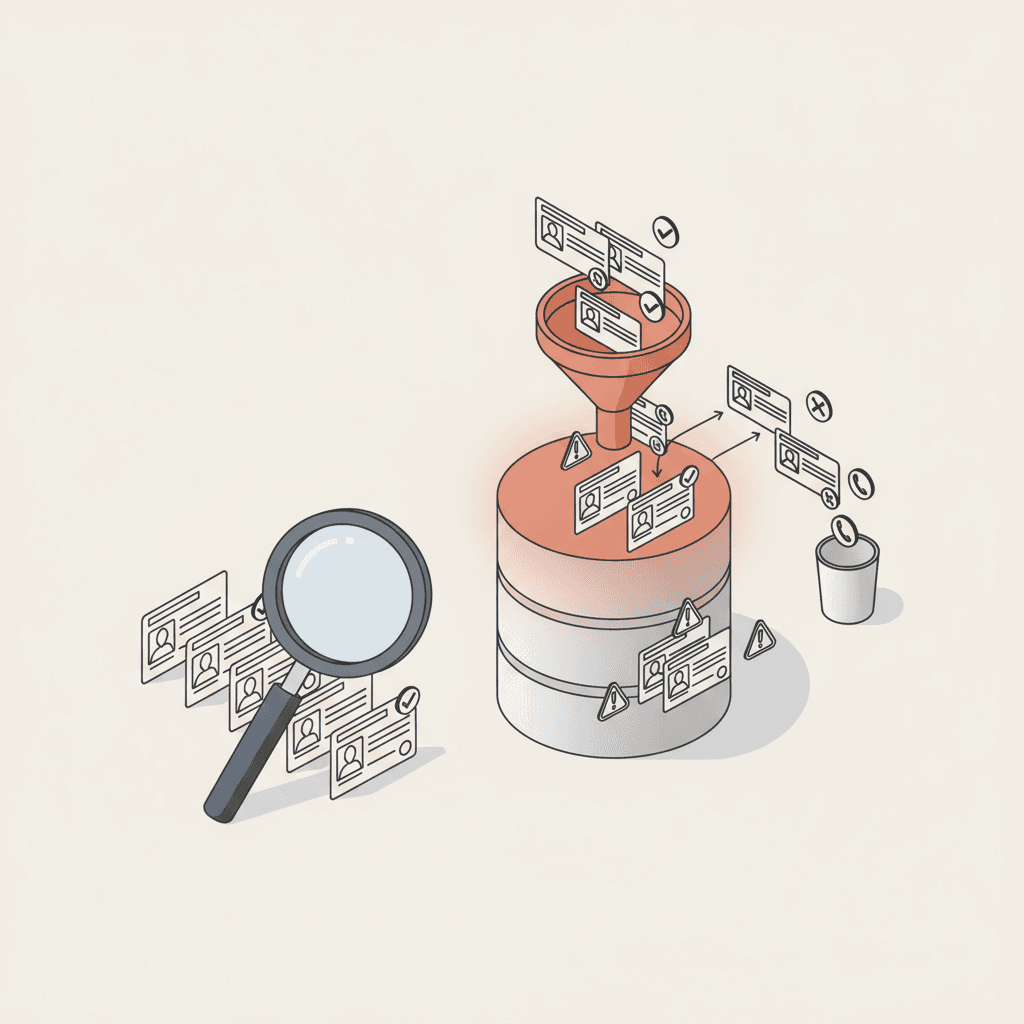
Student lead deduplication across channels means recognizing that a web form, a chat conversation, a text thread and a missed call came from the same person, then attaching them to a single CRM record. For an admissions office the goal is practical: one advisor reaches the applicant, once, knowing what has already happened.
Canadian admissions create their own duplicate patterns. Applicants in Ontario apply to several universities through a shared application centre (OUAC), while applicants elsewhere deal with each institution or provincial service separately. Many are international students writing from outside the country, and many ask in English at one school and French at another. Each school sees fragments, and each channel writes its own record.
This guide covers where duplicates come from, which matching keys to use, what merge rules to document and what privacy law applies. It builds on our pieces on cleaning a student lead database and lead routing and SLAs.
Where duplicates come from: a different identifier per channel
| Channel | Reliable identifier | Typical cause of a duplicate |
|---|---|---|
| Inquiry form on your site | Email, often phone | Personal email first, school email later |
| Website chat | Nothing, or an email given mid-conversation | Anonymous visitor returning on another device |
| Text or messaging thread | Mobile number | Number entered with dashes, brackets or +1 |
| Inbound call | Caller ID, sometimes blocked | Parent's phone instead of the applicant's |
| Open houses, fairs, partner and recruiter lists | Email, name | Bulk uploads with no checks |
Three cases need an explicit rule: the parent who writes for an applicant, the applicant with two email addresses and the international applicant whose phone prefix changes between channels. Record the preferred language of contact as a separate attribute.
Choose matching keys from safest to most fragile
- Exact match. The same normalized email (lowercase, trimmed) or the same normalized mobile number. Matching can be automatic.
- Probable match. The same first and last name with the same program of interest, or the same phone with different emails. The system suggests; a person confirms.
- Possible match. Similar names, missing accents, compound surnames. Flag, never auto-merge.
Normalize phone numbers to the international format in ITU recommendation E.164: +1, area code and number, no punctuation. Accents matter in Canada: "Hélène" and "Helene" should match, so use accent-insensitive comparison on names.
Never merge on name alone. Namesakes exist, and a wrong merge mixes two applicants' files.
Write merge rules before the first merge
- Master record. The oldest stays; the others attach to it, keeping the identifier your other systems use.
- Contact details. The most recent verified value wins; the older goes to history.
- Program of interest. Keep the latest and preserve earlier ones. A move from a college diploma to a university degree is a signal, not noise.
- Owner. The advisor with the most recent human contact keeps the record; otherwise your routing rule decides.
- Consent and opt-outs. The most restrictive setting wins.
- Audit trail. Log who merged what, when and why so merges can be reversed.
Keep un-merging possible, especially for shared family phones.
Privacy: PIPEDA, provincial law and anti-spam rules
Merging records is processing personal information. For private institutions, federal law applies to commercial activity unless a provincial law is substantially similar; public universities and colleges are usually governed by provincial public-sector or freedom-of-information statutes. The Office of the Privacy Commissioner of Canada explains the federal framework (PIPEDA). Confirm with your privacy officer which regime covers your institution and your applicants' provinces.
Two principles bear directly on deduplication. Accuracy supports it, and the right to access and correct information means you must be able to find every fragment of a person's data, which a single record makes easier. Limiting retention stops you from keeping everything just in case.
Commercial electronic messages are governed by Canada's anti-spam legislation, which requires consent and a working unsubscribe mechanism. The deduplication consequence is simple: if any merged record carries an unsubscribe or an erasure request, the surviving record inherits it. Have your privacy officer review the approach.
Three habits reduce risk:
- Store the date and source of each consent, channel by channel.
- Apply the most restrictive setting when two records conflict.
- Keep a suppression list separate from the CRM so a later import cannot recreate an opt-out.
For applicants under the age of majority in their province, involve a parent or guardian in conversations that lead to a commitment.
Put the process in place in six steps
- List every entry point: forms, chat, text, phone lines, fairs, recruiter lists.
- Normalize on entry: lowercase emails, +1 phone format, accent-insensitive names.
- Turn on CRM duplicate rules, in suggest mode first, then automatic for exact matches.
- Clear the existing database in batches, exact matches first.
- Write the ownership rule: who takes over the merged record and how the other advisor is told.
- Review monthly the rejected suggestions and reversed merges.
If a university shares its database with affiliated colleges or partner recruiters, settle with your privacy officer whether matching across them is permitted before you switch it on.
Measure without inventing a benchmark
No public source says what duplicate rate is normal for a Canadian institution, so measure your own before and after.
| Indicator | What it shows |
|---|---|
| Share of records with at least one probable duplicate | The size of the backlog |
| Duplicates created per channel per month | The entry point to fix first |
| Reversed merges | The quality of your keys |
| Applicants contacted by more than one advisor | The visible cost to the team |
| Merged records that kept an unsubscribe | Whether safeguards hold |
Do not credit fewer duplicates for higher yield. Admissions outcomes have many causes, and any effect has to be tested against your own comparison periods.
What Skolbot contributes, and what stays with the institution
Skolbot Chat is an agent installed on the institution's website. It answers from content the institution has published, qualifies the inquiry, offers an appointment or open house and hands the conversation to the team and the CRM. Capturing an email or phone number early gives you a matching key anonymous visitors usually lack. The wider logic is in our article on AI agents from first contact to CRM.
Matching and merge rules stay with the institution and its CRM. How the connector behaves with your CRM is confirmed during scoping. To place your tooling, see the CRM comparison for higher education, and for the big picture return to our guide to recruiting more students.