 ChatGPT
 Claude
 Perplexity
 Gemini
 Grok
Grok91% of visitors to your institution's website leave without ever making contact. Each one cost you money in paid search, college fairs, and content marketing. This article gives you the exact formula to convert that percentage into dollars — and the benchmarks to know whether your institution is above or below market.
Why this calculation matters
Most enrollment management teams track cost per enrolled student. Very few track cost per enrollment missed. These are different numbers, and the gap between them is where institutional revenue disappears.
Without the second figure, no enrollment director can make a data-backed case for investing in conversion. With it, the conversation shifts from "can we afford a chatbot?" to "can we afford not to have one?" Enrollment management is a formal discipline at US institutions precisely because yield and melt are measurable — but measuring only what you captured misses half the picture.
The complete student recruitment guide lays out the strategic framework. This article handles the financial detail.
Step 1 — Calculate your Student Lifetime Value
Student Lifetime Value (SLV) is the total tuition revenue generated by one enrolled student over the full duration of their program. It is the number you multiply by every missed enrollment to get the true cost of inaction.
The base calculation is straightforward: SLV = Annual tuition × Program duration. At a private university with $50,000 per year in tuition and a four-year program, the SLV is $200,000. That is what you do not collect every time a prospective student who would have enrolled drops out of your funnel without contacting you.
Reference values for US institutions, calculated from published tuition averages and data from College Scorecard, US News & World Report, and institutional websites:
| Institution type | Program length | Estimated SLV |
|---|---|---|
| Community college | 2 years | $18,000 |
| Public university (in-state) | 4 years | $44,000 |
| Private liberal arts college | 4 years | $160,000 |
| MBA (full-time) | 2 years | $140,000 |
| Private nonprofit university | 4 years | $200,000 |
| Private business school | 4 years | $240,000 |
(Source: calculation based on average published tuition × program duration. College Scorecard, US News, IPEDS. Values include tuition; exclude room and board, indirect alumni revenue, and corporate partnership income.)
These figures are floor estimates. They exclude alumni giving, sibling referrals, and corporate recruitment partnerships tied to the alumni network. Use them as a conservative baseline.
Step 2 — Map your enrollment funnel drop-off
Before calculating the cost, you need to know where you are losing prospective students. The enrollment funnel has six stages, with drop-off rates measured across 30 institutions (2025-2026 cohort):
| Stage | Drop-off rate | Prospects remaining (per 1,000 site visits) |
|---|---|---|
| Site visit → first contact | 91% | 90 |
| First contact → application submitted | 64% | 32 |
| Application → campus visit registration | 42% | 19 |
| Campus visit registration → attendance | 35% (no-show) | 12 |
| Campus visit attendance → complete application file | 28% | 9 |
| Complete file → final enrollment | 18% | 7 |
| Overall conversion: visit → enrollment | 0.8% |
(Source: funnel analysis, 30 institutions, 2025-2026 cohort.)
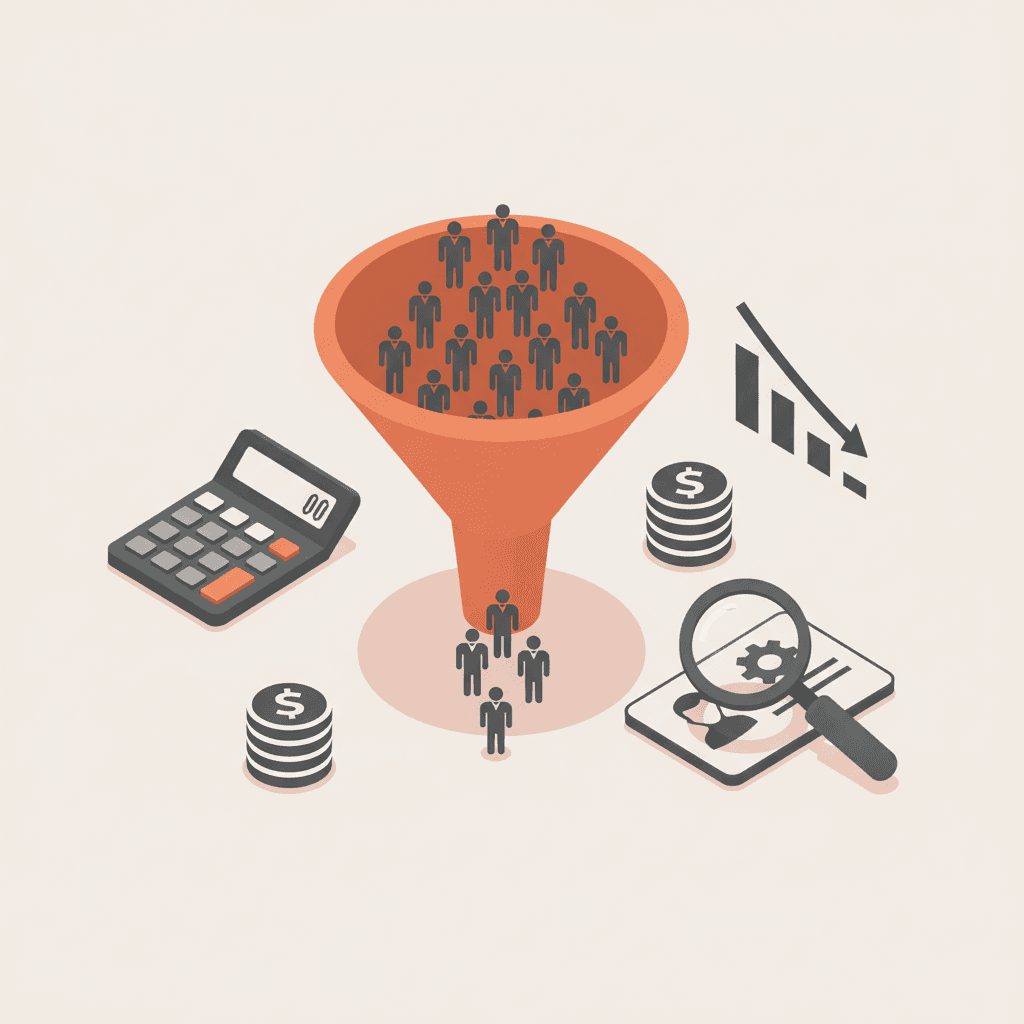
The steepest drop happens at the very top: 91% of visitors take no action at all. A prospective student who reaches first contact is already 11 times more likely to enroll than one who never interacts. That makes the first step the highest-leverage point in the entire funnel.
Response time is the single biggest factor at that first step. The average response time via contact form at US higher education institutions is 72 hours; by email, 47 hours (Source: mystery shopping audit, 80 institutions, 2025). An AI chatbot responds in 3 seconds, 24/7. That availability gap is why chatbot deployment moves the contact rate from 9% to 24% — reducing first-step abandonment from 91% to 76%.
For a stage-by-stage breakdown and the levers that move each one, see our analysis of the real cost of a lost student prospect.
Step 3 — Annual cost of lost prospects (formula and calculation)
With SLV and drop-off rates in hand, the complete formula is:
Annual lost revenue = Recoverable prospects × SLV
Where:
Recoverable prospects = Annual visitors × (Target contact rate − Current contact rate) × Adjusted conversion rate
Applied to a private nonprofit university with 2,000 monthly visitors:
- Annual visitors: 2,000 × 12 = 24,000
- Prospects currently making contact (9%): 24,000 × 9% = 2,160
- Prospects who would contact with a chatbot (24%): 24,000 × 24% = 5,760
- Recoverable prospects: 5,760 − 2,160 = 3,600
- Estimated additional enrollments (adjusted conversion rate 0.56%): 3,600 × 0.56% ≈ 20
- Annual lost revenue: 20 × $200,000 = $4,000,000
The adjusted conversion rate (0.56%) is below the full-funnel average (0.8%) because prospects recovered at the first step have, on average, slightly lower initial intent than those who contact the institution spontaneously. The figure of 20 additional enrollments corresponds to the median observed at institutions of comparable size (Source: Skolbot median results, 18 institutions, 2024-2025).
Acquisition cost benchmarks for US institutions, for reference:
| Institution type | Acquisition cost per enrollment |
|---|---|
| Community college | $800 – $1,200 |
| Public university | $1,200 – $1,800 |
| Private liberal arts college | $1,800 – $2,500 |
| Private nonprofit university | $2,200 – $3,200 |
| Business school | $2,800 – $4,000 |
| International prospective students | $3,200 – $4,500 |
(Source: estimates based on data from NACAC, EAB, IPEDS. Indicative ranges.)
Benchmarks by institution type
The $4,000,000 figure for a private university is not an outlier. The table below applies the same formula across institution types, all based on 2,000 monthly visitors.
| Institution type | SLV | Overall conversion | Average CPL | Estimated missed enrollments | Annual lost revenue |
|---|---|---|---|---|---|
| Private nonprofit university (4 yr) | $200,000 | 2.3% | $52 | ~20 | $4,000,000 |
| Private business school (4 yr) | $240,000 | 4.1% | $48 | ~12 | $2,880,000 |
| Private liberal arts college (4 yr) | $160,000 | 1.8% | $55 | ~24 | $3,840,000 |
| Public university, in-state (4 yr) | $44,000 | 5.2% | $38 | ~8 | $352,000 |
| Community college (2 yr) | $18,000 | 3.0% | $28 | ~15 | $270,000 |
(Source: Skolbot data across 50 institutions, 2024-2026. Missed enrollments estimated from the gap between contact rates with and without AI chatbot.)
Liberal arts colleges carry the worst combination in the table: the lowest natural conversion rate (1.8%) and a high SLV. They lose more prospective students per 1,000 visits than any other institution type. Community colleges, at the other end, convert better and have lower SLV — the financial stakes per lost prospect are lower, but the volume of losses is still substantial.
For the ROI analysis once you have your loss figure, see our article on student acquisition ROI.
How to reduce costs (response time, chatbot, automation)
Three levers account for 80% of the impact on reducing lost prospects.
Response time: from 72 hours to 3 seconds
Response time is the factor with the strongest effect on first-contact conversion. A prospective student who receives a response within 5 minutes is 21 times more likely to convert than one contacted after 30 minutes (Source: Harvard Business Review, validated against sector data). With a median response time of 72 hours for contact forms and 47 hours for email across US institutions, most schools are not within an order of magnitude of that threshold.
NACAC's research consistently shows that speed of response is among the top factors prospective students cite when evaluating which institutions take their inquiry seriously.
Availability outside business hours
67% of prospective student search activity happens outside business hours, with the single highest peak on Sundays between 8 pm and 9 pm (Source: interaction logs, 200,000 sessions, Oct 2025 — Feb 2026). In August — around FAFSA completion, Common App opening day, and move-in season — this proportion reaches 81%. An admissions office that closes at 5 pm structurally misses two thirds of its potential interactions.
AI chatbot: +62% qualified prospects, −38% cost per prospect
Median data from 18 institutions for the 2024-2025 cycle: qualified prospects +62%, cost per prospect −38%, 12-month ROI 280% (Source: Skolbot median results, 18 institutions, 2024-2025). Break-even occurs at month 5 of deployment.
For the full breakdown of that ROI, see our student chatbot ROI calculation.
Campus visit follow-up is the third lever. Without follow-up, 52% of registered prospective students are no-shows. With personalized chatbot follow-up, the no-show rate drops to 19%. At an event with 200 registrants, that is 66 additional prospective students walking through the door — and the applications that follow.
Any automated system handling student data must comply with FERPA for enrolled-student records, state consumer protection law for prospective student data, and FTC guidelines for commercial messaging. The IPEDS data reporting framework also requires institutions to track enrollment by source — which means your tracking infrastructure needs to be in place before you can validate any of these numbers.