 ChatGPT
 Claude
 Perplexity
 Gemini
 Grok
GrokWhy phone outreach fails with international applicants
Calling an international applicant rarely reaches them, because the call lands at the wrong hour, from a number they don't recognize, on a line they have no reason to trust. Admissions counselors who build a follow-up plan around outbound calls are optimizing for a channel that international prospects are structurally unlikely to pick up — one piece of the broader response-time problem covered in our guide to recruiting more students in private higher education.
The scale of the applicant pool makes this worth fixing. International enrollment in US higher education reached 1,177,766 students in 2024/25, the highest total IIE has recorded since it began tracking the figure in 1948, with India (363,019) and China (265,919) as the two largest sending countries (IIE Open Doors 2025). New international enrollment then dropped sharply in fall 2025 — institutions cited visa-process concerns and travel restrictions as the leading causes (ICEF Monitor). A shrinking, more anxious applicant pool makes every missed connection more expensive, not less.
The time zone problem, mapped to where applicants actually are
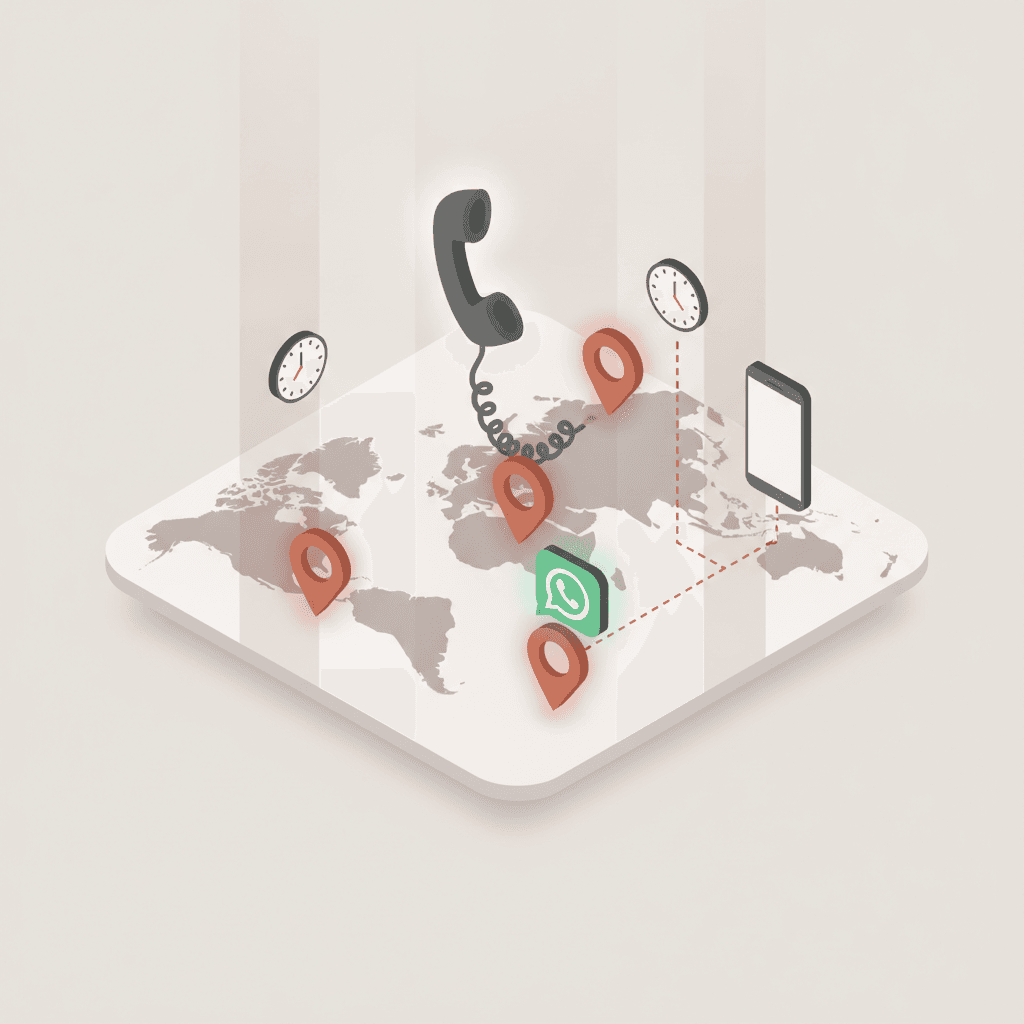
A 9-to-5 Eastern Time call schedule is built around the wrong clock for most international applicants. Delhi runs 9.5 to 10.5 hours ahead of the US mainland depending on the coast; Beijing runs 12 to 13 hours ahead. An admissions office dialing during its own business hours is calling the middle of the night for its two largest applicant countries of origin — and that's before accounting for exam schedules, family obligations, or the applicant simply being asleep.
Email and web forms sidestep the time zone problem but introduce a different one: they're slow enough that the applicant has often moved on to a competing school's inbox by the time a reply arrives. Contact-form responses across Skolbot's partner-school base average 72 hours and email averages 47 hours, against 3 seconds for an AI chatbot answering 24/7 (Source: Skolbot mystery-shopping audit, 2025, 80 partner institutions). Neither the phone nor traditional written channels solve the actual constraint, which is that the applicant is awake and asking a question at a moment no admissions office is staffed for.
What the pickup-rate data says about unknown numbers
Most calls from a number an applicant doesn't recognize go unanswered, and that pattern has only gotten stronger. A US consumer survey found that 87% of people ignore calls from unknown numbers "often" or "very often" (MarTech). For an applicant overseas, a US area code is by definition an unrecognized number — there's no local caller-ID context to override the instinct to let it ring through to voicemail.
This is a demand-side problem, not a staffing problem. Hiring more callers or dialing more persistently doesn't change the fact that the number itself is the barrier. Industry-wide cold call connect rates hover around 16-17% — roughly one attempt in six reaches a live person (Trellus) — and international dialing adds the time zone penalty on top of that baseline. Counselors end up spending the bulk of a calling block on voicemail and disconnected attempts rather than actual conversations.
The cost compounds on both sides of the ledger. A 16-17% connect rate means an admissions office needs roughly five or six dial attempts to produce one actual conversation, and each of those attempts consumes counselor time whether or not anyone answers. Add the fact that many campus phone systems route outbound international calls through a per-minute long-distance plan, and every unanswered attempt to a Delhi or Beijing number is a small direct cost on top of the staff time — for a connection that, per the pickup-rate data above, is unlikely to happen on that particular try.
Response time by channel: the real comparison
The table below lines up the channels admissions teams typically use for international outreach, based on Skolbot's mystery-shopping audit of response behavior across partner institutions.
| Channel | Response time | Reachability | Time-zone dependent |
|---|---|---|---|
| Phone (outbound call) | 3 min 20s once answered | 34% pickup rate | Yes — tied to office hours |
| Contact form | 72 hours | Not measured | No, but slow enough to lose the applicant |
| 47 hours | Not measured | No, but slow enough to lose the applicant | |
| WhatsApp + AI chatbot | 3 seconds | Available 24/7 | No |
(Source: Skolbot mystery-shopping audit, 2025, 80 partner institutions)
Phone is fast once it connects, which is exactly the trap: the 3-minute-20-second figure only applies to the 34% of attempts that connect at all. For the other two-thirds, the real response time is however long it takes for a voicemail to be checked, and voicemails from unfamiliar numbers are, by the same survey data, among the least-checked message type for most consumers.
Why WhatsApp closes the gap for international prospects
WhatsApp works for international recruitment because it removes the two things that make a phone call fail: the unfamiliar-number instinct and the fixed office-hours window. It's a messaging surface the applicant already uses daily to talk to family and friends abroad, so a message from a school doesn't carry the same "who is this" hesitation a ringing phone does. The WhatsApp Business Platform is built for exactly this use case — a verified business profile, template messages for structured updates, and two-way conversation once the applicant replies.
This is a genuinely different case from domestic Gen Z outreach. US-based prospects are fragmented across Instagram DMs, SMS, and iMessage, and WhatsApp adoption in the general US teen population is limited — a point covered in our guide to messaging chatbots and Gen Z. International applicants are the exception: outside the US, WhatsApp is often the default messaging app for both personal and business communication, which is why it fits the international segment specifically rather than the domestic one.
It works across time zones without staffing overnight shifts
An applicant in Mumbai or Beijing can send a question at 11pm local time and get an answer without anyone on the admissions team being awake to send it. Pairing WhatsApp with an AI chatbot means the message is answered the moment it arrives, then handed to a human counselor for anything that needs judgment — the AI clears the routine questions (deadlines, required documents, program details) so staff time goes to the applicants who need a real conversation, not to closing the same gap between a question sent at midnight and a reply sent the next afternoon. This is the same architecture covered in our multilingual AI chatbot guide for international students.
It handles the language mix international pipelines actually have
International pipelines are rarely single-language, and a channel that only works well in English underperforms the moment the applicant pool diversifies. Across Skolbot's partner-school base, 58% of international prospect conversations happen in a language other than the school's primary teaching language (Source: automatic language detection across 8,500 Skolbot conversations, 2025-2026). A WhatsApp number connected to a chatbot with automatic language detection removes the need to staff native speakers for every language in the applicant pool, a topic covered in depth in our multilingual chatbot for international student recruitment.
What to keep in mind before switching a channel
Moving outreach to WhatsApp doesn't remove the need for a licensed counselor on anything that touches admissions decisions, financial aid amounts, or visa guidance — the chatbot handles the routine layer and routes the rest. Institutions should also confirm consent language covers messaging outreach the same way it covers email, since applicants opting into WhatsApp updates should know what they're opting into and how to opt out. None of this requires new legal infrastructure; it requires treating WhatsApp as a formal communication channel with the same disclosure standards as email, not an informal side channel.
It's also worth setting expectations internally before the switch. A counseling team used to judging effort by dial count needs a different success metric once WhatsApp and an AI chatbot are handling first contact — response time and resolution rate matter more than attempts made. And WhatsApp doesn't replace the moments where a live conversation genuinely helps, like a hesitant applicant weighing an offer against a competing school; it just makes sure that conversation happens because the applicant reached out on a channel they were actually going to use, not because a counselor got lucky on a sixth dial attempt.