 ChatGPT
 Claude
 Perplexity
 Gemini
 Grok
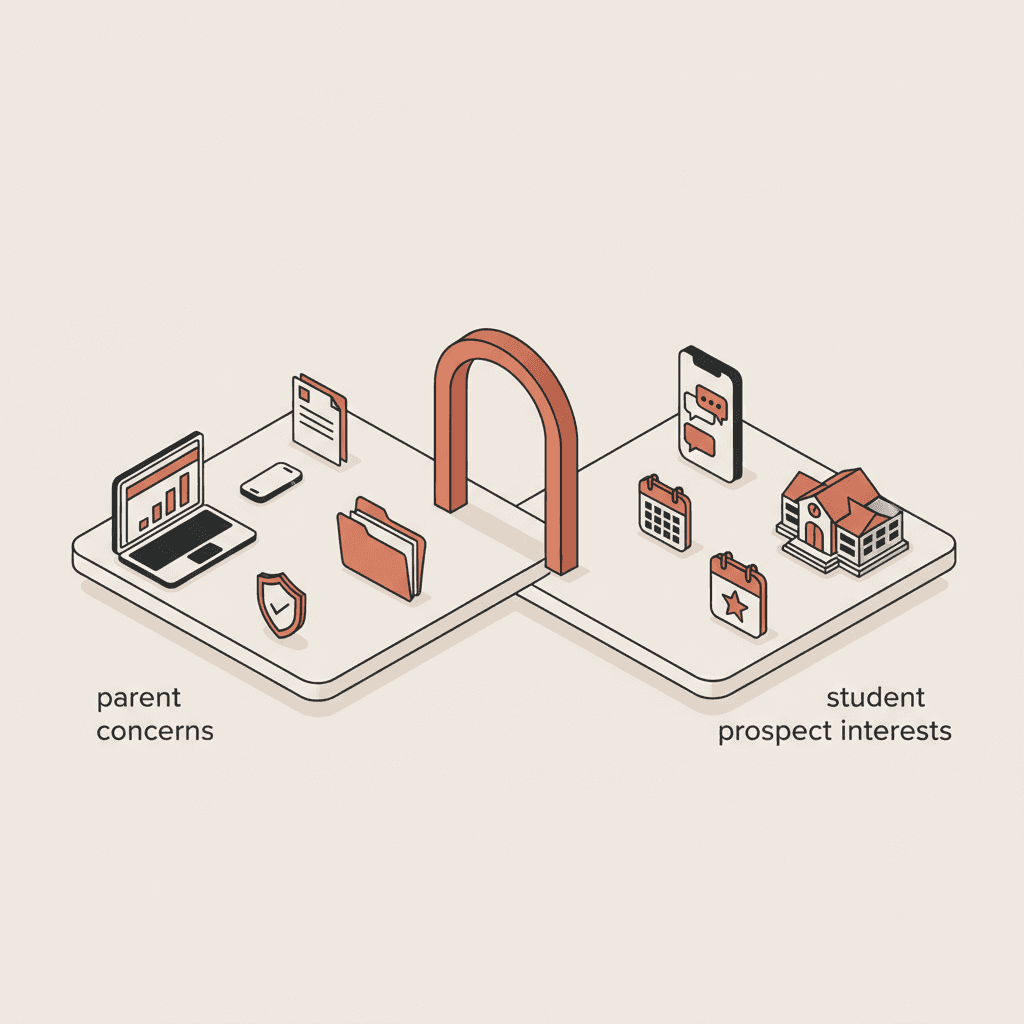
GrokTwo people walk into your admissions funnel. They want completely different things.
When a family drives four hours to visit your campus on a Saturday morning, the student is checking whether the common rooms feel right and whether people seem like them. The parent is mentally calculating the total cost of attendance, asking the tour guide what percentage of graduates find employment within six months, and wondering quietly whether a regional accreditor they have never heard of actually matters.
Same campus visit. Two entirely separate decision-making processes.
This dynamic shapes every stage of the enrollment funnel — from the first Google search to the May 1 Decision Day deposit. Yet most admissions operations run a single email sequence, a single campus tour script, and a single set of landing pages. The result is a communication strategy that half-answers everyone and fully answers no one.
The enrollment cliff is making this mistake costly. With the National Student Clearinghouse projecting a significant drop in traditional-age college-going students starting in the late 2020s, yield management is no longer a secondary concern. Every qualified prospect who melt-outs because their questions went unanswered represents a direct revenue loss. Converting both the student and the parent — who EAB research identifies as major influencers in 70% of enrollment decisions — requires understanding that these are two distinct journeys.
What parents actually want to know
Parents approaching the college selection process are not primarily asking about campus culture. They are making a large financial decision under significant uncertainty, often with information they distrust.
Total cost of attendance at private four-year colleges ranges from $55,000 to $85,000 per year when tuition, room and board, fees, and personal expenses are combined. At out-of-state public universities, the range runs $35,000 to $55,000. For many families, this is the largest expenditure they will make after purchasing a home. The parent's research process reflects that reality.
The questions parents prioritize, in order of frequency, mirror financial due diligence:
- What is the net price after institutional aid? (Not sticker price — net price)
- What is the four-year graduation rate, and what does the institution's IPEDS data show?
- Is the school regionally accredited, and does that matter for grad school or employer recognition?
- What are actual employment outcomes, not marketing copy — where do graduates work, and what do they earn?
- How does FAFSA work, and what is the Expected Family Contribution (now the Student Aid Index)?
- What is the institutional financial stability? (Some parents — particularly after high-profile college closures — ask this directly)
Parents consult US News & World Report rankings, IPEDS data, the College Scorecard, and Federal Student Aid's resources before they set foot on campus. They arrive at campus tours with printed spreadsheets. They read your Common Data Set, which most admissions teams do not expect.
89% of prospective students ask about tuition and fees before anything else, and 84% ask about career outcomes (Source: Analysis of 12,000 Skolbot chatbot conversations, Sept 2025 – Feb 2026). Those figures reflect the student perspective — but they map almost perfectly to parent priorities too, which tells you something: this information needs to be front and center in your communications, not buried in a viewbook PDF.
The critical difference between how parents and students approach cost: parents want net price calculations, not gross tuition figures. A sticker price of $62,000 means little to a parent without knowing the average institutional grant for families at their income level. Your Net Price Calculator — required by the US Department of Education — should be one click from your homepage, not three.
What students actually want to know
The prospective student's decision calculus operates on a different set of variables. This is not irrational — it reflects a genuine assessment of fit, which is one of the strongest predictors of retention and graduation.
A high school junior researching colleges late on a Sunday evening is not running a spreadsheet. They are building a mental image of themselves in four years. The questions they ask are concrete but experiential: What does the campus feel like at night? Do the student organizations match what I care about? Will I find my people? Is Greek life dominant, or is there a robust alternative social scene?
Their information channels are also different. Prospective students consult Niche, Reddit threads ("Is [Your School] worth it?"), TikTok campus tour videos, and Discord servers run by admitted students — often more than official admissions materials. They rely on peer testimony in ways that marketing copy cannot replicate.
Their Common App essay is consuming months of attention. They are thinking about major selection, double majors, pre-med or pre-law tracks, the reputation of the undergraduate research program, whether they can walk on to the lacrosse team. The application process itself — Early Decision, Early Action, Regular Decision deadlines — creates sustained deadline pressure that generates intense research activity in October through January.
67% of prospect activity happens outside office hours, with the absolute peak on Sunday evenings (Source: Skolbot interaction logs, 200,000 sessions, Oct 2025 – Feb 2026). This single metric explains why a large share of prospective student questions go unanswered: they are asked at 9 p.m. on a Sunday, and your admissions office opens Monday at 8 a.m.
Students are not particularly focused on regional accreditation, four-year graduation rates, or FAFSA mechanics — not because these things don't matter, but because they trust parents or school counselors to navigate that layer. Their decision energy goes toward fit, social life, campus experience, and whether the academic program matches their specific goals.
The enrollment funnel seen from two angles
The same stages of the enrollment funnel read very differently depending on who is moving through them.
| Funnel stage | Parent's primary question | Student's primary question |
|---|---|---|
| Discovery | "Is this school accredited and reputable?" | "Does this school feel right for me?" |
| Website visit | "What is the net price and graduation rate?" | "What does campus life actually look like?" |
| Campus tour | "Can I meet with a financial aid officer?" | "Are the people here people I could see myself with?" |
| Application period | "Have we submitted all FAFSA documentation?" | "Is my Common App essay strong enough?" |
| Admitted students day | "What is the scholarship renewal requirement?" | "Would I want to spend four years here?" |
| Decision Day (May 1) | "Does the financial aid package make this viable?" | "Is this where I belong?" |
The practical implication for your enrollment management team: a single nurture email sequence that describes the campus meal plan renovation will engage neither parent. A single financial aid webinar without any content about campus culture will lose the student halfway through. These audiences need separate — or at minimum dual-track — communication strategies.
Why campus visits are your highest-leverage conversion moment
The campus visit is the closest thing higher education has to a conversion event. A prospective student who visits campus and has a positive experience is significantly more likely to apply and to enroll if admitted. For parents, the campus visit is also the moment at which abstract financial commitment becomes tangible.
The problem is that campuses typically design one visit experience and hope it works for both audiences. A two-hour information session followed by a walking tour is structured primarily around institutional information delivery — and it serves neither the student who wants authentic peer interaction nor the parent who wants twenty minutes with a financial aid counselor.
Formats that consistently produce higher application rates separate the two tracks explicitly: an unscripted student panel for prospective students running simultaneously with a financial aid Q&A for parents. An optional individual slot with an admissions counselor serves both. After the visit, a 48-hour follow-up sequence that references what the student's specific questions were — not a generic "We hope you enjoyed your visit!" — closes significantly more applications.
For a detailed breakdown of why campus tour registration drops and how to fix it, the article 10 Reasons Prospects Don't Register for Your Campus Tours covers every stage of the registration and attendance funnel.
The research mismatch your office hours create
Here is the core operational problem. Parents and students both conduct their most intensive college research outside business hours. The parent researching net price on a Tuesday night at 11 p.m. and the student exploring academic programs on a Sunday evening are not going to email your office and wait 47 hours for a reply.
The mystery shopping benchmark across 80 US institutions (Source: Skolbot mystery shopping audit, 2025) shows an average email response time of 47 hours and a phone answer rate of 34%. Meanwhile, the student has three other schools on their list. The parent has already moved to the next tab.
An AI chatbot trained on your institutional data solves this specific problem by serving both audiences simultaneously, around the clock. A parent asking about FAFSA deadlines at 10 p.m. gets the same quality of response as if they had called during office hours. A student asking what the student-to-faculty ratio is in the Computer Science department gets an immediate, specific answer — not a link to your viewbook.
The critical design requirement for this to work: your chatbot needs to be trained to recognize which type of question it is receiving and respond accordingly. A parent asking about regional accreditation bodies like SACSCOC, HLC, or MSCHE deserves a precise, credible answer. A student asking about intramural sports registration needs an equally responsive but tonally different reply.
The 15 questions every prospect asks before enrolling breaks down the full list of recurring questions by frequency — including which ones are parent-driven versus student-driven.
Building a dual-track communication strategy
A dual-track approach does not require building two entirely separate enrollment operations. It requires segmenting your existing communications to recognize that the same household has two decision-makers with different information needs.
Practical steps that high-performing enrollment teams implement:
On your website: Create a dedicated "For Families" landing page that leads with net price, accreditation, IPEDS outcomes data, and a direct link to your Net Price Calculator via Federal Student Aid. Keep your main program pages student-facing — campus photos, student testimonials, club listings, internship partner names.
In your email sequences: When a prospective student submits an inquiry, ask at the opt-in stage whether they would like to include a parent or guardian on communications. Send the student the campus life content, the academic department spotlight, the student ambassador story. Send the family contact the financial aid timeline, the institutional scholarship information, the employment outcomes data.
At campus events: Run parallel programming. Not two separate events — one visit day with two simultaneous tracks. This is standard practice at competitive institutions and signals to families that you understand how their decision actually works.
With your chatbot: Configure distinct response paths for questions that are clearly parent-driven (accreditation, net price, FERPA rights, graduation rates) versus student-driven (campus life, housing options, Greek life, research opportunities). Both audiences should feel that the system is responding to them specifically, not delivering a one-size-fits-all institutional response.
For the full framework on how the prospect journey unfolds from first visit to enrollment decision, see our guide on the ideal prospect journey for enrollment.
What Gen Z prospects expect that parents do not
One additional dynamic shapes the dual-track strategy: the student experience of your digital presence carries disproportionate weight in the early funnel. Gen Z prospects are deciding within eight seconds of landing on your homepage whether this institution is worth further investigation.
What they are assessing is not primarily your program reputation — it is responsiveness, authenticity, and peer credibility. A website full of stock photography, vague program descriptions, and a "Contact Us" form that routes to an email queue signals to a Gen Z applicant that this institution does not particularly care about their experience as a prospect.
The detailed expectations of this cohort — and the five most costly website mistakes for Gen Z enrollment — are in our pillar article on what Gen Z expects from a college website.
Parents, by contrast, are assessing credibility signals that lean institutional: US News rankings, IPEDS data tables, whether the financial aid office page is clearly organized, whether Common App integration is smooth. They are less likely to leave over visual design and more likely to leave over opacity on cost and outcomes.
The yield problem neither audience can solve alone
Melt — accepted students who deposit and then do not enroll — is a significant and growing problem in US higher education. Between May 1 and the start of fall semester, yield rates are under active pressure from competing offers, waitlist movement at other schools, and family financial recalculation.
The institutions that manage melt most effectively are those that maintain active engagement with both the student and the family through this window. A personal call from an admissions counselor to the enrolled student matters. A financial aid clarification email to the parent matters equally — and addresses a different concern.
Institutions running a single communication track during this window are, in effect, betting that either the student or the parent will carry the decision across the finish line without assistance. Given that 70% of enrollment decisions involve parents as major influencers, that is a significant risk to run passively.
FAQ: Parents and students in the enrollment funnel
Should admissions offices have separate staff who manage parent communications?
Not necessarily separate staff, but separate communication tracks. At larger institutions, a dedicated family relations function within the admissions office makes sense. At smaller colleges, the same admissions counselors can manage both tracks if they are equipped with segmented email sequences and clear protocols for routing parent questions to financial aid.
When do parents become dominant in the decision process?
Parents tend to become more influential at two specific moments: when the financial aid package arrives and must be evaluated, and when the deposit deadline approaches. Outside those windows, most students self-report as the primary driver of institution selection. Your communication strategy should reflect this: student-facing content dominates the discovery and visit stages; dual-track or parent-facing content is essential from admit decision through May 1.
Does a chatbot actually help with parent questions about financial aid?
Yes, provided it is trained with accurate institutional data. Parents asking about SAI calculation, FAFSA verification timelines, merit scholarship renewal GPA requirements, or FERPA rights can receive accurate, immediate responses. The chatbot should know when to escalate — a parent with a complex dependency override situation should be routed to a financial aid counselor, not handled by an automated response.
How should campus visits be structured to serve both audiences?
The highest-converting format combines: a student panel without admissions staff present (authenticity requires an adult-free environment), a parallel financial aid session for parents running at the same time, and individual fifteen-minute slots with an admissions counselor available to both the student and the family together. Separating the audiences for part of the visit consistently produces higher application rates than keeping them together throughout.
What data should enrollment managers track to measure dual-track performance?
Track inquiry-to-visit conversion separately for family-referred versus student-direct inquiries. Monitor email open rates and click-through by audience segment. Measure admitted students day attendance rates — specifically whether attending students brought a parent, which is a strong positive yield predictor. Post-deposit melt rates broken down by whether the family track was engaged during the yield window give you the clearest signal of where the dual-track strategy is and is not working.
Try Skolbot on your campus in 30 seconds