Back to blog




















Prospect experience
Improving the prospect experience on your website and digital channels.
Gen Z Attention Span: What Your Program Page Must Show
Gen Z attention span data for college program pages: what eyetracking research actually shows about the first two screenfuls, and what belongs on them.
Skolbot·Aug 13, 2026·10 min read
WhatsApp Messaging to Prospective Students: The Opt-In Rules
How schools can message prospective students on WhatsApp without tripping Meta's opt-in rules, quality rating, or tier limits — plus the US TCPA layer.
Skolbot·Aug 7, 2026·11 min read
Student Lead Routing SLAs: Who Responds and How Fast
Which admissions staffer answers a prospective student's inquiry, how fast, and with what tool — SLA tiers, routing logic and CRM options for US teams.
Skolbot·Jul 25, 2026·10 min read
Bachelor vs Master vs MSc: The Complete Degree Guide for 2026
Confused about Bachelor's, Master's, MSc or postgraduate diplomas in the UK? This guide explains every degree level, recognition by QAA, and how schools can communicate their offer more clearly.
Skolbot·Jun 15, 2026·11 min read
90-Day Reputation Plan: Google Reviews, Forums and Reddit for Schools
Operational 90-day guide to managing your US higher education institution's online reputation: Google reviews, Rate My Professors, Niche, Reddit strategy. Tools + KPIs.
Skolbot·Jun 10, 2026·18 min read
What Parents Look for When Choosing a College: Content That Converts
Parents influence 70–80% of college enrollment decisions in the US. Here are the content types that address their ROI concerns and turn campus visits into signed enrollment agreements.
Skolbot·Jun 9, 2026·13 min read
College Website UX: Stop Losing Applicants to Poor Design
Broken mobile forms, 12-step campus tour sign-ups, FERPA pitfalls: your college website is silently losing applicants. UX checklist for forms, mobile, and campus tours.
Skolbot·Jun 3, 2026·15 min read
Student Admission Rejection Email: The Workflow That Protects Your Institution's Brand
For US colleges and private universities, the rejection letter is a regulated brand touchpoint governed by FERPA and NACAC standards. Here's the workflow that protects your reputation.
Skolbot·May 29, 2026·14 min read
College Website Personalization by Student Persona
Segment your college website by student persona to serve dynamic content that converts. Practical guide to persona-based personalization for US higher education 2026.
Skolbot·May 28, 2026·15 min read
Student Photos & Videos on College Websites: What Converts
Which student photos and videos drive enrollment on US college websites — and which ones drive prospects away. A practical guide for VP-level admissions teams.
Skolbot·May 25, 2026·17 min read
Hybrid Open Days: How to Maximise Your Digital Follow-Up
Running a hybrid open day is just the start. Discover how UK universities and colleges convert event attendees into enrolled students with a smart post-event digital strategy.
Skolbot·May 7, 2026·14 min read
NPS for Student Prospects: 5 Tools and Methodology for Higher Education
How to measure NPS at every admissions funnel stage. Comparison of 5 tools, adapted methodology and benchmarks for UK universities and private higher education.
Skolbot·May 6, 2026·11 min read
Live Chat for Higher Education: Comparing 5 Tools (2026)
Side-by-side comparison of 5 live chat tools for UK universities and colleges. UK GDPR compliance, clearing readiness, pricing and ROI benchmarks for admissions teams.
Skolbot·May 4, 2026·14 min read
Measure Prospect Satisfaction Across the U.S. Admissions Funnel
A 7-stage framework to measure prospect satisfaction across the U.S. admissions funnel — CSAT, NPS, CES and attributional surveys, with benchmarks per stage.
Skolbot·Apr 20, 2026·11 min read
Mobile-First Enrollment UX Checklist: 30 Points for US Colleges
A 30-point mobile-first UX checklist for college enrollment journeys. Skolbot scoring on 40 sites, performance targets, forms, trust, WCAG 2.2 AA, ADA and Section 508 conformance.
Skolbot·Apr 17, 2026·11 min read
Google Reviews, School Reputation and Student Recruitment in the US
89% of prospective students check reviews before choosing a college. A practical reputation strategy for US colleges, K-12 districts and private higher education.
Skolbot·Apr 16, 2026·12 min read
College Website: the 7 Pages That Convert Prospects in the US
The 7 pages your US college website must get right to convert prospective students — from homepage to application, with US-specific benchmarks, Net Price Calculator and Common Data Set.
Skolbot·Apr 15, 2026·15 min read
Yield Management for US Colleges: Cut Summer Melt After Deposits
How US colleges reduce summer melt and no-shows after enrollment deposits with a 4-stage re-engagement plan — data from 4,200 registrations across 12 institutions.
Skolbot·Apr 13, 2026·14 min read
Yield Management for US Colleges: Cut No-Shows After Offer Acceptance
Summer melt costs US colleges thousands of enrolled students per year. Here's how enrollment managers can reduce no-shows with a proven 4-stage re-engagement playbook.
Skolbot·Apr 13, 2026·12 min read
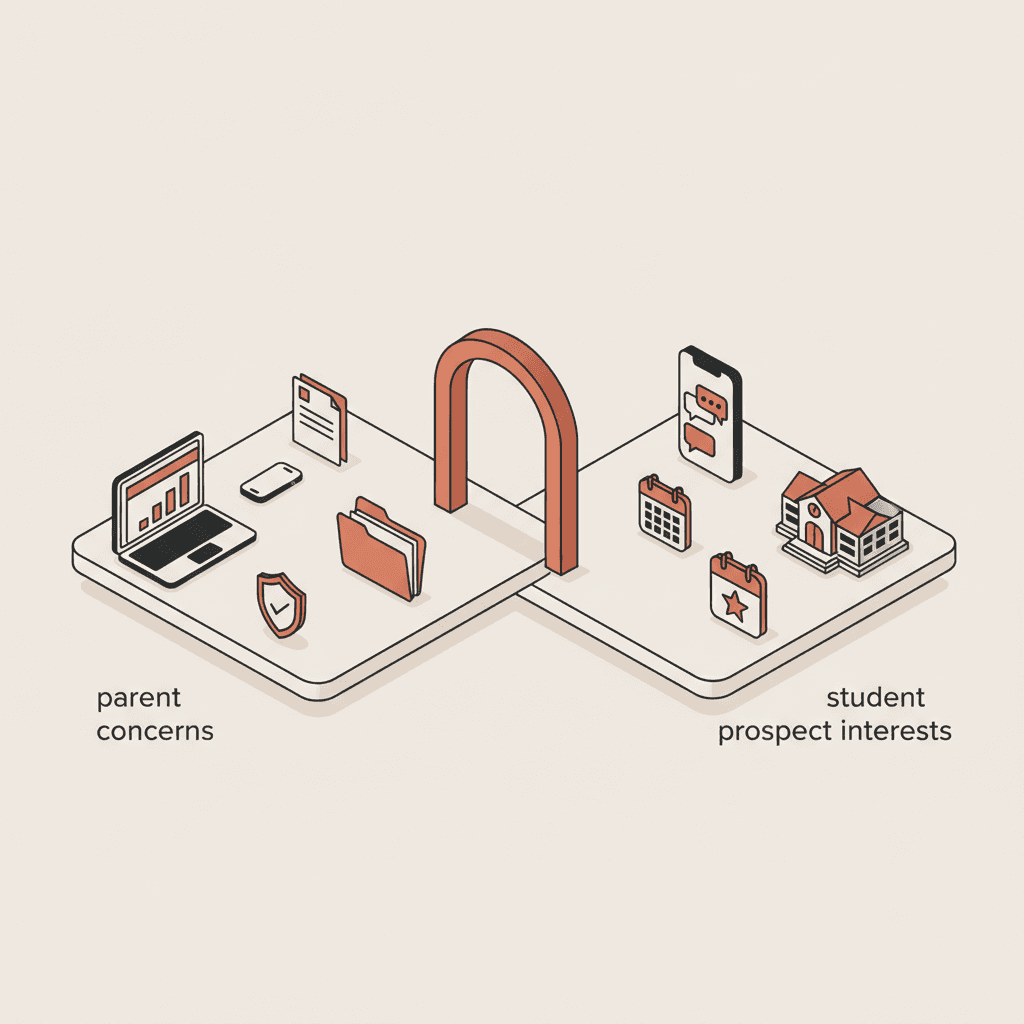
Parents vs Students: Two Journeys, Two Enrollment Strategies
Parents and prospective students have fundamentally different priorities. Here's how to build a dual enrollment strategy that converts both audiences and improves yield.
Skolbot·Apr 11, 2026·14 min read
The Ideal Prospect Journey: From First Visit to Enrollment
Map the ideal student prospect journey for your college or university: key stages, friction points, and proven levers to increase enrollment rates.
Skolbot·Apr 10, 2026·11 min read
Messaging Chatbots for Colleges: Reaching Gen Z Where They Actually Talk
US Gen Z prospects don't live on WhatsApp the way Europe does — they live on Instagram DMs, iMessage, SMS, Snapchat, and TikTok. A 5-channel comparison and FERPA-aware deployment guide for college admissions.
Skolbot·Apr 9, 2026·12 min read
The questions your prospects ask but never get answered
Analysis of 200,000 conversations: the 10 critical questions institutions leave unanswered — and the enrollments they lose because of it.
Skolbot·Mar 13, 2026·11 min read
Recruiting international students: the multilingual guide
58% of international prospects don't speak English as a first language. Language barriers, time zones, cultural gaps: how US colleges and universities can recruit without losing candidates.
Skolbot·Feb 17, 2026·8 min read
Campus tours that convert: how to triple your event ROI with digital tools
How to triple campus tour and admitted students day conversion with digital tools — before (registration), during (engagement) and after (follow-up). Data from 40 institutions.
Skolbot·Feb 13, 2026·10 min read
The 15 questions every prospect asks before enrolling
Tuition costs, career outcomes, campus tours: the 15 most common questions from prospective students at US colleges and universities and how to answer them effectively.
Skolbot·Feb 10, 2026·10 min read
What Gen Z expects from a college website in 2026
Digital behaviors, mobile expectations and the demand for instant answers: what Generation Z actually looks for on a higher education website in the United States.
Skolbot·Jan 13, 2026·12 min read