 ChatGPT
 Claude
 Perplexity
 Gemini
 Grok
GrokWhatsApp Is Not a Free, Limitless SMS Replacement
No — a school cannot message prospective students on WhatsApp as often as it likes just because the channel feels less intrusive than SMS. Meta enforces its own frequency and quality threshold mechanically, and a school that ignores it gets throttled or blocked regardless of intent.
Admissions offices are moving to WhatsApp for a real reason. On a recent call, one school marketer described reminder SMS to 16-25 year-olds as something closer to an aggression than a nudge — a blunt, interruptive channel that reads as institutional rather than personal. WhatsApp, with its conversational interface and read receipts, feels different, which is why more admissions teams are pairing it with chatbot messaging built for how Gen Z actually communicates.
But "less intrusive" is not "unregulated." WhatsApp has its own threshold past which a message stops feeling like help and starts feeling like spam, and Meta's platform responds to that threshold with hard technical consequences: throttled sending limits, rejected templates, and in the worst case a number that can no longer send outbound messages at all. Understanding that mechanism is what separates a WhatsApp strategy that scales from one that gets shut down mid-cycle.
How Meta's Blocking Mechanism Actually Works
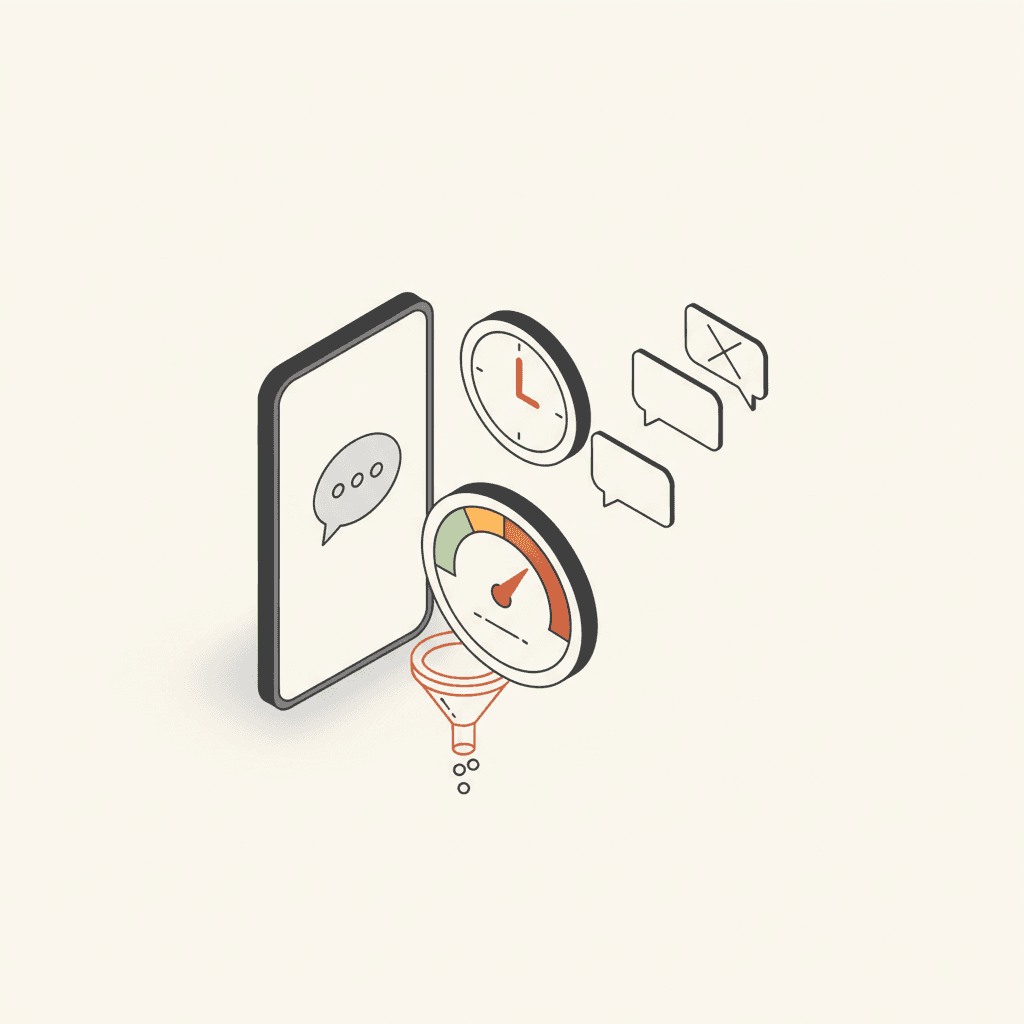
Meta does not moderate outreach by reading messages; it scores the number automatically based on how prospective students respond to it, through two parallel systems: a quality rating that reacts to recipient behavior, and a messaging tier that caps how many people the number can contact in a rolling 24-hour window.
The quality rating is a rolling score, recalculated continuously over roughly the trailing seven days, built from blocks, spam reports, and — since a 2026 scoring update — read rates. A number that gets blocked or reported often, or whose messages simply go unread, drifts from Green (High) toward Yellow (Medium) and eventually Red (Low), independent of any single bad message; it is a trend line, not a one-strike system.
The messaging tier is the volume side of the same mechanism. A new number starts at 250 conversations per 24 hours, then rises to 2,000 after Meta Business Verification, then 10,000, then 100,000, then unlimited. Meta re-evaluates tier advancement roughly every six hours, and upgrading requires using at least 50% of the current tier within a rolling seven-day window while holding a High or Medium quality rating. If the rating stays Low for seven consecutive days, Meta downgrades the tier; Meta has also removed the old "Flagged" status, so a single quality dip no longer auto-downgrades a tier on its own — but it still blocks any upgrade until the rating recovers.
| Rating level | Trigger signals | Consequence |
|---|---|---|
| Green (High) | Low block/report rate, healthy read rates | Number is eligible to advance to the next messaging tier |
| Yellow (Medium) | Rising blocks, spam reports, or falling read rates | Tier upgrades paused; existing tier still usable |
| Red (Low) | Sustained blocks, spam reports, low read rates over the trailing window | No tier advancement; 7 consecutive days at Low triggers a tier downgrade |
The practical takeaway: a school does not get warned before it is throttled — the rating moves continuously off recipient behavior, so the first sign of trouble is usually a stalled tier upgrade, not a notification from Meta.
Opt-In: What Has to Be True Before the First Proactive Message
A school needs documented, affirmative consent from the prospective student before sending the first proactive WhatsApp message — not implied consent from a form fill or an inquiry submitted somewhere else on the site. Since the November 2024 WhatsApp Business Messaging Policy update, businesses can rely on a single general opt-in rather than a separate opt-in for every use case, provided it complies with local law. But Meta still requires documented proof of that consent to approve message templates, and marketing-category templates specifically must include an unsubscribe line or opt-out button; Meta has tightened review of marketing-category templates and opt-out compliance through 2026.
For a US admissions office, that general opt-in is not the end of the question. The Telephone Consumer Protection Act (TCPA) requires prior express written consent before sending automated marketing texts or calls to a US cellular number, and a one-to-one consent rule effective January 2026 bars sharing or reselling consent across brands — each sending entity must obtain its own consent, tied to a specific campaign or purpose, through an unchecked-by-default checkbox or equivalent. TCPA's statutory text targets calls and SMS to cellular numbers, and whether it extends directly to WhatsApp is not settled law. Current compliance guidance for higher-education institutions nonetheless recommends applying the same consent standard to WhatsApp — this is guidance, not a legal ruling, and offices with counsel available should confirm their own institution's position rather than treat this article as legal advice.
In practice, that means the consent checkbox on an inquiry form or application portal should state plainly that the applicant will receive WhatsApp messages from the school, describe the kind of messages (admissions updates, deadline reminders, event invitations), and default to unchecked. This is the same discipline schools already apply when they recruit internationally without relying on phone calls: the channel only works long-term if the first message a prospective student receives is one they actually agreed to get.
Frequency: What SMS Fatigue Data Says About Cadence
The safe cadence for proactive WhatsApp outreach is a small number of clearly purposeful messages, not a running commentary on the admissions cycle. The data explaining why schools are leaving SMS also explains the ceiling WhatsApp shares with it: too many messages is the single biggest reason prospective students disengage from any outbound texting channel.
On SMS specifically, 44% of people who unsubscribe from a brand's texts cite "too many messages" as the top reason, and 81% of US consumers unsubscribe from brands that message too frequently. Of those who get annoyed, 58% unsubscribe outright and 38% mark the brand's texts as spam or junk — the exact recipient behavior WhatsApp's quality rating is built to detect and penalize.
This is not a rejection of texting as a channel. Gen Z has not abandoned texting — 44% actively prefer it over other channels, and 90% check a text within five minutes of receiving it. The problem schools are solving by switching to WhatsApp is frequency and tone, not the medium itself, so the fix carries over directly: cap proactive outreach to genuine admissions milestones — a missing document, an upcoming deadline, an event invitation — rather than treating WhatsApp as a free-form channel because it feels friendlier than SMS.
Timing: Being Active at 9pm Doesn't Mean It's Okay to Message at 9pm
A prospective student browsing the admissions site or chatting with a bot at 9pm on a Sunday is not signaling that a school should push them a WhatsApp message at that same hour. Skolbot's own usage data makes the after-hours pattern unmistakable: 67% of Skolbot chatbot interactions with prospects happen outside standard business hours, with the single sharpest peak on Sunday 8-9pm (source: internal Skolbot usage benchmark).
The distinction that matters is who initiated contact. A prospective student opening the chatbot at 9pm is pulling information on their own schedule — a self-directed action they can stop at any moment by closing the tab. A proactive WhatsApp push at that same hour is the opposite: an interruption the school initiates, at an hour most institutions would not consider normal for outbound contact by any other channel.
This is one of the clearest ways schools accidentally cross WhatsApp's spam threshold — treating high after-hours engagement with the chatbot as license to send proactive messages at the same hours. A safer default is to schedule proactive WhatsApp sends within a standard daytime-to-early-evening window (for example, roughly 9am to 7pm local time for the prospective student), reserving off-hours entirely for messages the applicant initiates through the chatbot. The same logic applies to incomplete-application follow-up: the urgency of a missing document does not justify an off-hours proactive push, because the same pattern that drives SMS unsubscribes also drives blocks and spam reports on WhatsApp.
Tone: Admissions Counselor Message vs. Broadcast Blast
A WhatsApp message that reads like it came from an admissions counselor who knows the applicant's file survives Meta's quality mechanism; a message that reads like a broadcast blast erodes it. The difference is not cosmetic — it is the exact signal the quality rating is measuring.
A counselor-style message names the applicant, references the specific stage of their file ("your supplemental essay for the Fall 2027 cohort"), and asks a real question or offers a real next step. It reads as a continuation of a conversation the prospective student is already having with the school, which is why it gets read, replied to, and rarely blocked or reported. This is the same standard covered in what Gen Z expects from a school's website and digital communication: personalized, specific, and easy to act on in one tap.
A broadcast-style message — the same generic line sent to an entire inquiry list, with no reference to where the recipient is in the process — reads as marketing even when the content is useful. Marketing-category templates require an unsubscribe line or opt-out button by Meta's own policy, and messages that feel like a blast are also the ones most likely to be blocked, reported as spam, or simply left unread — all three of which drag the quality rating down and stall tier upgrades. A school running both types of messages should expect broadcast-style sends to cost more quality-rating headroom per message than counselor-style ones.